Public Adjuster Illinois in Florida: What You Need to Know Before Hiring Across State Lines
Quick Answer
An Illinois-licensed public adjuster can work in Florida only if they hold Florida licensure or appointment, since Florida requires all public-adjusting activity within the state to follow its own contract, fee, and conduct rules regardless of where the adjuster is based. Florida does recognizeIllinois for continuing education reciprocity, but that does not substitute for Florida’s licensing, $50,000 bond, and 10% emergency fee cap requirements.
What Is an Illinois Public Adjuster Doing Business in Florida?
Searches for “public adjuster illinois in Florida” usually come from one of two places: a Florida homeowner who found an out-of-state adjuster online, or an Illinois-licensed adjuster who wants to expand into Florida’s storm-driven claims market. Either way, the answer is the same. Apublic adjusteris a licensed professional who, for a fee, prepares, files, or negotiates an insurance claim on behalf of a policyholder, and Florida law is explicit that only attorneys and properly licensed or appointed public adjusters may perform that work for compensation, as outlined inFlorida Statute 626.854.
That means an adjuster’s Illinois license, by itself, does not authorize them to adjust claims for a condo in Miami, a flooded ranch home in Fort Myers, or a hurricane-damaged roof in the Tampa Bay area. Florida requires its own licensing and appointment process, and theIllinois Department of Insurance’s public adjuster pageconfirms that Illinois licensees must separately qualify to practice in any state where they intend to handle claims.
How Does Florida’s Reciprocity With Illinois Actually Work?
Florida maintains a list of states with which it has continuing education (CE) reciprocity for non-resident all-lines public adjuster licenses. According to theFlorida Department of Financial Services reciprocity chart, Illinois is listed as a “Yes” for CE reciprocity. That is a narrow benefit: it means an Illinois adjuster who already holds Florida non-resident licensure may satisfy some CE requirements through Illinois coursework.
It does not mean Illinois licensing automatically converts into Florida authority. The adjuster still has to apply for and hold a Florida non-resident public adjuster license, pass background checks, and post the required bond. CE reciprocity simplifies renewal paperwork; it does not eliminate the underlying licensing obligation.
What Florida Rules Apply Regardless of Illinois Licensing?
Once an adjuster, Illinois-based or otherwise, is working a Florida claim, Florida’s substantive rules control the engagement from contract to payout. These rules exist to protect policyholders across the state, from the Panhandle to the Keys, and they are enforced independent of where the adjuster’s home license was issued.
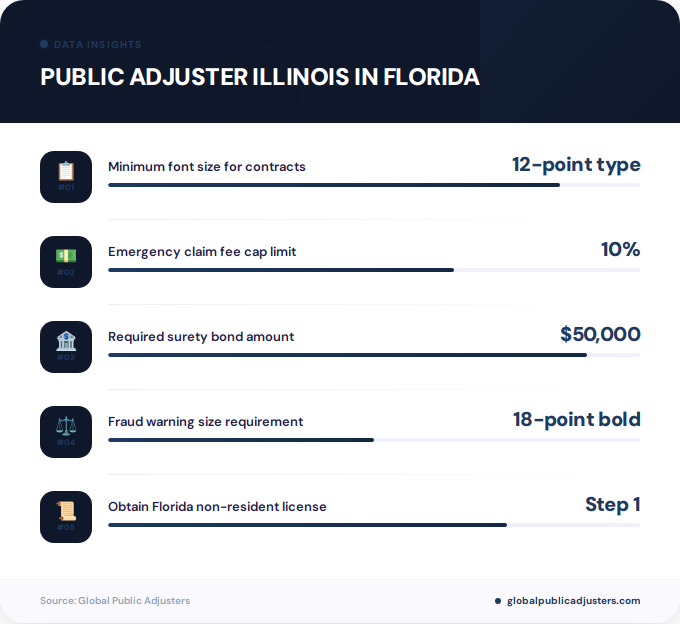
- Fee cap on emergency claims:Florida law caps public adjuster compensation at10%of the claim payment for losses tied to a gubernatorial state-of-emergency declaration, a rule tracked in detail bythis chronology of Florida public adjuster fee regulations.
- Written contract mandate:Contracts must be titled “Public Adjuster Contract,” printed in at least 12-point type, and carry an 18-point bold fraud warning above the signature line.
- $50,000 surety bond:Every applicant must file and maintain this bond to hold a Florida public adjuster license.
- Age and residency status:Applicants must be at least 18 and either a U.S. citizen or legally authorized alien.
- Conduct and solicitation limits:Florida restricts unsolicited contact after a loss and regulates how adjusters can advertise or approach homeowners during disaster recovery.
Homeowners researchingpublic adjuster fees in Floridashould understand these caps apply whether the adjuster is licensed in Illinois, Colorado, or any other state, once the work happens on Florida soil.
What Do the Latest Numbers Show?
Public adjusting has grown steadily as claim complexity has increased nationwide. Industry tracking frompublic adjuster growth data covering 2018 to 2026shows the profession expanding alongside rising catastrophe claim volume, particularly in coastal states like Florida where hurricanes, hail, and flooding drive repeat large-loss activity. The U.S. Bureau of Labor Statistics’ occupational data for claims adjusters, appraisers, examiners, and investigators also confirms this is a sizable, wage-tracked profession nationally, as documented in theBLS occupational employment statistics for insurance adjusters.
| Requirement | Illinois | Florida |
|---|---|---|
| Home-state license required | Yes, per Illinois DOI | Yes, non-resident license required |
| Surety bond | Varies by rule | $50,000 minimum |
| Fee cap on emergency claims | No statewide cap noted | 10% of claim payment |
| CE reciprocity status | Recognized by Florida | Grants CE credit, not full licensure |
Illinois’ own regulatory framework has also tightened. Recent commentary summarized inupdates to Illinois public adjuster regulationsshows Illinois moving toward more consumer disclosure requirements, mirroring a broader national trend toward stricter contract and conduct standards, including in Florida.
Why Do Florida Homeowners Need Florida-Specific Expertise?
Florida’s insurance climate is unlike Illinois’. Hurricanes, tropical storms, sinkholes, and flat-roof water intrusion generate claim patterns that differ sharply from Midwest wind and hail losses. An adjuster who only knows Illinois claim norms may not understand Florida’s Assignment of Benefits restrictions, its emergency fee caps, or the appraisal clauses common in Florida homeowner policies.
Local knowledge matters in practice. A public adjuster working a claim in Orlando needs to understand Florida’s licensing pathway, which is why professionals often study guides likebecoming an insurance adjuster in Florida through Orlando’s licensing processbefore taking on Central Florida claims. Similarly, someone adjusting a denied water damage claim needs Florida-specific denial and appeal procedure, covered in depth inthis guide to appealing a water damage claim denial in Florida.
This isn’t unique to Illinois. The same cross-state licensing questions come up for adjusters from other states too, as detailed in our breakdown ofColorado-licensed public adjusters working Florida claims. The underlying lesson is consistent: Florida claims require Florida-compliant representation.
How Should Florida Policyholders Choose a Public Adjuster?
If you’re a homeowner in Naples, Sarasota, Jacksonville, or anywhere in between and you’re vetting an adjuster who mentions an Illinois background, ask direct questions before signing anything. Verification protects you from delayed claims, invalid contracts, or fee disputes down the road.
- Ask for theirFlorida license numberand verify it directly with the Florida Department of Financial Services.
- Request a written contract that meets Florida’s 12-point type and fraud-warning formatting rules.
- Confirm their fee structure complies with the 10% emergency cap if your claim stems from a declared disaster.
- Ask how long they’ve handled Florida-specific claims, not just claims generally.
- Check their bond status and standing, since a lapsed bond can void their authority to operate.
Pricing for public adjuster services in Florida typically ranges widely, often froma small percentage up through the statutory capdepending on claim size, complexity, whether it’s storm-related, and the scope of documentation required. Rather than quoting a flat number, reputable firms will assess your specific loss, property type, and policy language before proposing a fee, and pricing varies based on your specific project. For a clearer breakdown of what to expect, see our detailed guide onpublic adjuster fees in Florida.
Timing also matters. Many Florida homeowners want to know how long the process takes once representation is engaged, a question we answer directly inhow long an insurance claim takes in Tampa, and in our broader look atwhen to hire a public adjuster in Florida.
Maintained continuously while licensed
Applies during declared states of emergency
Fraud warning in18-point bold
Applies to continuing education only
Key Takeaways
- Illinois public adjusters must hold separate Florida licensure or appointment to legally work Florida claims.
- Florida recognizes Illinois forcontinuing education reciprocity only, not full license transfer.
- Florida caps public adjuster fees at10%for claims tied to a declared state of emergency.
- Florida requires a$50,000 surety bondand a formally formatted written contract for every licensed public adjuster.
- Homeowners should always verify Florida license status before signing a public adjuster contract.
- Florida’s storm-driven claim environment, from hurricane wind damage to sinkhole losses, demands local claims expertise beyond a general Illinois background.
- Fee structures and timelines vary by claim complexity, so getting a custom assessment matters more than a flat quote.
People Also Ask
Can an Illinois public adjuster legally handle a Florida hurricane claim?
Only if they hold a valid Florida non-resident public adjuster license and appointment. Illinois licensure alone does not authorize claim work inside Florida.
Does Illinois have a public adjuster licensing board like Florida?
Yes, the Illinois Department of Insurance licenses and regulates public adjusters in-state, with its own continuing education and conduct requirements.
What is the maximum fee a public adjuster can charge on a Florida emergency claim?
Florida law caps public adjuster fees at 10% of the claim payment for losses connected to a gubernatorial state-of-emergency declaration.
Is reciprocity the same as a full Florida license?
No. Florida’s reciprocity with Illinois applies specifically to continuing education credit, not to full non-resident licensing approval.
Frequently Asked Questions
Can someone with an Illinois public adjuster license work claims in Florida?+
Only after obtaining Florida’s own non-resident public adjuster license and appointment. Florida statute restricts claim preparation and negotiation for compensation to licensed adjusters and attorneys operating under Florida rules.
What does “Illinois CE reciprocity” mean for Florida licensing?+
It means Florida will accept continuing education credits completed through Illinois toward maintaining a Florida non-resident license. It does not replace the need to originally obtain that Florida license.
How much can a Florida public adjuster legally charge?+
For claims tied to a declared state of emergency, Florida law caps fees at 10% of the claim settlement. Fees for non-emergency claims can vary, so it’s important to review the written contract carefully before signing.
What should a Florida public adjuster contract include?+
Florida requires the contract be titled “Public Adjuster Contract,” written in at least 12-point type, and include an 18-point bold fraud warning immediately before the signature line. Contracts that don’t meet this format may not be enforceable.
Do public adjusters need a bond to work in Florida?+
Yes, Florida requires public adjuster license applicants to file and maintain a $50,000 surety bond throughout their licensure period.
Why would a Florida homeowner hire a local public adjuster instead of an out-of-state one?+
Local adjusters understand Florida-specific storm damage patterns, appraisal procedures, and denial trends that differ significantly from other states’ claim environments. This familiarity often leads to more accurate damage documentation and stronger settlement negotiations.
How can I verify a public adjuster’s license before signing a contract?+
Contact the Florida Department of Financial Services directly to confirm license status, appointment, and bond standing. You can also review services and credentials through resources likeour public adjuster services overviewor by visitingour contact pageto ask questions directly.
Related:Public Adjuster Definition in Orlando: What Florida Law Actually Says
Related:PA Public Adjuster in Tampa: Your Complete 2026 Guide to Hiring the Right Claims Advocate
Whether you’re comparing an Illinois-based adjuster against a Florida-licensed one, or you simply want a team with proven Florida claims experience across hurricane, water, and fire losses, it pays to work with professionals who know Florida’s rules inside and out. Learn more about our approach on theGlobal Public Adjusters about us page, explorethe range of claim types we handle, or start withGlobal Public Adjusters’ homepageto request a consultation today.
Further reading:Los Angeles Public Adjuster in Jacksonville: What Florida Homeowners Need to Know
Further reading:Can You Negotiate Insurance Settlement in Jacksonville? A Complete 2026 Guide