Colorado Insurance Adjuster in Florida: Licensing, Reciprocity, and What Homeowners Need to Know
Quick Answer
A Colorado insurance adjuster working in Florida cannot rely on a Colorado independent adjuster license because Colorado does not issue one; instead, Colorado residents typically obtain a Florida non-resident designated home state (DHS) adjuster license. Florida’s reciprocity table currently lists Colorado as “No” for exam and continuing-education exemptions, meaning Colorado-based applicants generally must sit for Florida’s exam and meet Florida’s CE requirements directly.
If you searched for acolorado insurance adjuster in Florida, you have probably run into a confusing wrinkle: Colorado does not actually license independent insurance adjusters. That single fact reshapes everything about how a Colorado-based adjuster legally operates on a hurricane claim in Fort Myers, a hailstorm loss in Kissimmee, or a burst pipe claim in a Jacksonville condo. Understanding Florida’s licensing framework, and where Colorado fits (or doesn’t) within its reciprocity system, is essential before anyone touches a Florida property claim.
This matters more than it sounds. Florida homeowners rely on adjusters, whether company adjusters, independent adjusters, or public adjusters, to evaluate damage accurately after hurricanes, tropical storms, and the state’s routinely aggressive summer thunderstorm season. If the person handling your claim isn’t properly licensed under Florida law, that raises real questions about the validity of the claim decision and your rights as a policyholder.
What Is a Designated Home State Adjuster License?
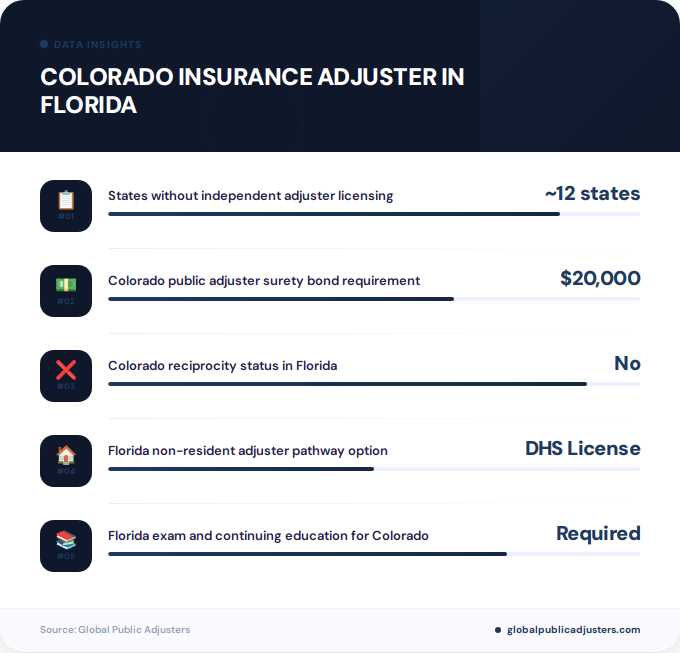
Florida’snon-resident designated home state (DHS) adjuster licenseallows an adjuster who lives in a state without its own independent adjuster licensing system, like Colorado, to use Florida as their “home state” for licensing purposes. Once licensed through Florida’s DHS pathway, that adjuster can often apply for reciprocal licenses in other states that recognize Florida credentials.
This model exists because roughly a dozen states, Colorado included, don’t license independent adjusters at all, according to state-by-state licensing breakdowns for Colorado adjusters. Without a home-state license to build from, these adjusters need a state like Florida, Texas, or Georgia willing to serve as their base of operations.
Florida’s Department of Financial Services oversees this entire structure through its agent and adjuster licensing division, which processes DHS applications, tracks continuing education, and maintains the reciprocity tables that determine exam and CE exemptions state by state.
Why Doesn’t Colorado License Independent Adjusters?
Colorado’s insurance code focuses regulatory attention onpublic adjustersrather than independent or staff adjusters working for insurance carriers. Colorado public adjusters must carry a$20,000 surety bond, a requirement detailed in Colorado licensing guidance, but this bond and licensing structure applies only to public adjusters representing policyholders, not to independent adjusters working claims on behalf of insurers.
This creates a gap: an independent adjuster living in Denver, Colorado Springs, or Boulder who wants to work catastrophe claims nationally, including in Florida after a hurricane, has no Colorado license to lean on. Firms that recruit catastrophe adjusters, sometimes called “storm chasers” in the industry, frequently direct Colorado-based recruits toward Florida’s DHS license as the practical starting point, a pattern documented across adjuster licensing resources like independent adjuster licensing guides.
What Does Florida’s Reciprocity Data Show for Colorado?
Florida statute Section 626.866 governing nonresident adjusters and the broader Florida Insurance Code Chapter 626 lay out the legal foundation for reciprocity, but the practical detail lives in Florida’s reciprocity tables. Those tables currently markColorado as “No”for both license exam exemption and continuing education reciprocity for non-resident all-lines adjusters.
In plain terms, a Colorado resident cannot skip Florida’s licensing exam simply by pointing to Colorado credentials, because Colorado doesn’t issue an equivalent independent adjuster license to reciprocate against. Compare that to Florida’s broader reciprocity reach, which extends to every U.S. territory including Puerto Rico, Guam, and the U.S. Virgin Islands for major insurance lines.
| Reciprocity Factor | Status for Colorado Residents |
|---|---|
| Florida exam exemption | Not available (marked “No”) |
| Continuing education reciprocity | Not available (marked “No”) |
| DHS license eligibility | Available; Florida commonly used as home state |
| Colorado independent adjuster license | Does not exist under Colorado law |
How Does a Colorado Resident Get Licensed to Adjust Claims in Florida?
The practical route runs through Florida’s DHS non-resident license application, processed through Florida’s licensee search and application portal. Applicants complete pre-licensing education, pass Florida’s adjuster exam (since the Colorado exemption doesn’t apply), submit fingerprints, and pay the required fees.
There is one important nuance worth noting for anyone who eventually relocates: Florida law requires an applicant who was licensed in another state for at leastone yearbefore becoming a Florida resident to use the resident portability path rather than starting from scratch. This mostly matters for adjusters who move to Florida permanently rather than those working storm season temporarily from Colorado.
- Complete Florida-approved pre-licensing education for the 5-20 all-lines adjuster license.
- Pass the Florida state licensing exam (no Colorado exemption applies).
- Submit fingerprints and background check documentation.
- Apply through Florida’s DFS licensing system as a non-resident designated home state applicant.
- Maintain Florida continuing education requirements directly, since Colorado CE does not satisfy Florida’s rules.
Why Does Florida Require Adjusting Firms to Be Licensed?
Florida’s licensing guidance is clear that any business location used to perform adjusting functions must itself be licensed as anadjusting firm, separate from the individual adjuster’s personal license. This applies whether the firm operates out of a Tampa office park, a temporary catastrophe response trailer in the Panhandle, or a home office.
This firm-level requirement is one reason enforcement in Florida has tightened around operational compliance rather than just individual credentials. If you’re comparing multi-state claims representation, our related coverage onmulti-state claims advocacy for Florida property ownerswalks through how out-of-state credentials interact with Florida enforcement in more depth.
“Homeowners rarely ask who licensed the adjuster standing in their living room after a hurricane. They should. An improperly licensed adjuster, even one with years of Colorado experience, can create real problems for the validity of a claim decision in Florida,” notes a senior claims consultant at Global Public Adjusters.
What Does This Mean for Florida Homeowners Filing Claims?
For homeowners in Orlando, Tampa, Jacksonville, or coastal communities from Naples to Daytona Beach, the licensing status of the adjuster reviewing your claim is not just a technicality. Florida’s climate, with its Atlantic hurricane season running June through November and near-daily summer thunderstorms producing wind and hail damage, means catastrophe adjusters flood into the state every storm season, many from out of state, including Colorado.
If your claim was handled by an improperly licensed adjuster, or if you feel your damage was undervalued, you have options. Homeowners frequently askwhether an insurance settlement can be negotiated in Orlando, and the answer is generally yes, especially with proper representation. Similarly, if your claim was denied outright, our guide onwhat to do when a hurricane damage claim is denied in Floridacovers your next steps in detail.
Homeowners in Jacksonville facing similar issues can review our dedicated resource onhurricane damage claims for Jacksonville homeowners, and those wondering about negotiation leverage should seeJacksonville’s complete 2026 settlement negotiation guide. Tampa-area homeowners can also reference our step-by-step breakdown onfiling a hurricane claim as a Tampa homeowner.
Public adjuster bond:$20,000
Florida exam exemption:No
Exam required:Yes
Firm license needed:Yes, for business locations
Guam:Reciprocal
U.S. Virgin Islands:Reciprocal
What Are the 2026-2027 Trends for Multi-State Adjusters?
Looking toward 2026 and 2027, Florida is expected to remain the primary launch point for adjusters based in non-licensing states like Colorado. The DHS model continues gaining traction because it offers a single, well-established path into a state that regularly needs catastrophe response capacity, particularly given Florida’s exposure to hurricanes, tropical storms, and severe convective weather across the peninsula.
Expect continued enforcement emphasis on firm-level licensing compliance, a trend flagged directly by Florida’s own licensing guidance. Adjusters and agencies operating temporary offices during storm season should anticipate closer scrutiny of whether those locations carry proper adjusting firm licenses, not just individual adjuster credentials. For homeowners evaluating whether a Colorado-based public adjuster is appropriate for their Orlando-area claim, our detailed piece onwhat to know before hiring a Colorado public insurance adjuster in Orlandois essential reading. You can also explore our full range ofclaims advocacy servicesor review specificclaims types we handleacross Florida.
- Colorado does not license independent adjusters, so Florida’s DHS pathway is the practical route for Colorado residents.
- Florida’s reciprocity table marksColorado “No”for both exam exemption and CE reciprocity.
- Florida requires business locations performing adjusting functions to hold anadjusting firm license, separate from individual credentials.
- Colorado public adjusters carry a$20,000 surety bond, but that rule applies only to public adjusters, not independent adjusters.
- Florida has reciprocal agreements withall U.S. territories, a much broader arrangement than what exists with Colorado.
- Homeowners should verify adjuster licensing status, especially after major storms bring waves of out-of-state adjusters into Florida.
- Pricing for professional claims representation varies based on your specific project, the complexity of damage, and the insurer involved; always request a custom evaluation rather than assuming a flat rate.
People Also Ask
Can a Colorado adjuster work in Florida without a Florida license?
No. Anyone acting or advertising as an adjuster in Florida must hold proper Florida authorization, typically a non-resident designated home state license, regardless of Colorado experience.
Does Colorado have reciprocity with Florida for adjusters?
Florida’s current reciprocity table lists Colorado as “No” for both exam exemption and continuing education reciprocity, so Colorado residents generally cannot skip Florida’s licensing steps.
Why doesn’t Colorado license independent insurance adjusters?
Colorado’s insurance regulations focus licensing requirements on public adjusters, who must carry a $20,000 surety bond, while leaving independent and staff adjuster licensing to other states like Florida.
What is a designated home state license?
A designated home state (DHS) license lets adjusters who live in states without independent adjuster licensing use a state like Florida as their official licensing base for multi-state work.
Frequently Asked Questions
Is a Colorado insurance adjuster license valid in Florida?+
Colorado does not issue an independent adjuster license, so there is nothing for Florida to recognize through reciprocity. Colorado residents must instead apply directly for a Florida non-resident designated home state license.
How long does it take to get a Florida DHS adjuster license from Colorado?+
Timing depends on exam scheduling, background check processing, and pre-licensing course completion, but applicants should plan for several weeks from application to approval through Florida’s DFS licensing system.
Do Colorado adjusters need to retake continuing education in Florida?+
Yes. Florida’s reciprocity table does not recognize Colorado CE credits, so Florida-licensed adjusters based in Colorado must complete Florida-approved continuing education directly.
What happens if an adjusting firm operates in Florida without a firm license?+
Florida law requires any business location performing adjusting functions to hold an adjusting firm license, and operating without one can expose the firm and its adjusters to regulatory action.
Should Florida homeowners hire a local public adjuster instead of an out-of-state one?+
Homeowners should prioritize properly Florida-licensed representation, whether local or from another state, and verify credentials through Florida’s licensee search before signing any agreement.
Does Florida’s reciprocity apply to public adjusters the same way as independent adjusters?+
No, public adjuster licensing and reciprocity rules are evaluated separately from independent all-lines adjuster reciprocity, and Colorado’s public adjuster bond requirement does not translate into a Florida exemption.
How much does it cost to hire a public adjuster in Florida?+
Pricing varies based on your specific project, the size and complexity of the claim, and the scope of damage involved, so it’s best to contact a licensed firm for a custom evaluation rather than relying on a flat estimate.
Whether you’re a homeowner in Orlando trying to verify who is handling your storm claim, or an adjuster trying to understand how Colorado’s licensing gap affects your ability to work in Florida, getting the licensing details right protects everyone involved. Exploreour team’s background and credentials, review our fullservice offerings, or visitGlobal Public Adjustersto see how properly licensed Florida representation can strengthen your claim. Ready to talk through your specific situation?Contact our team todayfor a custom consultation.
Further reading:Water Damage Insurance Adjuster in Florida: What Homeowners Must Know Before Filing a Claim