How to Negotiate Insurance Settlement in Jacksonville: A 2026 Homeowner’s Guide
Quick Answer
To negotiate an insurance settlement in Jacksonville, document every loss with photos, invoices, and independent estimates, request the insurer’s written valuation and denial rationale, and counter with third-party evidence before signing a release. If the carrier won’t move, Florida’s appraisal, mediation, and Department of Financial Services complaint processes give policyholders real leverage to push toward fair value.
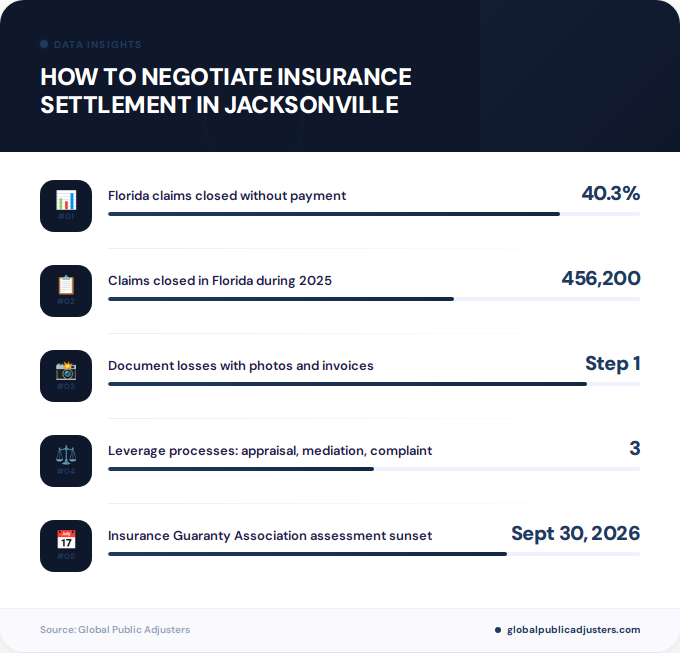
Nearly40.3% of Florida private homeowner claims closed without any paymentin 2024, the highest rate of any state that year, according to national claims data cited in industry reporting.recent claims journal analysis of national homeowner claims data If you’re wondering how to negotiate insurance settlement in Jacksonville after a hurricane, water loss, or fire, that statistic should change how you approach every phone call with your adjuster. Understanding the leverage points available to Duval County homeowners in 2026 can mean the difference between a lowball check and a settlement that actually covers repairs.
Jacksonville sits in a unique position heading into 2026: the broader Florida insurance market is stabilizing, but individual claim outcomes still depend heavily on how well policyholders document and push back. This guide breaks down exactly what to do, from the first denial letter to a final settlement release.
What Does Jacksonville’s 2026 Insurance Market Mean for Your Claim?
Florida’s property insurance market is showing genuine signs of relief. Governor Ron DeSantis announced major insurance rate relief tied to Florida’s legislative reforms, and Citizens Property Insurance policyholders are expected to see meaningful premium reductions beginning at spring 2026 renewals. More insurers are also entering the state, and reinsurance pricing discipline appears to be holding steady even as capital returns to the market, according to reinsurance industry coverage of 1/1 renewal pricing trends.
Florida’s Property Insurance Stability Report for July 2026 shows456,200 claims closed in 2025 alone, according to the state’s ownFlorida Office of Insurance Regulation stability unit report. That volume shows just how many Jacksonville-area homeowners are navigating this exact process right now, from Riverside flooding claims to Mandarin roof damage after summer storms.
Meanwhile, the Florida Insurance Guaranty Association’s 1% emergency assessment, first levied in 2023 to cover insolvent insurers’ obligations, is scheduled to sunset on September 30, 2026. That’s a small but real signal that the market’s crisis phase is winding down, even as individual settlement negotiations remain tough on the ground.
Why Do Insurers Still Lowball or Deny Claims in Duval County?
Even with market stabilization, at least11 Florida property insurers closed more claims without payment in 2025 than in 2023, showing that no-pay and low-pay outcomes remain widespread. This matters enormously for Jacksonville homeowners near the St. Johns River, the Beaches communities, and inland neighborhoods prone to wind and flood damage, because carriers often start negotiations from a defensive posture rather than a fair one.
“Negotiation outcomes increasingly hinge on how claims leaders and policyholders alike apply structured, evidence-based tactics rather than relying on the first number a carrier puts on the table.”— Insights on claims negotiation science, Risk & Insurance analysis of negotiation science in 2026 claims handling
Legacy issues also play a role. Years of carrier insolvencies and catastrophe losses have left some insurers cautious on borderline claims, which translates into more disputed estimates, more requests for additional documentation, and more initial denials that require a formal rebuttal. This is one reason Jacksonville homeowners often benefit from the same negotiation strategies used inOrlando insurance settlement negotiations, where similar market pressures are playing out statewide.

How Do You Negotiate an Insurance Settlement Step by Step?
Negotiating with an insurer isn’t a single conversation; it’s a structured process. Jacksonville policyholders who follow a clear sequence tend to recover significantly more than those who accept the first offer.
- Request everything in writing.Ask for the denial letter, partial-payment explanation, and any estimate or reserve details the adjuster used to reach their number.
- Build an independent damage file.Date-stamped photos, videos, repair invoices, and contractor bids create a paper trail the insurer can’t easily dismiss.
- Get a second opinion on value.An independent estimate from a licensed contractor or public adjuster often reveals gaps the insurer’s estimate missed, such as hidden moisture damage or code-upgrade costs.
- Submit a formal written rebuttal.Point-by-point responses to the insurer’s estimate, backed by your documentation, force a substantive reply rather than a form letter.
- Escalate through Florida’s dispute channels.If negotiation stalls, appraisal, mediation, or a Department of Financial Services complaint keeps pressure on the carrier.
- Review the release language before signing.Never sign a full release until you’re certain the settlement covers all documented damage, including supplemental costs discovered during repairs.
For homeowners dealing specifically with hurricane-related claims, the process closely mirrors what’s outlined in this guide onhurricane damage claim adjusters in Florida, particularly around documentation timing and adjuster communication.
What Tools and Documents Strengthen Your Negotiating Position?
Jacksonville practitioners consistently point to a handful of tools that move negotiations forward. The strongest leverage comes from proving the insurer’s estimate is incomplete, not simply asserting that the offer feels too low.
| Tool | What It Does |
|---|---|
| Independent contractor estimate | Establishes a competing repair cost figure the insurer must address |
| Public adjuster review | Provides a policy-based valuation and negotiation representation |
| Written appraisal demand | Forces a binding valuation process outlined in most Florida policies |
| DFS complaint filing | Creates regulatory pressure when an insurer stalls or acts in bad faith |
Florida law underFlorida Statute 626.9743 governing property insurance claims practicesalso sets requirements for how insurers must communicate claim decisions, which gives policyholders grounds to demand clearer written explanations when a settlement offer seems inconsistent with the actual damage. If your claim involves water intrusion, understanding the specific documentation insurers require is critical, and this breakdown of what to know before filing awater damage insurance claim in Floridacovers those details in depth.
When Should You Use Appraisal or Mediation in Florida?
Most Florida homeowner policies include an appraisal clause, and the state also offers a formal mediation program for disputed property claims. The American Arbitration Association outlines structured claims programs that many insurers and policyholders use as a neutral alternative to litigation, as described in its overview of AAA claims and arbitration programs.
Appraisal is typically the right move when liability isn’t disputed but the dollar amount is. Mediation works better when there’s disagreement over coverage interpretation or causation. Jacksonville homeowners should also be aware that Florida’s statute of limitations for many property claims is now two years from the date of loss, so waiting too long to escalate can forfeit these options entirely.
Legal experts who handle high-value negotiations often stress that framing matters as much as facts. Attorneys like those profiled at Morgan & Morgan’s personal injury and insurance dispute practice emphasize that a well-organized demand package, not just a strong case, is often what pushes insurers to increase offers before mediation even begins.
How Long Does Settlement Negotiation Take in Jacksonville?
Timelines vary widely depending on claim complexity, liability disputes, and how quickly documentation is submitted. Simple claims with clear damage and no coverage disputes can resolve in a matter of weeks, while contested claims involving multiple disputed line items or large losses can take several months.
Liability:Not disputed
Documentation needed:Standard
Liability:Amount disputed
Documentation needed:Independent estimate required
Liability:Coverage disputed
Documentation needed:Appraisal/mediation likely
This variability is consistent with what’s reported across the state, including in guides coveringout-of-state licensed adjusters working Jacksonville claims, where cross-jurisdiction licensing can occasionally add procedural steps to an already complex negotiation.
Why Hire a Public Adjuster for Jacksonville Claims?
A public adjuster works exclusively for the policyholder, not the insurance company, and their job is to build the strongest possible valuation of your loss. This matters because insurer-side adjusters are evaluating your claim against the carrier’s own reserve targets, which don’t always reflect true repair costs in today’s Jacksonville construction market.
Pricing for public adjuster services varies based on your specific claim size, complexity, and the scope of documentation required, so it’s worth requesting a custom consultation rather than assuming a flat rate applies. If you’re comparing options, this guide onchoosing the right public adjusting company in Jacksonvillewalks through the credentials and track record you should verify before signing a contract.
Homeowners working with adjusters licensed in other states should also confirm reciprocity rules apply correctly to Florida claims, a topic covered in detail in this overview ofColorado-licensed adjusters handling Florida claims. The same licensing scrutiny applies to any out-of-state adjuster working a Jacksonville property loss.
- Document everything immediately:Photos, videos, and receipts dated at the time of loss carry the most weight in negotiations.
- Never accept the first offer as final:Florida’s 40.3% no-payment rate in 2024 shows initial offers are frequently far below fair value.
- Use written communication whenever possible:Written denial letters and estimates create an accountability trail insurers can’t easily walk back.
- Know your deadlines:Florida’s two-year statute of limitations for many property claims means delays can cost you your leverage entirely.
- Escalate strategically:Appraisal, mediation, and DFS complaints are underused tools that can break a stalled negotiation.
- Consider professional representation:Public adjusters and attorneys bring negotiation experience that levels the playing field against carrier adjusters.
- Watch the broader market:Florida’s 2026 rate relief and stabilization trends may soften some insurer resistance, but individual claim outcomes still depend on your documentation.
People Also Ask
Can you negotiate an insurance settlement in Jacksonville?
Yes, insurance settlements in Jacksonville are negotiable, and most initial offers are starting points rather than final numbers. Policyholders who provide independent estimates and written rebuttals typically see improved offers compared to those who accept the first proposal.
What is the settlement negotiation process in a personal injury or property claim?
The process typically starts with a demand or claim submission, followed by an initial insurer offer, a documented counteroffer, and back-and-forth negotiation until both sides agree or escalate to mediation, appraisal, or litigation. Complex claims with disputed liability or damages take longer to resolve.
What should you expect during a settlement negotiation?
Expect multiple rounds of offers and counteroffers, requests for additional documentation, and possible delays while the insurer reviews independent estimates. Having organized records and realistic expectations about timeline speeds the process considerably.
How much can you realistically negotiate an insurance settlement up?
There’s no fixed percentage, since outcomes depend on documentation quality, policy language, and damage scope, but claims backed by independent estimates and public adjuster involvement often recover significantly more than the insurer’s opening offer. Pricing and recovery potential vary based on your specific claim.
Frequently Asked Questions
How do I start negotiating an insurance settlement in Jacksonville?+
Start by requesting your insurer’s written estimate and any denial or partial-payment explanation. Then build your own documentation file with photos, invoices, and an independent contractor estimate before submitting a formal counteroffer.
Why did my Jacksonville insurance claim get closed without payment?+
Florida had a 40.3% no-payment rate on private homeowner claims in 2024, the highest in the country, often due to disputed causation, missing documentation, or policy exclusions. Reviewing the denial letter carefully and submitting additional evidence can reopen many of these claims.
Is it worth hiring a public adjuster in Jacksonville?+
For moderate to large claims, a public adjuster’s independent valuation and negotiation experience often results in a higher settlement than handling it alone. Pricing varies based on claim size and complexity, so it’s best to request a custom consultation.
What is Florida’s deadline for filing a property insurance claim?+
Florida’s statute of limitations for many property insurance claims is two years from the date of loss. Missing this deadline can eliminate your ability to pursue additional recovery, so early documentation and prompt filing are essential.
Should I accept the first settlement offer from my insurer?+
Generally no. First offers are often below fair value, and once you sign a release, you typically can’t reopen the claim even if repair costs turn out higher than expected.
What is appraisal in a Florida insurance claim?+
Appraisal is a binding process, usually written into the policy, where each side selects an appraiser and a neutral umpire resolves disagreements over the dollar value of damage. It’s typically used when liability isn’t disputed but the settlement amount is.
How is Jacksonville’s insurance market changing in 2026?+
Florida’s market is stabilizing in 2026 with rate relief, Citizens premium reductions, and the scheduled end of the 1% FIGA emergency assessment on September 30, 2026. Despite this, individual claim outcomes still depend heavily on documentation quality and negotiation persistence.
Related:Water Damage Claim Denial Florida: Why Insurers Say No and How to Fight Back
Related:Hurricane Damage Insurance Claim Denied in Florida: What Homeowners Need to Know
Related:Water Damage Claim Denied in Florida? Here’s What to Do Now
Negotiating a fair insurance settlement in Jacksonville takes preparation, patience, and often professional support. Whether you’re dealing with hurricane damage, water intrusion, or a flat denial, the right documentation and escalation strategy can move your claim from a lowball offer to a fair resolution. If you’re ready to build a stronger case for your claim, exploreGlobal Public Adjusters’ claim recovery servicesorcontact our teamfor a personalized review of your Jacksonville property claim.
Further reading:How Does Insurance Adjuster Get Paid in Tampa: A Local Guide