Quick Answer
Public adjuster services for Florida homeowners in Orlando involve a licensed professional who inspects damage, documents losses, interprets policy language, and negotiates directly with your insurer on your behalf. Florida law caps public adjuster fees at20% of qualifying claim payments, dropping to10% during the first year after a governor-declared emergency. With the Orange-Seminole-Lake-Osceola region seeing a14.01% claim litigation ratein 2025, having an advocate who understands local policy disputes can make a meaningful difference in claim outcomes.
Nearly700,000property insurance claims closed across Florida in 2024 alone, according to the state’s own regulators. Yet most homeowners in Orlando only discover how complicated the claims process really is after a pipe bursts, a tree falls through the roof, or a tropical storm tears off shingles in Lake Nona or Winter Park. That’s where public adjuster services for Florida homeowners in Orlando come in: licensed professionals who work exclusively for the policyholder, not the insurance company, to document damage accurately and push for the payout you’re actually owed.
This guide walks through what these services involve end to end, what Florida law says about fees, what affects pricing, and how to know whether hiring one makes sense for your specific claim.
What Is a Public Adjuster, and Why Do Orlando Homeowners Need One?
A public adjuster is a state-licensed professional hired by the policyholder, not the insurance carrier, to manage and negotiate a property damage claim. Unlike the adjuster your insurance company sends out, a public adjuster’s only job is to represent your financial interests.
In practice, this means inspecting your property, documenting both obvious and hidden damage, reviewing your policy’s fine print, and negotiating the settlement figure with the insurer. For Orlando homeowners dealing with anything from storm damage in Dr. Phillips to a slow roof leak in Baldwin Park, this representation can mean the difference between a lowball check and a settlement that actually covers repairs.
Public adjusters do not replace attorneys. If your claim involves an outright denial, a bad-faith dispute, or litigation, you may still need legal counsel alongside your adjuster, as outlined by the Florida Bar’s consumer guide on homeowners insurance.
What Does the Orlando Insurance Market Look Like Right Now?
Florida’s property insurance landscape has shifted considerably in recent years, and Orlando homeowners are feeling it both in premiums and in claim disputes. TheFlorida Office of Insurance Regulation’s January 2026 stability reportrecorded698,742 unique claims closed statewide during 2024, underscoring just how common claim disputes remain despite market reforms.
Locally, the data gets more specific. For claims closed during 2025, the Orange-Seminole-Lake-Osceola region, which covers most of metro Orlando, had a14.01% litigation rate, compared to12.10% statewideand a much higher27.27%in the Miami-Dade-Broward-Palm Beach corridor. That regional gap suggests Central Florida claims are somewhat less contentious than South Florida’s, but still well above a “no-dispute” baseline.
Separately, statewide litigation tied to property insurance has reportedly fallen from representing79% of U.S. homeowners-insurance lawsuits in 2020 down to 41% in 2025, a trend tied to legislative reforms reducing insurer legal costs, according to reporting on Florida’s shifting insurance litigation landscape. Meanwhile, a 2026 statewide survey of1,511 Florida homeownersfound that261 respondentshad filed a claim within the prior five years, and insurance affordability now ranks as a bigger worry for many residents than property taxes, per a 2026 Central Florida homeowner insurance poll.
When Should You Hire a Public Adjuster in Orlando?
Not every claim requires professional representation. A small, straightforward loss, like a single cracked window, may be simple enough to handle directly with your carrier. But several situations call for a closer look:
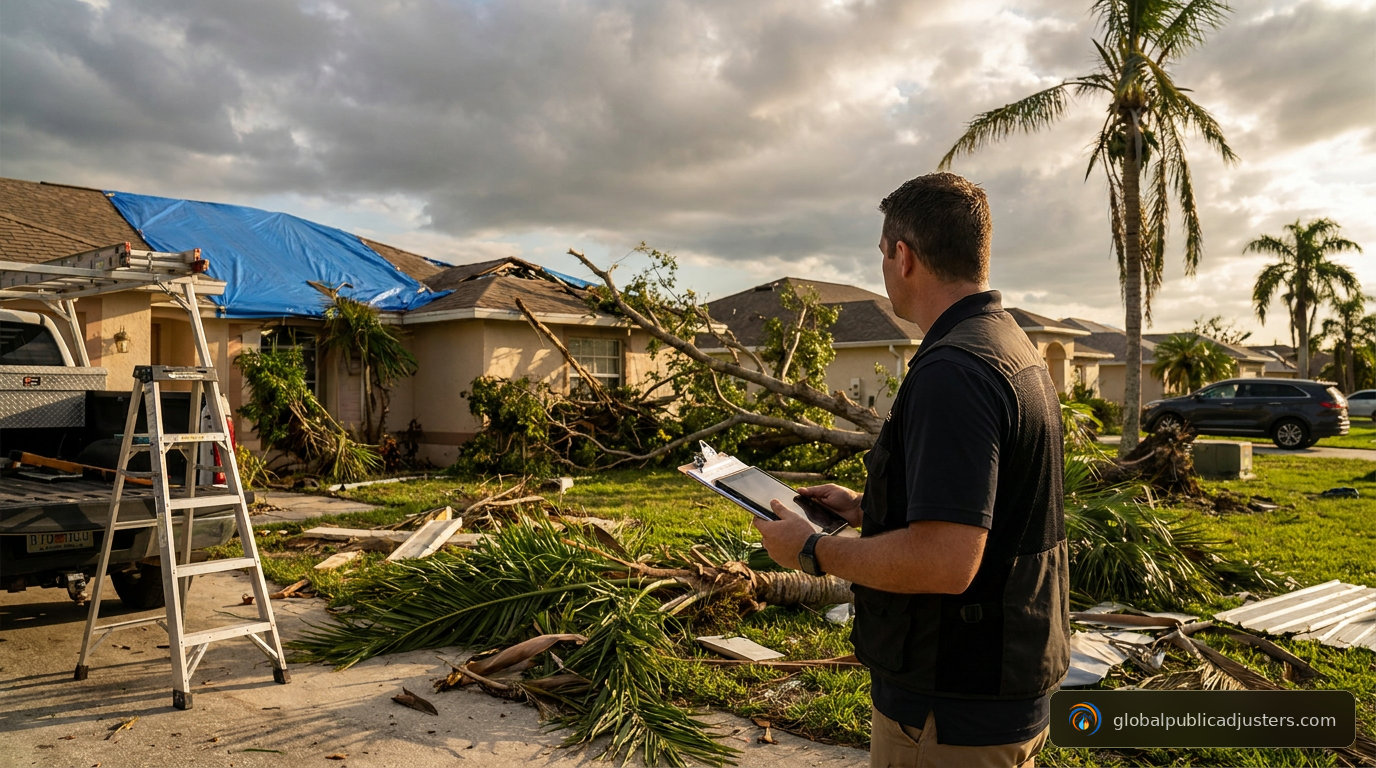
- Hurricane or tropical storm damageaffecting roofing, siding, or window seals across multiple rooms.
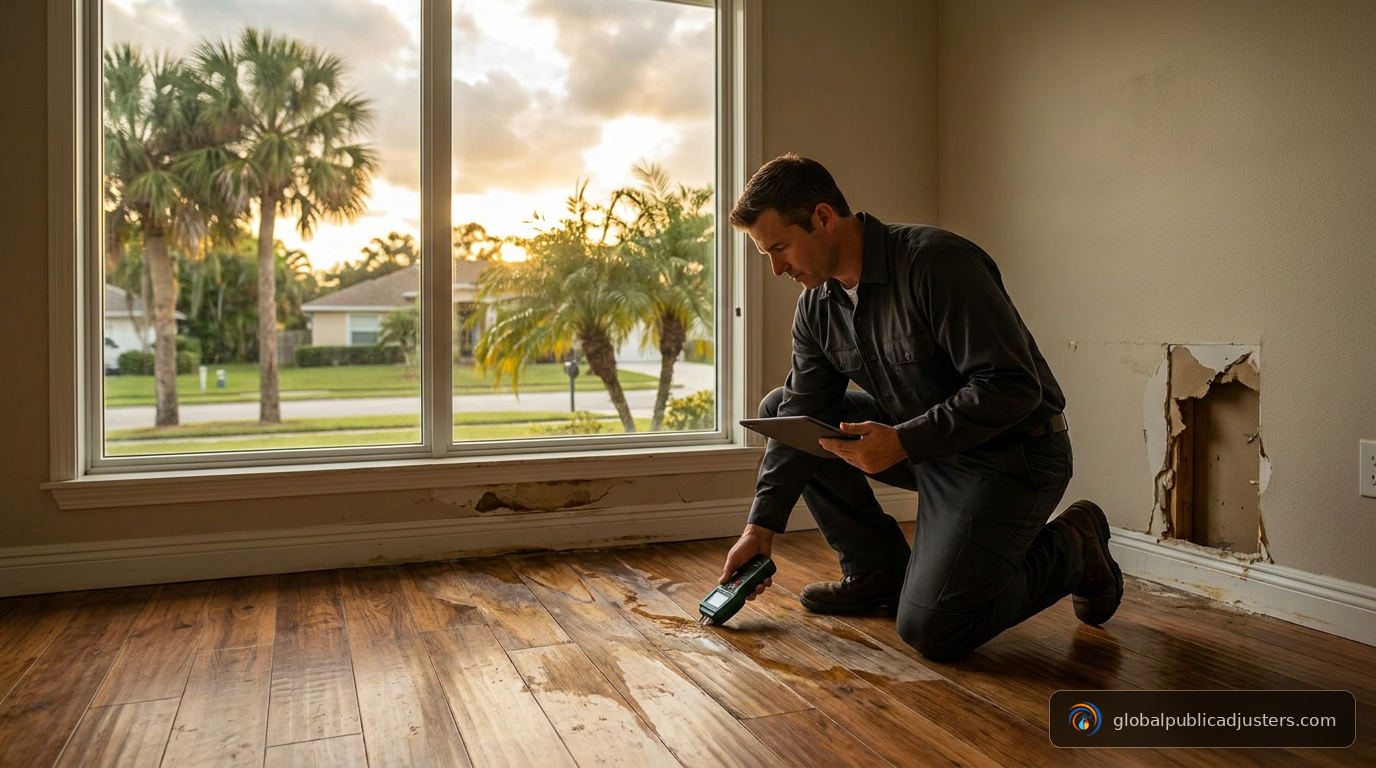
- Water damagefrom pipe bursts, slab leaks, or appliance failures, where hidden moisture can spread into subflooring and drywall.
- Denied or underpaid claimswhere the insurer’s offer seems far below your contractor’s repair estimate.
- Older Orlando homes(common in historic districts like College Park or Thornton Park) where code-upgrade costs aren’t automatically included in a payout.
- Large or multi-system lossesinvolving roof, flooring, cabinetry, and contents damage simultaneously.
If you’re unsure whether your situation qualifies, it helps to review how adjusters approach similar claims elsewhere in the state. Our breakdown offiling a hurricane damage insurance claim in Floridaand ourstep-by-step water damage claim guideboth walk through comparable scenarios homeowners across the state encounter.
What Does the Claim Process Actually Involve?
Public adjuster services follow a fairly consistent workflow, though the depth of work scales with the size and complexity of the loss. Here’s what the process typically covers from start to finish:
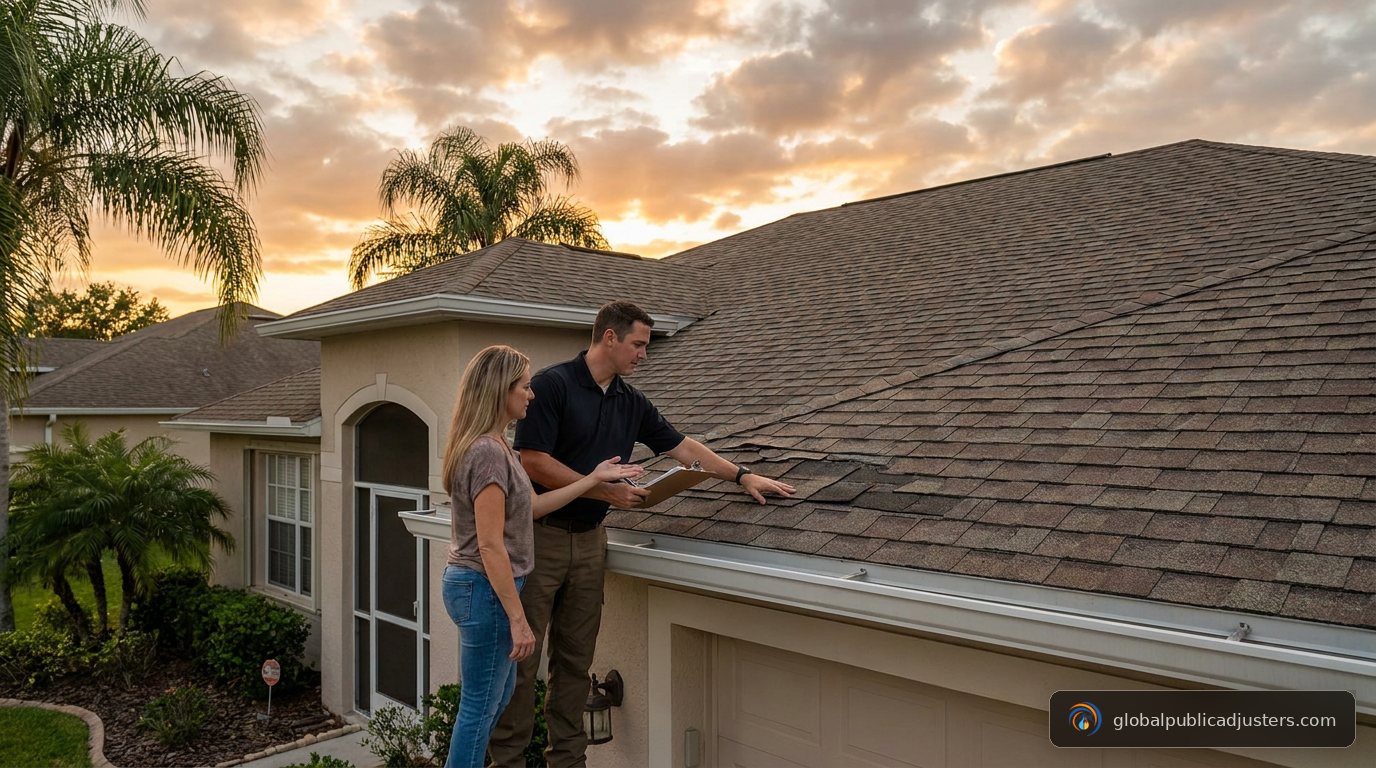
- Property inspection:A thorough walkthrough documenting visible damage (roof, walls, flooring) and less obvious issues (moisture intrusion, structural shifts, HVAC damage).
- Policy review:Careful reading of your declarations page, endorsements, exclusions, deductibles, and coverage limits to identify what you’re actually entitled to.
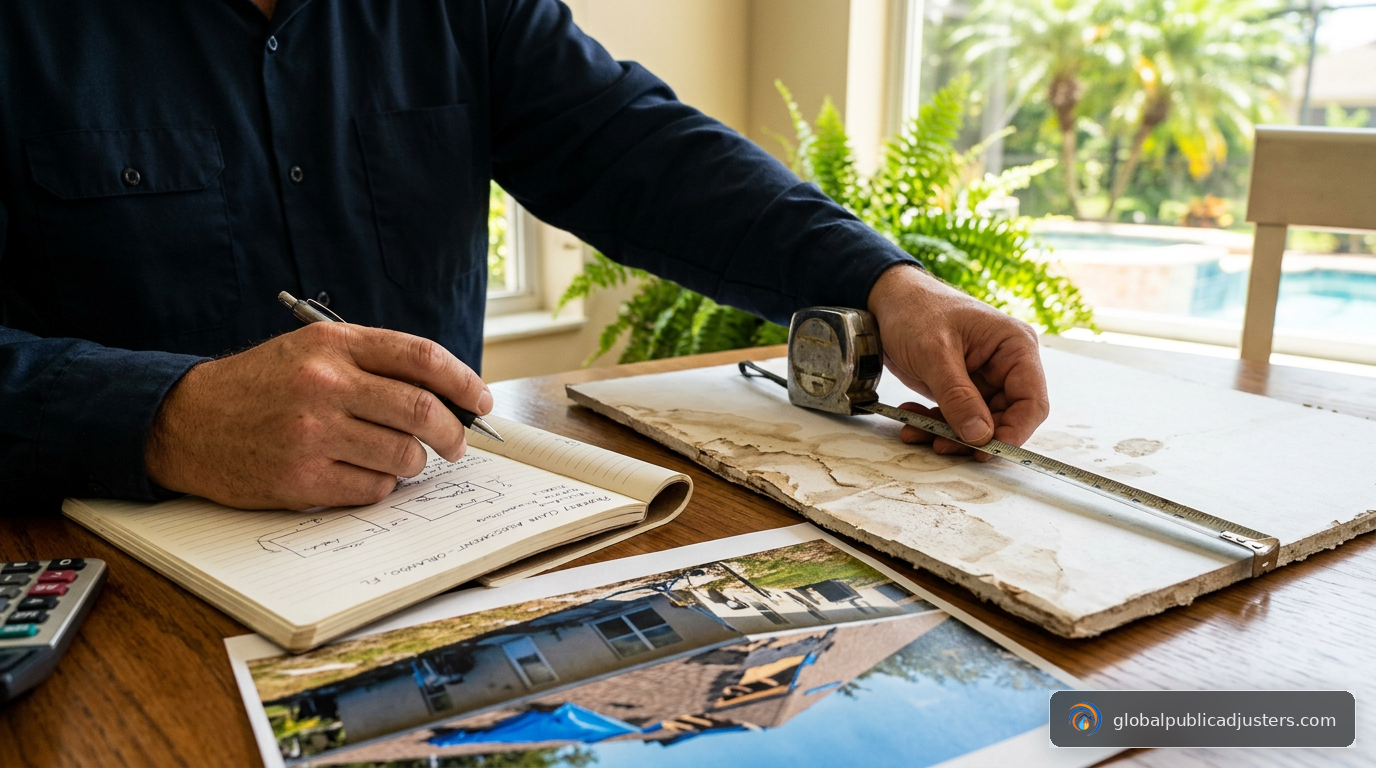
- Inventory and estimate preparation:Room-by-room documentation of damaged contents and a replacement-cost estimate built to match local Orlando labor and material costs.
- Proof of loss submission:Formal documentation filed with the insurer that establishes the scope and value of the claim.
- Scope comparison:Cross-checking your contractor’s estimate against the insurer’s scope of work to flag underpriced or omitted line items.
- Negotiation:Direct communication with the insurer’s adjuster to resolve disputed valuations, request supplemental payments, or challenge a denial.
- Supplemental and reopened claims:Ongoing support if new damage is discovered or if the first settlement doesn’t fully cover repair costs.
This process often uncovers damage the initial insurance inspection missed entirely, such as water intrusion behind drywall or compromised roof decking that isn’t visible from a ladder inspection. For a closer look at how this plays out specifically with roofing claims, see our guide onpublic adjusters for roof claims, which covers scope disputes that frequently show up in Central Florida too.
How Much Do Public Adjuster Services Cost in Florida?
Florida law requires a written contract before any public adjuster can charge for services, and the state caps what they’re allowed to charge. Under Florida Statute 626.854, fees are generally capped at20% of qualifying claim paymentsfor standard, non-emergency claims. That cap drops to10%for claims tied to a governor-declared state of emergency, but only during the first year after the declaration.
Because fees are contingency-based and tied directly to your settlement, pricing varies based on your specific claim size, complexity, and whether litigation becomes necessary. A straightforward water damage claim will typically involve less work (and lower overall fees) than a multi-system hurricane claim spanning roof, interior, and contents losses. The best way to understand what your specific situation might cost is to request a custom consultation rather than rely on a blanket number.
| Claim Type | Statutory Fee Cap |
|---|---|
| Standard, non-emergency claim | Up to 20% of qualifying payment |
| Governor-declared emergency, filed within first year | Up to 10% of qualifying payment |
Recent legislative sessions have continued to refine these rules; theFlorida Senate’s 2026 bill analysisoffers useful background on how fee structures and claims-handling requirements continue evolving. For homeowners who want a general overview of how adjuster compensation works across the state, our guide onhow insurance adjusters get paidbreaks down the mechanics further.
How Does a Public Adjuster Differ From the Insurer’s Adjuster?
This is one of the most common points of confusion for Orlando homeowners filing their first claim. Both professionals inspect damage and prepare estimates, but they work for entirely different parties.
Paid by:Contingency fee from settlement
Goal:Maximize documented, qualifying damage
Represents insurer interests:No
Paid by:Salary from insurer
Goal:Resolve claim within insurer guidelines
Represents insurer interests:Yes
Paid by:Fee per claim from insurer
Goal:Process high claim volume quickly
Represents insurer interests:Yes
If you want to understand how independent adjusters fit into the broader claims ecosystem, our article onfinding independent adjusters before hurricane seasonexplains how that role differs further. The Florida Department of Financial Services also maintains a consumer resource on public adjusters that’s worth reviewing before you sign any contract.
How Do You Choose the Right Public Adjuster in Orlando?
Not all public adjusters operate the same way, and choosing the right one matters as much as deciding to hire one at all. A few things worth checking before signing a contract:
- Florida licensing status, verifiable through the state’s Department of Financial Services.
- Experience with your specific damage type, whether that’s hurricane wind damage, water intrusion, or fire loss.
- Local familiarity with Orlando construction, since repair costs and code requirements vary by neighborhood and home age.
- Transparent fee structurethat matches Florida’s statutory caps, in writing, before any work begins.
- Clear communication practicesso you’re not left wondering about claim status for weeks at a time.
Homeowners sometimes assume they need someone local to physically visit the property, but experienced firms often coordinate inspections and negotiations remotely when needed. If you’re curious how that works in practice, see our piece onremote public adjuster support for Florida homeowners. You can also browse the full range ofpublic adjuster servicesoffered or review specificclaims typesto see which category matches your situation.
Key Takeaways
- Public adjusters work exclusively for the homeowner, not the insurance company, when documenting and negotiating property claims.
- Florida caps public adjuster fees at20% of qualifying payments, dropping to10%during the first year after a governor-declared emergency.
- Orlando’s Orange-Seminole-Lake-Osceola region saw a14.01% claim litigation ratein 2025, slightly above the statewide average of 12.10%.
- Statewide,698,742 claimsclosed in 2024, reflecting ongoing complexity in Florida’s property insurance market.
- A written contract is legally required before a public adjuster can charge for services in Florida.
- Public adjusters are not attorneys; denials, bad-faith disputes, or litigation may still require legal representation.
- Choosing an adjuster with local Orlando experience and verifiable licensing helps avoid costly missteps during negotiation.
People Also Ask
Is it worth hiring a public adjuster in Florida?
For larger or disputed claims, many homeowners find value in having a dedicated advocate who understands policy language and negotiation tactics. For small, straightforward losses, the added fee may not justify the benefit, so it depends on claim complexity and size.
How much does a public adjuster take from a settlement?
Florida law caps fees at 20% of qualifying claim payments for standard claims, reduced to 10% during the first year after a governor-declared emergency. The exact percentage is set in a written contract before work begins.
Can a public adjuster help with a denied claim in Orlando?
Yes, a public adjuster can review the denial reasoning, re-document damage, and push back with additional evidence. If the denial involves a legal dispute or bad-faith allegation, an attorney may need to be involved as well.
What’s the difference between a public adjuster and the insurance company’s adjuster?
A public adjuster is hired by and works for the homeowner, while the insurance company’s adjuster works for and is paid by the insurer. Their incentives and loyalties point in different directions.
How long does a public adjuster take to settle a claim in Florida?
Timelines vary widely depending on claim complexity, insurer responsiveness, and whether supplemental documentation or negotiation rounds are needed. Simple claims may resolve in weeks, while disputed or litigated claims can take months.
Frequently Asked Questions
Do I need a public adjuster for a small claim in Orlando?+
Small, single-item claims with clear damage and a cooperative insurer often don’t require professional representation. Larger or multi-system losses, or any claim where you disagree with the insurer’s valuation, are where public adjusters tend to add the most value.
Is a public adjuster the same as a lawyer?+
No. A public adjuster documents damage and negotiates settlements, but cannot provide legal representation in court. Denials, bad-faith claims, or litigation typically require a licensed attorney in addition to or instead of a public adjuster.
What does Florida’s fee cap mean for homeowners?+
It means public adjusters cannot legally charge more than 20% of your qualifying claim payment under standard circumstances, or 10% during the first year after a declared emergency. This protects homeowners from excessive fees while still compensating adjusters for successful negotiation work.
Why is Orlando’s litigation rate lower than South Florida’s?+
The Orange-Seminole-Lake-Osceola region recorded a 14.01% litigation rate for claims closed in 2025, compared to 27.27% in Miami-Dade-Broward-Palm Beach. Factors likely include differences in claim volume, storm exposure history, and regional insurer practices, though exact causes vary by case.
Can a public adjuster help after a hurricane in Central Florida?+
Yes, public adjusters frequently handle hurricane-related claims involving roof damage, water intrusion, and structural issues. Because emergency-related claims may fall under the reduced 10% fee cap during the first year after a declaration, timing of your claim can affect overall cost.
What should I look for in a public adjuster contract?+
Make sure the contract is in writing, clearly states the fee percentage, and complies with Florida’s statutory caps. It should also outline the scope of services, communication expectations, and what happens if the claim is denied or underpaid.
Related:Water Damage Claim Adjuster Florida in Orlando: How to Get a Fair Settlement
If you’re facing a denied, delayed, or underpaid claim anywhere in Central Florida, the team atGlobal Public Adjusterscan walk through your policy and damage documentation with you. Visit ourabout us pageto learn more about our approach, or reach out directly through ourcontact pageto schedule a no-obligation consultation before your claim deadline passes.