Public Adjuster Washington State in Jacksonville: What Policyholders Need to Know
Quick Answer
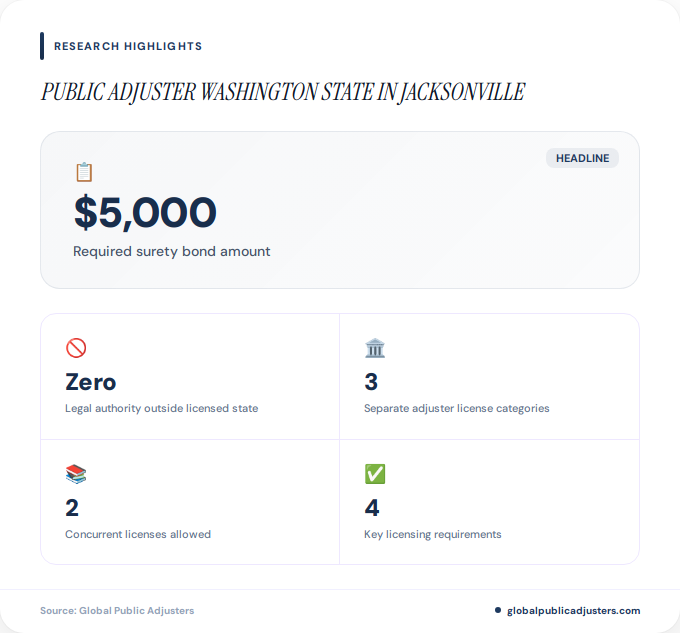
A “Washington state public adjuster” license only governs claims and property located in Washington, requiring a$5,000 surety bondand state licensure through the Office of the Insurance Commissioner. If you are a homeowner or contractor in Jacksonville, Florida, your claim is governed by Florida’s public adjuster licensing rules, not Washington’s, even though firms may market services across both states.
Here’s a statistic that surprises most homeowners: a public adjuster licensed in Washington state has zero legal authority to handle a property claim in Jacksonville, Florida, no matter how experienced or well-reviewed that adjuster is. The phrase “public adjuster washington state in Jacksonville” gets searched frequently, but it actually points to two entirely separate regulatory systems that never overlap unless a claimant has property or a policy tied to Washington. Understanding this distinction can save Jacksonville homeowners from hiring the wrong professional, delaying their claim, or worse, working with someone practicing outside their licensed jurisdiction.
This guide breaks down exactly how Washington regulates public adjusters, what that means if you’re searching from Jacksonville, and how Florida’s rules differ so you can get the right representation for your specific claim.
What Is a Public Adjuster and Why Does Jurisdiction Matter?
A public adjuster is a licensed professional who represents the policyholder, not the insurance company, during a property damage claim. Washington law defines a public adjuster as an adjuster representing solely the financial interests of the insured named in the policy, a definition that draws a clear line between insurer-side and policyholder-side representation underWashington’s adjuster licensing statute, RCW 48.17.380.
This matters because licensing is state-specific. A public adjuster licensed in Washington cannot legally adjust a claim on a home in Jacksonville’s Riverside, San Marco, or Mandarin neighborhoods unless they also hold a Florida license or an appropriate reciprocal credential. If you’re comparing this to other cross-state licensing questions, our breakdown ofhow Missouri licensing intersects with Tampa claimscovers a nearly identical scenario.
How Does Washington State License Public Adjusters?
Washington requires all public adjusters to be licensed through the state Office of the Insurance Commissioner, with separate license categories for public adjusters, independent adjusters, and other adjuster types, according to theWashington Office of the Insurance Commissioner’s adjuster licensing guidance. Both individuals and business entities can hold a public adjuster license in the state.
Key requirements include:
- A$5,000 surety bondfiled with the state, which does not increase even if the adjuster adds affiliates.
- Passing a state licensing exam covering insurance law and claims practices.
- The ability to hold both a public adjuster license and an independent adjuster license concurrently, provided the adjuster keeps client representation separate and conflict-free.
- Ongoing continuing education to maintain active licensure.
Third-party licensing trackers such as LicenseMap’s Washington adjuster licensing overview and AdjustThis’s guide to Washington adjuster licenses confirm these bonding and exam requirements are consistently enforced, with the NAIC’s state profile of the Washington Office of the Insurance Commissioner reinforcing the regulator’s oversight role.
“Licensing exists to protect the claimant, not just to satisfy paperwork. When someone hires a public adjuster, the very first thing they should confirm is whether that adjuster’s license actually covers the state where the damaged property sits. That single check prevents most of the disputes we see later,” notes a claims industry compliance reviewer familiar with multi-state adjuster licensing standards.
Why Would a Jacksonville Claimant Care About Washington Rules?
Jacksonville is Florida’s largest city by land area, spanning coastal neighborhoods like Atlantic Beach and Jacksonville Beach to inland communities such as Mandarin and Arlington. It sits squarely within Florida’s jurisdiction for insurance regulation, so Washington licensing rules simply don’t apply to a standard Jacksonville roof leak, hurricane claim, or water damage loss.
There are a few realistic reasons a Jacksonville resident might search for Washington-specific adjuster information: they own a second property in Washington, they relocated from Washington and still have an open claim there, or they’re researching how licensing works nationally before choosing a Florida-licensed firm locally. In all of these cases, the underlying advice is the same:match the adjuster’s license to the state where the property is located, not to where the claimant currently lives.
For readers actually dealing with storm damage in Northeast Florida, our detailedguide to Florida public adjuster hurricane claims in Jacksonvilleis the more directly applicable resource, and our piece onnegotiating an insurance settlement in Jacksonvillewalks through the local claims process step by step.
Washington vs. Florida: How Do the Rules Compare?
While both states require licensure, bonding, and clear separation between insurer and policyholder representation, the specifics differ enough that treating them interchangeably is a mistake. Here’s a side-by-side look:
| Requirement | Washington State | Florida (Jacksonville applies) |
|---|---|---|
| Licensing Body | Office of the Insurance Commissioner | Florida Department of Financial Services |
| Bond Requirement | $5,000 flat bond | $50,000 bond (varies by entity type) |
| Dual Licensing | Public and independent adjuster licenses allowed concurrently | Restrictions apply on representing both sides |
| Entity Licensing | Individuals and business entities eligible | Individuals and business entities eligible |
National directories like the National Association of Public Insurance Adjusters’ Pacific region directory and membership groups such as PCAPIA’s public adjuster membership listings show active licensed professionals in Washington, confirming the market is well-established there even though it operates entirely separately from Florida’s system.
What Changed in Washington’s Claims-Handling Standards?
Washington adopted extensive updates to its claims-handling standards, reportedly effective around August 2026, adding explicit language that claimants cannot be treated differently simply because they are represented by a public adjuster. This includes prohibitions on insurers delaying recognition of the public adjuster’s authority or withholding pertinent claim information and policy documents, a change detailed by Repairer Driven News’ coverage of Washington’s insurance commissioner adopting new claims-handling standards.
This regulatory shift matters nationally because it signals a broader industry trend: insurance commissioners are increasingly focused on equal treatment for policyholders who choose professional representation. Florida homeowners, including those in Jacksonville, have raised similar concerns about delay tactics, which is why understandingwhat Florida homeowners must know before filing a water damage claimis equally important regardless of which state’s rules apply to your property.
License types:Public, Independent, Crop
Recent update:Equal treatment standard (2026)
Governing law:Florida Statutes, not Washington RCW
Labor market reference:BLS Jacksonville MSA data
For broader labor and economic context on the Jacksonville metro area, theBureau of Labor Statistics’ Jacksonville MSA economic summaryoffers a snapshot of the regional employment and business landscape that shapes local claims activity, from construction trades to insurance services.
How Do You Choose the Right Public Adjuster?
Whether you’re in Jacksonville or dealing with a Washington property, the vetting process is similar. Start by confirming active licensure in the state where the damaged property is located, then check bonding status, disciplinary history, and whether the adjuster works exclusively for policyholders.
- Verify the license number directly with the relevant state insurance department, not just the firm’s website.
- Ask whether the adjuster or firm has handled claims similar to yours, such as hurricane damage, water intrusion, or fire loss.
- Request a written fee agreement before any inspection or paperwork is signed.
- Confirm the adjuster represents only your interests, never the insurer’s, consistent with Washington’s statutory definition and Florida’s parallel standards.
- Ask about typical timelines and communication practices, since claim delays are a common complaint nationally.
Pricing for public adjuster services typically runs on a contingency basis tied to the settlement amount, and full-service restoration or rebuild costs after a claim is settled can range anywhere from$10,000 to $50,000 or moredepending on the scope of damage, materials selected, and property size. Because every claim and property is different, pricing varies based on your specific project, and it’s best tocontact a licensed team for a custom quoterather than rely on generic estimates.
If your claim involves a denied hurricane or windstorm loss, our guide onwhat to do when a hurricane damage claim is denied in Floridaoffers a practical next-step checklist, and our resource onnegotiating an insurance settlementapplies broadly across Florida markets.
Key Takeaways
- Washington public adjusters are licensed by the Office of the Insurance Commissioner and must post a$5,000 surety bond.
- Jacksonville claims fall under Florida law, not Washington’s regulatory framework, regardless of where a firm is headquartered.
- Washington allows individuals to hold both public adjuster and independent adjuster licenses simultaneously, with proper conflict separation.
- Washington’s 2026 claims-handling updates require insurers to treat represented claimants equally, without delay tactics.
- Always verify license status directly with the state regulator before signing any representation agreement.
- Restoration and rebuild costs vary widely, often from $10,000 to $50,000 or more, depending on damage scope and materials.
- For Jacksonville-specific claims, work with a Florida-licensed public adjuster familiar with local building codes and coastal climate risks.
People Also Ask
What does a public adjuster do?
A public adjuster inspects damage, documents losses, prepares estimates, and negotiates directly with the insurance company on behalf of the policyholder, never the insurer.
Is a public adjuster required to be licensed in Washington?
Yes, Washington requires public adjusters to hold a state-issued license through the Office of the Insurance Commissioner before handling any claim in the state.
How much bond is required in Washington?
Washington requires a $5,000 surety bond for public adjusters, and this amount does not increase even when the adjuster adds additional affiliates to their business.
Can one person work as both an independent adjuster and a public adjuster?
Yes, Washington allows a person to hold both licenses concurrently, provided they keep client representation clearly separated to avoid conflicts of interest.
Does having a public adjuster slow down a claim?
No, and Washington’s updated claims-handling standards specifically prohibit insurers from delaying claims or withholding information because a public adjuster is involved.
Is a Jacksonville-based claim handled under Washington or Florida rules?
A Jacksonville claim is governed by Florida law and requires a Florida-licensed public adjuster, since licensing follows the location of the damaged property, not the claimant’s residence.
Frequently Asked Questions
Why do people search “public adjuster Washington state in Jacksonville” if the two are unrelated?+
Many searchers are comparing licensing rules across states or have property interests in both regions. The search often reflects confusion about jurisdiction rather than an actual cross-state service need.
Can a public adjuster represent the insured only, not the insurer?+
Yes, by definition and by law in both Washington and Florida, a public adjuster represents solely the policyholder’s financial interests and cannot simultaneously work for the insurance company on the same claim.
What should Jacksonville homeowners verify before hiring an adjuster?+
Confirm the adjuster holds an active Florida public adjuster license, ask for references from local claims, and get a written fee agreement before signing anything.
Does Washington allow business entities to be licensed as public adjusters?+
Yes, Washington permits both individuals and business entities to obtain public adjuster licenses, as confirmed by the state’s Office of the Insurance Commissioner.
What types of claims do public adjusters typically handle in Jacksonville?+
Common Jacksonville claims include hurricane and windstorm damage, roof leaks, water intrusion from tropical storms, and mold resulting from humidity and coastal weather patterns.
How can I find a reliable public adjuster near me?+
Related:Hurricane Damage Claim Adjuster Florida in Orlando: What Homeowners Need to Know
Related:Can You Negotiate Insurance Settlement Amount in Orlando? A Complete 2026 Guide
Related:How to Negotiate Insurance Settlement in Jacksonville: A 2026 Homeowner’s Guide
Start by reviewing licensedpublic adjuster servicesand comparing experience with your specificclaim typebefore scheduling a consultation.
Further reading:Public Adjuster for Roof Claim in Tampa: A Buyer’s Guide to Fair Payouts
Further reading:California Public Adjuster in Jacksonville: What Florida Property Owners Need to Know
Further reading:Public Insurance Adjuster Los Angeles: Remote Help for Florida Owners in Orlando