Hurricane Damage Insurance Claim Denied in Florida: What Homeowners Need to Know
Quick Answer
A hurricane damage insurance claim denied in Florida is often not outright fraud or misconduct, but rather a “closed without payment” outcome tied to below-deductible damage or flood exclusions. Florida data from Hurricane Milton shows 41% of closed-without-payment claims were below deductible, while Hurricane Helene saw 33.2% below-deductible denials and 20.3% flood-exclusion denials. Homeowners who believe their claim was wrongly denied should request a written explanation, get an independent inspection, and consider hiring a licensed public adjuster before accepting the insurer’s decision as final.
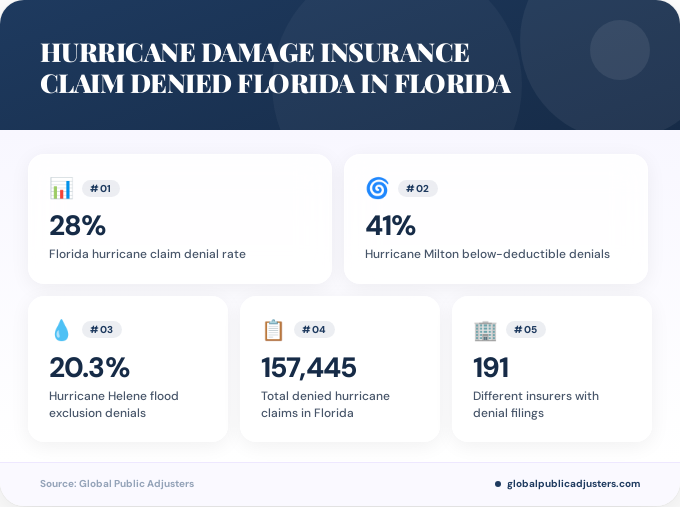
If your hurricane damage insurance claim was denied in Florida, you are far from alone. Florida regulators report that by March 2025, more than560,000 hurricane-related claims had been filed statewide, and 157,445 were denied, a 28% denial rate that has left homeowners from Fort Myers to Jacksonville scrambling to understand what went wrong. The truth behind most of these denials is more nuanced than headlines suggest, and understanding the real reasons can mean the difference between walking away empty-handed and recovering the money you are owed.
What Do the Latest Florida Hurricane Claim Denial Statistics Show?
Florida’s Office of Insurance Regulation has released detailed breakdowns of hurricane claim outcomes that paint a more complicated picture than a simple “denied” label. ForHurricane Helene, below-deductible denials made up33% of closed claims without payment, while flood-coverage exclusions accounted for20%of those unpaid closures. ForHurricane Milton, below-deductible denials were even more common, representing41% of closed-without-payment claims.
A later industry summary of the same state data found that insurers had closed81.7% of Milton’s 343,789 total claimsby February 28, with121,985 claims closed without payment, 35,043 still open without payment, and 27,894 still open with payment. Of Milton’s closed-without-payment claims, 41% were below deductible, 4% involved flood damage, and nearly23% were denied for other reasons. For Helene, roughly88% of claims were paid, but among the 46,656 claims closed without payment, 33.2% were below deductible, 20.3% were flood exclusions, and 18.8% fell into other coverage disputes, according to reporting cited by Newsweek’s analysis of Helene and Milton claim outcomes.
| Denial Reason | Hurricane Helene | Hurricane Milton |
|---|---|---|
| Below deductible | 33.2% | 41% |
| Flood exclusion | 20.3% | 4% |
| Other coverage issues | 18.8% | ~23% |
Beyond storm-specific data, a broader denial archive tracking Florida Civil Remedy Notices found1,166 hurricane and wind claim-denial filings out of 1,891total Florida filings in its database, with 136 later withdrawn or resolved. That same archive documented filings naming191 different insurers, according to Oceanpoint’s Florida claim denial statistics database, underscoring just how widespread these disputes have become across the state’s insurance market.
Why Do Insurers Deny Hurricane Damage Claims in Florida?
Understanding the specific reasons behind a denial is the first step toward challenging it. Florida homeowners, whether in Naples, Tampa, or the Panhandle, tend to face the same handful of recurring justifications from insurance carriers.
- Damage falls below the deductible.Florida hurricane deductibles are often a percentage of the home’s insured value, sometimes 2% to 10%, meaning many legitimate but smaller claims never clear the threshold for payment.
- Flood versus wind disputes.Standard homeowners policies generally exclude flood damage, so insurers frequently argue that water intrusion came from storm surge or rising water rather than wind-driven rain, shifting the loss to a separate flood policy the homeowner may not have.
- Alleged pre-existing damage.Insurers sometimes claim that roof wear, prior leaks, or maintenance issues, not the hurricane, caused the loss.
- Missed deadlines or paperwork gaps.Florida law requires claims to be filed within a set window after a hurricane, and missing documentation or late notice can trigger a denial.
- Disputed cause of loss.Adjusters may attribute damage to normal wear, settling, or unrelated causes instead of the storm itself.
According to CMS Law Group’s breakdown of common hurricane claim denial tactics, insurers frequently lean on ambiguous policy language and causation disputes to minimize payouts, which is why an independent review of the denial letter matters so much.
Is a “Closed Without Payment” Claim the Same as a Denial?
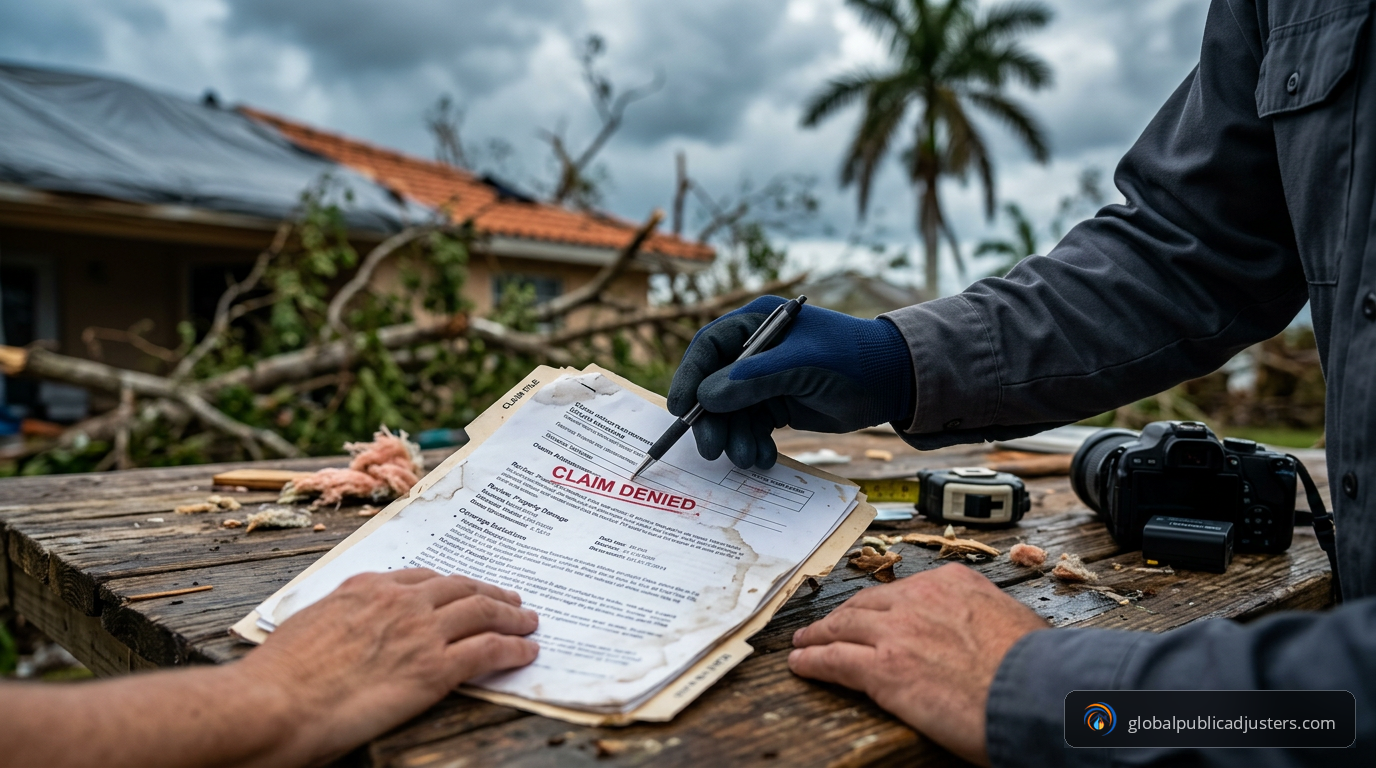
Not exactly, and this distinction matters enormously for Florida homeowners trying to figure out their next move. Florida’s Office of Insurance Regulation has pushed for greater transparency precisely because consumers often cannot tell whether their unpaid claim reflects a true denial, a below-deductible determination, or a flood exclusion, as detailed in theFlorida OIR’s official statement on hurricane claim transparency.
Many carriers use “closed without payment” as a catch-all category that lumps together several very different outcomes. A claim marked this way could mean the damage genuinely didn’t meet the deductible, or it could mean the insurer misclassified wind damage as flood damage to avoid paying. Homeowners in Sarasota, Cape Coral, and other storm-battered communities should never assume a “closed without payment” letter is the final word without reviewing the specific reason coded on the file.
Requires: Written appeal or legal review.
Requires: Independent estimate review.
Requires: Causation dispute and possible NFIP claim.
What Should You Do If Your Hurricane Claim Was Denied in Florida?
The steps you take in the first weeks after a denial can shape the entire outcome of your case. Florida homeowners should move quickly but carefully, because deadlines under Florida’s insurance statutes are strict.
- Request the denial in writing.Insurers must provide a specific reason, and vague language should be challenged immediately.
- Order an independent inspection.A second opinion from a licensed professional, separate from the insurer’s adjuster, often uncovers damage that was underestimated or misclassified.
- Compare the denial reason against your policy language.Many disputes hinge on how “flood,” “wind-driven rain,” and “surface water” are defined in your specific policy.
- Document everything.Photos, contractor estimates, receipts, and communication logs all strengthen a potential appeal.
- Review ourhurricane insurance tipsand our detailed guide onfiling a hurricane damage claim in Floridabefore signing any settlement release.
Homeowners in Orlando and surrounding Central Florida communities dealing with a denial or lowball offer can also review this guide onwhat Orlando homeowners need to know about hurricane damage claim adjustersfor region-specific insight.
How Can a Public Adjuster Help After a Denied Hurricane Claim?
A licensed public adjuster works exclusively on behalf of the policyholder, not the insurance company, which changes the entire dynamic of a dispute. Public adjusters re-inspect the property, build an independent damage estimate, and directly challenge the insurer’s causation findings, whether that means proving wind damage rather than flood, or documenting that repair costs actually exceed the deductible.
Claims professionals and policyholder advocates commonly recommend independent inspections because insurer-side adjusters are, by design, working to control claim costs for the carrier. This is echoed by legal resources like the Merlin Law Group’s overview of hurricane insurance claim denials, which notes that policyholders who challenge denials with independent documentation often see improved outcomes. For homeowners in Tampa, understanding licensing rules also matters, as explained in this breakdown ofwhy licensing and location both matter when hiring a public adjuster in Tampa.
Global Public Adjusters and similar firms typically work on a contingency basis, meaning there is no upfront cost, and fees are based on a percentage of the additional settlement recovered. Pricing for these services varies based on your specific claim size, complexity, and location, so homeowners should always request a custom quote rather than relying on flat industry averages. Explore our fullrange of claims servicesto see how the process works for hurricane, wind, and water damage claims.
How Do You Appeal or Fight a Denied Florida Hurricane Claim?
Florida law gives policyholders several formal paths to challenge a denial, and understanding the sequence matters. Homeowners can file a Civil Remedy Notice with the Department of Financial Services, request mediation through the state’s mandatory hurricane mediation program, or pursue appraisal if the policy includes that clause.
Litigation remains an option when negotiation and mediation fail, particularly for large commercial or high-value residential losses. According to the Florida Advocates’ guide to disputing a denied hurricane damage claim, homeowners who act within Florida’s statute of limitations and gather strong documentation early tend to have far more leverage in settlement negotiations. Homeowners negotiating a settlement in Northeast Florida may also benefit from this guide tonegotiating an insurance settlement in Jacksonville, while those in Central Florida can review this resource onnegotiating insurance settlement amounts in Orlando.
Water intrusion disputes are especially common after hurricanes, and homeowners statewide should understand the specific documentation needed, as outlined in this piece onwhat Florida homeowners must know before filing a water damage claim. For a full overview of howGlobal Public Adjusterssupports policyholders through every stage of a dispute, visit our homepage orcontact us directlyfor a free case review.
Key Takeaways
- Florida’s denial rate reached roughly28%statewide by March 2025, with over 560,000 claims filed and 157,445 denied.
- Below-deductible closures were the leading unpaid outcome for both Helene (33.2%) and Milton (41%).
- Flood exclusions accounted for 20.3% of Helene’s unpaid claims but only 4% of Milton’s, showing storm-specific variation.
- “Closed without payment” is not always a true denial, it can reflect deductible thresholds, flood causation disputes, or genuine coverage denials.
- A denial archive found 1,166 hurricane and wind denial filings across 191 Florida insurers.
- Independent inspections and public adjuster reviews are the most effective tools for challenging a wrongful denial.
- Strict Florida deadlines mean homeowners should act quickly after receiving any denial letter.
People Also Ask
What is the most common reason hurricane claims are denied in Florida?
The most common outcome is damage falling below the hurricane deductible, which accounted for 33.2% of Helene’s and 41% of Milton’s closed-without-payment claims. Flood exclusions are the second leading cause, especially in coastal areas.
Can I fight a denied hurricane claim in Florida?
Yes, homeowners can request mediation through Florida’s hurricane mediation program, invoke appraisal clauses, file a Civil Remedy Notice, or pursue litigation. Acting quickly and documenting damage independently significantly improves the odds of a successful appeal.
How many hurricane claims were denied in Florida in 2025?
By March 2025, over 560,000 hurricane-related claims had been filed statewide and 157,445 were denied, representing a 28% denial rate according to Florida claims data.
Does homeowners insurance cover flood damage from a hurricane in Florida?
Generally no. Standard Florida homeowners policies exclude flood damage, which must be covered separately through the National Flood Insurance Program or a private flood policy, making wind versus flood causation a frequent point of dispute.
Frequently Asked Questions
What does “closed without payment” mean on my Florida hurricane claim?+
It means the insurer processed your claim but issued no payment, which could be due to damage falling below your deductible, a flood exclusion, or another coverage dispute. It is not always the same as a formal denial, and homeowners should request the specific reason code.
How long do I have to appeal a denied hurricane claim in Florida?+
Florida generally allows a limited window to file suit or invoke appraisal after a denial, often governed by your policy terms and state statute. It is important to act quickly and consult a public adjuster or attorney as soon as you receive a denial letter.
Should I hire a public adjuster if my hurricane claim was denied?+
A public adjuster can independently re-inspect your property, build a detailed damage estimate, and challenge the insurer’s causation findings on your behalf. This is especially valuable when a denial hinges on disputed wind versus flood causation or an underestimated repair scope.
Why do insurers say hurricane damage is below the deductible?+
Florida hurricane deductibles are often a percentage of a home’s insured value, sometimes 2% to 10%, so even legitimate damage must exceed that dollar threshold before any payment is issued. Independent estimates sometimes reveal that actual repair costs exceed what the insurer initially calculated.
What is the difference between flood damage and wind-driven rain damage?+
Flood damage generally refers to rising water from storm surge or overflow, which standard homeowners policies exclude, while wind-driven rain enters through wind-created openings and is typically covered. This distinction is one of the most disputed issues in Florida hurricane claims.
Can I still get paid if my claim was already denied?+
Yes, many denials are successfully overturned or renegotiated through mediation, appraisal, or supplemental claims backed by independent inspections. Homeowners should not treat an initial denial letter as the final outcome without a professional review.
How much does it cost to hire a public adjuster in Florida?+
Related:Water Damage Claim Denied in Florida? Here’s What to Do Now
Related:How Does Insurance Adjuster Get Paid in Tampa: A Local Guide
Related:Public Adjuster for Roof Claim in Tampa: A Buyer’s Guide to Fair Payouts
Public adjuster fees typically work on a contingency basis and vary depending on claim size, complexity, and location, so there is no flat industry rate. Pricing varies based on your specific project, and most reputable firms offer a free consultation before any commitment.
Further reading:Filing a Hurricane Damage Insurance Claim in Florida: How Adjusters Maximize Your Settlement