Quick Answer
A public adjuster for a roof claim in Tampa is worth hiring when your claim is large, complex, underpaid, or disputed, since Florida caps their fee at20% for ordinary claimsand10% during a declared state of emergency. On a typical $20,000 to $50,000 roof settlement, that fee translates to roughly $2,000 to $10,000, which is usually justified if the adjuster recovers significantly more than the insurer’s initial offer.
Nearlythree out of every four Citizens Property Insurance policiesin Hillsborough County vanished in a single year, dropping from 42,607 to just 11,060 during 2025 as private carriers absorbed the business. That kind of market churn means thousands of Tampa homeowners now hold policies they’ve never tested, written by insurers they don’t yet know, right as the next wind event looms. If your roof takes a hit and the adjuster’s check feels light, apublic adjuster for a roof claim in Tampamay be the difference between a patch job and a full, code-compliant replacement.
This guide walks through what these professionals actually do, what Florida law says about their fees, the red flags that separate reputable adjusters from opportunists, and how to decide whether hiring one makes financial sense for your specific roof claim.
What’s Happening With Tampa Roof Claims Right Now?
Tampa’s property insurance market has been in flux for several years, and that instability directly affects how roof claims get handled. As Citizens’ policy count collapsed in Hillsborough County, newer and smaller private carriers picked up the slack, and many homeowners are discovering unfamiliar claims departments, adjusters, and payout patterns for the first time.
Statewide sentiment reflects the strain. A recent survey on Florida’s property insurance market found residents increasingly skeptical that rates or claims handling will improve, even after years of legislative reform. Separately, a University of North Florida poll found homeowners now rank insurance costs and claims disputes above property taxes as their top financial worry. That frustration often peaks after a storm, when a homeowner expects a fair roof payout and instead receives an estimate that doesn’t cover materials, code upgrades, or full tear-off.
Industry coverage has echoed this disconnect, noting that Florida homeowners remain unconvinced the insurance market has actually recovered, despite insurer profitability improving. For Tampa Bay neighborhoods like Westshore, Carrollwood, South Tampa, and Brandon, this means roof claims filed after wind events, hail, or even plumbing-driven ceiling damage are getting more scrutiny, not less.
What Does a Public Adjuster Actually Do for a Roof Claim?
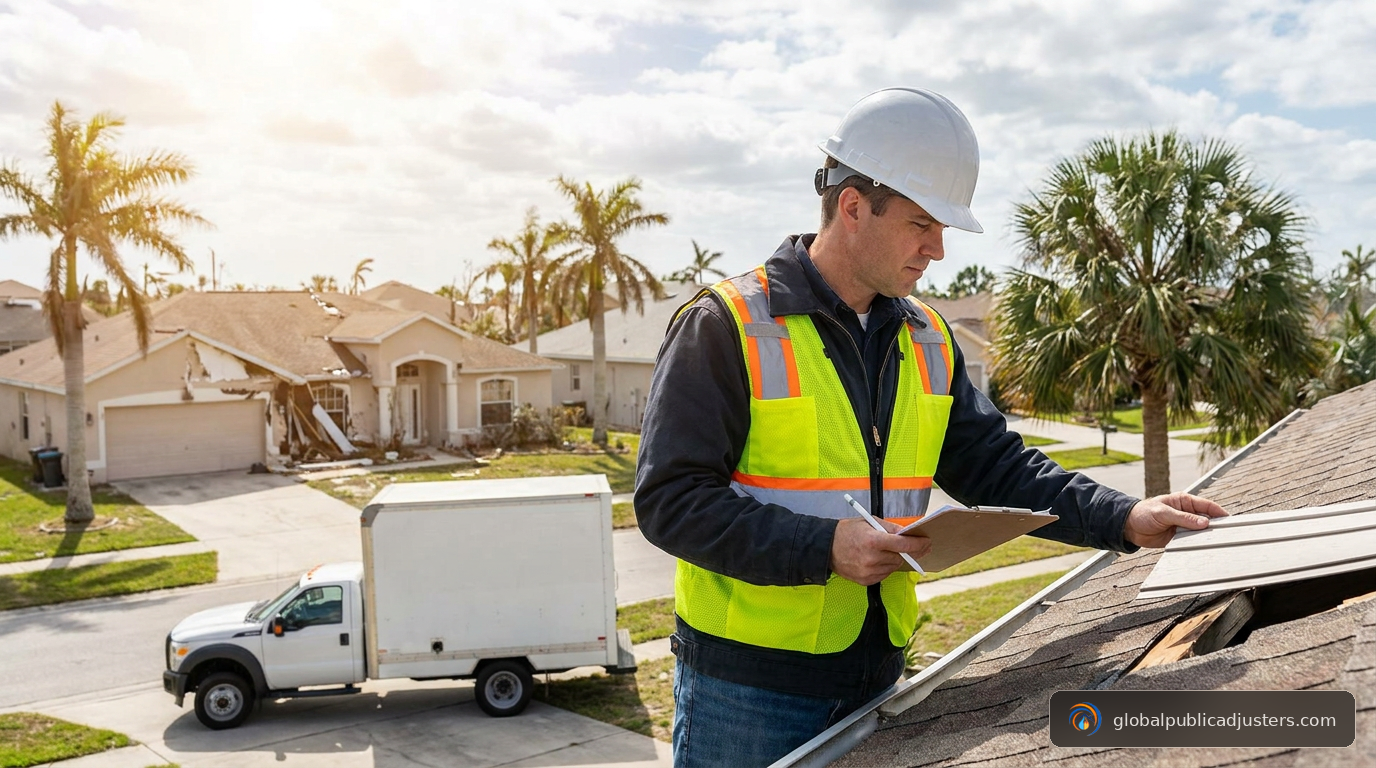
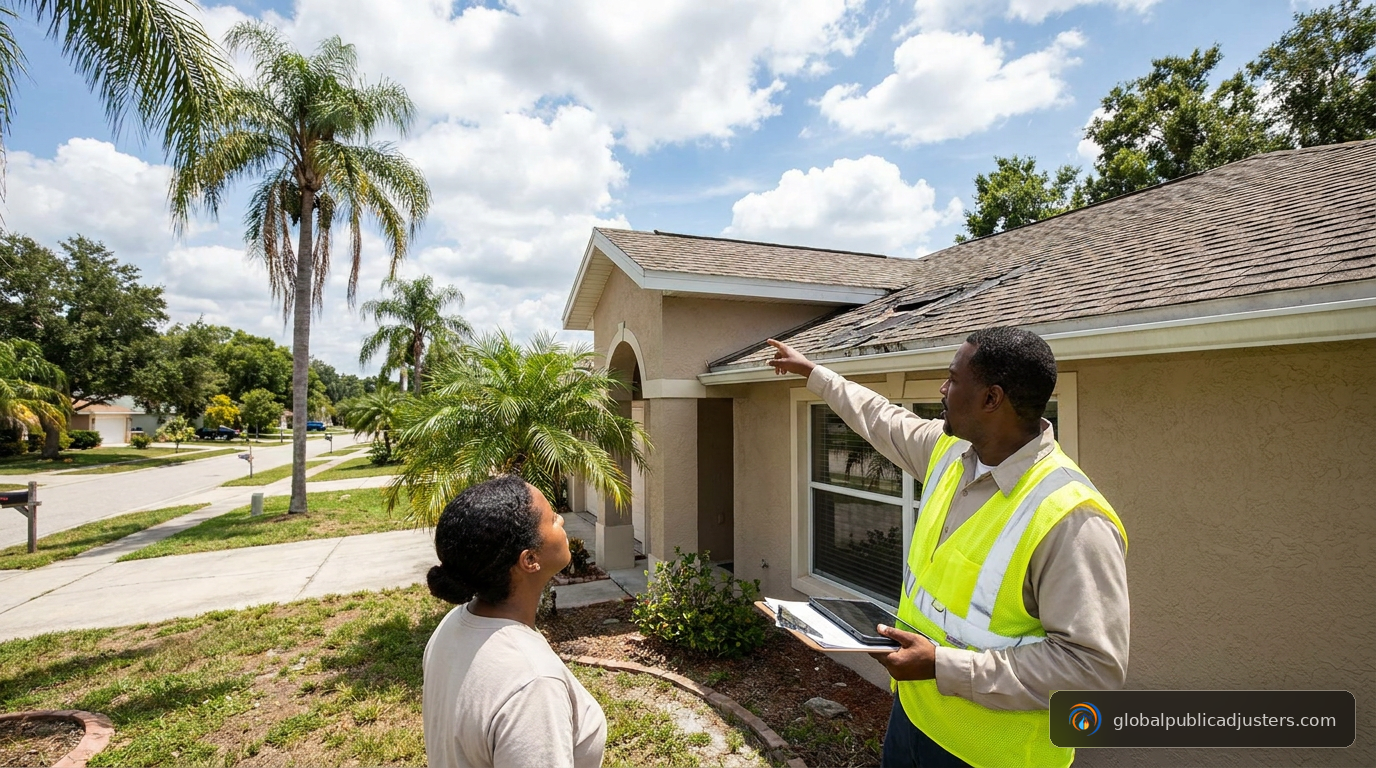
A public adjuster works exclusively for the policyholder, never the insurance company. For a roof claim, that typically includes:
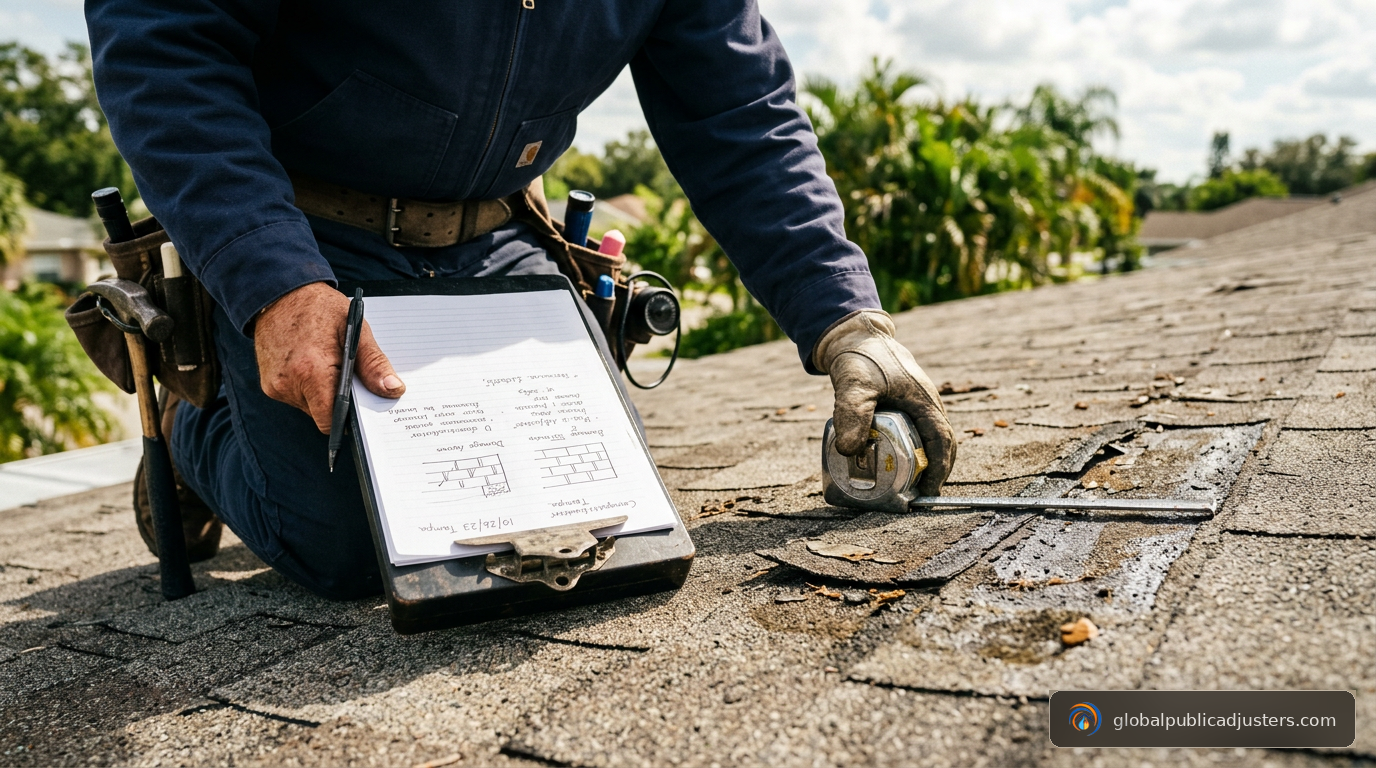
- Full damage documentation:inspecting shingles, decking, flashing, gutters, and any resulting interior damage to ceilings, insulation, or drywall.
- Detailed repair estimates:built from measurements, photos, material invoices, and current Tampa-area construction pricing rather than a generic software output.
- Policy review:checking the declarations page, roof-surface endorsements, matching provisions, ordinance-or-law coverage, and depreciation schedules that insurers sometimes apply inconsistently.
- Insurer communication:attending inspections, responding to requests, and keeping the claim moving instead of stalling in adjuster backlog.
- Supplemental claims:identifying damage the insurer’s estimate missed and submitting additional documentation to support a higher payout.
- Negotiation:pushing back on lowball offers with evidence rather than accepting the first number offered.
It’s important to understand the limits, too. A public adjuster does not guarantee coverage or payment, and disputes involving policy interpretation, alleged misrepresentation, litigation, appraisal, or bad-faith conduct may call for an insurance attorney instead. For background on how the adjusting process works from the insurer’s side, see thislocal guide to how insurance adjusters get paid in Tampa.
How Much Does a Public Adjuster Cost in Tampa?
Florida law caps public-adjuster compensation, and understanding these caps is essential before you sign a contract. According to guidance referenced in a breakdown of Florida public adjuster cost rules, fees generally apply only to the recovery attributable to the adjuster’s work, not to amounts the insurer already paid before you hired them.
| Situation | General Fee Limit |
|---|---|
| Ordinary new, supplemental, or reopened claim | Up to20%of covered recovery |
| Claim tied to a declared state of emergency (within the applicable one-year period) | 10%of covered recovery |
| Insurer pays or commits in writing to policy limits within an early window (e.g., 14 days of loss or 10 days of the contract) | May be capped as low as1% |
In dollar terms, a fee of 10% to 20% on a $20,000 roof settlement equals roughly$2,000 to $4,000. On a larger $50,000 settlement involving interior water intrusion and structural repairs, that same fee range equals$5,000 to $10,000. Tampa-area roof replacements commonly fall in the$10,000 to $25,000 range, though actual costs vary widely based on roof size, material, code requirements, decking condition, permitting, and any related interior damage, according to data cited by industry roofing cost resources.
These are planning benchmarks, not promises. Your actual settlement depends on your policy’s roof provisions, deductible, exclusions, depreciation schedule, roof age, and documented cause of loss. For a full breakdown of consumer protections around these contracts, the Florida CFO’s public adjuster code of ethics checklist is a useful reference before signing anything.
When Should You Hire One, and When Should You Skip It?
Not every roof claim needs a public adjuster. A straightforward claim with minor, clearly visible damage and a cooperative insurer may resolve fairly without one. But several situations tip the scale strongly in favor of hiring help:
- The insurer’s offer seems far below your contractor’s repair or replacement estimate.
- Your roof has multiple damage sources (wind, hail, age-related wear) and the insurer is disputing which portion is covered.
- There’s hidden decking or structural damage the initial inspection missed.
- Your claim involves adenied hurricane damage claimor a drawn-out dispute over causation.
- You’re juggling a busy schedule and can’t manage inspections, paperwork, and negotiation calls yourself.
On the other hand, if your insurer has already agreed to pay policy limits in writing shortly after the loss, the 1% fee cap may apply, making a public adjuster’s involvement less financially impactful, though still potentially useful for documentation accuracy.
What Red Flags Signal a Bad Public Adjuster?
The public adjuster industry has legitimate, licensed professionals, but it also attracts opportunists who chase storm damage. Watch for these warning signs:
- Door-to-door solicitation immediately after a storm, especially if the person can’t produce a Florida license number on request.
- Pressure to sign a contract on the spotwithout time to read the fee structure or cancellation terms.
- Vague fee languagethat doesn’t specify a percentage tied to Florida’s statutory caps.
- Promises of a guaranteed payout amountbefore any inspection has occurred.
- No physical office or verifiable track recordin the Tampa Bay area.
The Florida Bar’s consumer guide on homeowners insurance is a solid starting point for understanding your rights before engaging any adjuster or contractor. If you’re also fielding aggressive roofing-company pitches, know that much of this activity is driven by targeted roofing lead-generation campaigns in Tampa, which can blur the line between a licensed public adjuster and a contractor pushing a specific repair job.
What Questions Should You Ask Before Signing?
Before committing to any public adjuster, ask these directly:
- Are you licensed in Florida, and can I verify that license number myself?
- What percentage fee will you charge, and does it comply with the 20%/10% statutory caps?
- Will the fee apply only to amounts you recover, or to the full claim value including prior insurer payments?
- Can I cancel the contract within the state-mandated review period without penalty?
- Do you have references from other Tampa-area homeowners with roof claims?
- How will you document pre-existing wear versus storm-caused damage?
- What happens if the insurer denies the claim outright, will you refer me to an attorney?
If any answer feels evasive, that’s reason enough to look elsewhere. You can review service details and credentials on pages likethe full list of public adjusting servicesor learn moreabout a firm’s background and licensingbefore signing anything.
Public Adjuster vs. DIY vs. Attorney: Which Fits Your Claim?
Choosing the right path depends on claim size, complexity, and how the insurer has responded so far.
Cost:$0 in fees
Risk: Underpayment from insurer-favored estimates
Cost:10%-20% of recovery
Risk: Fee reduces net payout, but often still nets more
Cost: Often contingency-based, varies
Risk: Longer timeline, formal legal process
Many homeowners start with a public adjuster and only escalate to an attorney if the insurer denies the claim outright or acts in bad faith. If that happens, resources likethis guide on what to do after a denied water damage claimorwhy insurers deny claims and how to fight backoutline next steps, even though they focus on water damage, the denial tactics often overlap with roof claims.
Key Takeaways
- Florida caps public-adjuster fees at20% for ordinary claimsand10% during a declared state of emergency, with a possible 1% cap in rare early-payout scenarios.
- Hillsborough County’s Citizens policy count fell roughly74% during 2025, reshaping who’s handling Tampa roof claims today.
- Tampa roof replacements typically run$10,000 to $25,000, though scope, material, and code requirements shift that range significantly.
- A public adjuster’s fee should apply only to the portion of the recovery they helped secure, not amounts already paid before they were hired.
- Red flags include door-to-door pressure tactics, vague fee terms, and promises of guaranteed payouts before any inspection.
- Public adjusters don’t guarantee coverage; disputed denials or bad-faith conduct often require an insurance attorney instead.
- Always verify licensing and ask direct questions about fee structure before signing a contract.
People Also Ask
Is it worth hiring a public adjuster for a roof claim?
It’s generally worth it for large, complex, or underpaid claims where the fee (10%-20%) is offset by a significantly higher settlement. For small, clear-cut claims, the fee may not be worth it.
How much does a public adjuster take from a roof claim settlement?
Florida law typically caps fees at 20% for ordinary claims and 10% for claims tied to a declared emergency. On a $20,000 settlement, that’s roughly $2,000 to $4,000.
Can a public adjuster guarantee my roof claim gets approved?
No. A public adjuster can document damage and negotiate aggressively, but they cannot guarantee coverage or payment, since that depends on policy terms and the cause of loss.
What’s the difference between a public adjuster and an insurance company adjuster?
A public adjuster works for the policyholder and is paid a percentage of the recovery, while the insurance company’s adjuster works for the insurer and has no direct financial stake in maximizing your payout.
Frequently Asked Questions
Do I need a public adjuster if my roof claim was already approved?+
Not necessarily, but if you believe the approved amount is too low for actual repair or replacement costs, a public adjuster can review the estimate and file a supplemental claim for the difference.
How long does a roof claim take with a public adjuster in Tampa?+
Timelines vary widely based on insurer responsiveness and claim complexity, but many roof claims resolve within a few weeks to a few months once properly documented and submitted.
What documents should I gather before contacting a public adjuster?+
Gather your insurance policy declarations page, any prior correspondence with the insurer, photos or video of the damage, and any contractor estimates you’ve already received.
Can a public adjuster help with a denied roof claim?+
Yes, a public adjuster can often help rebuild documentation and resubmit a denied claim, though outright denials tied to policy interpretation or alleged misrepresentation may ultimately require an attorney.
Are public adjuster fees negotiable in Florida?+
Fees are capped by statute (20% ordinary, 10% during a declared emergency, and as low as 1% in certain early-payout situations), but the exact percentage within those caps can sometimes be discussed before signing.
What should I do immediately after roof damage from a storm in Tampa?+
Document the damage with photos and video, make temporary repairs to prevent further harm, avoid signing contractor contracts on the spot, and contact your insurer and a public adjuster before accepting any settlement offer.
Further reading:Public Adjuster Missouri Homeowners: Why Florida-Based Experts Serve Jacksonville and Beyond
Further reading:California Public Adjuster in Jacksonville: What Florida Property Owners Need to Know