Quick Answer
To file a water damage claim in Florida, Jacksonville homeowners must stop the source of water, document everything, report the loss to their insurer within 1 year under Fla. Stat. § 627.70132, and avoid signing away rights before understanding their coverage. Working with a licensed public adjuster before or shortly after filing often improves documentation quality and final settlement amounts, since insurers statewide closed nearly700,000 property claimsin a single reporting period, many involving disputed water losses.
If you’ve ever stood in an ankle-deep puddle in your laundry room at 2 a.m. wondering what your insurance actually covers, you’re not alone. Learninghow to file a water damage claim in Florida in Jacksonvilleis something thousands of local homeowners are forced to figure out every year, often while their flooring buckles and drywall swells in real time. Florida’s 2024 Property Insurance Stability Report recorded698,742 closed property claimsstatewide, and water-related categories (accidental discharge/overflow plus “other water” losses) made up roughly24% of all closed claims, according to theFlorida Office of Insurance Regulation’s stability unit report.
Jacksonville’s combination of heavy seasonal rainfall, aging plumbing in older neighborhoods like Riverside and Avondale, and coastal flood exposure near the St. Johns River makes water damage one of the most common insurance issues local homeowners face. This guide walks through the exact filing process, the statutory deadlines that control your claim, and how a public adjuster can change the outcome of a water damage dispute.
Why Does Water Damage Hit Jacksonville Homeowners So Hard?
Jacksonville sits at the mouth of the St. Johns River, with many neighborhoods built on low-lying terrain, slab foundations, and older cast-iron or galvanized plumbing systems that are now 40 to 60 years old. Combine that with Northeast Florida’s intense summer thunderstorms and tropical system remnants, and you get a steady stream of pipe failures, roof intrusion, and slow seepage claims every year.
Unlike wind damage, water losses are frequently contested because insurers distinguish between “sudden and accidental” discharge (often covered) and long-term seepage, deterioration, or maintenance neglect (typically excluded). That distinction is exactly where many Jacksonville claims fall apart, and it’s why documentation from day one matters so much.
What Should I Do Immediately After Discovering Water Damage?
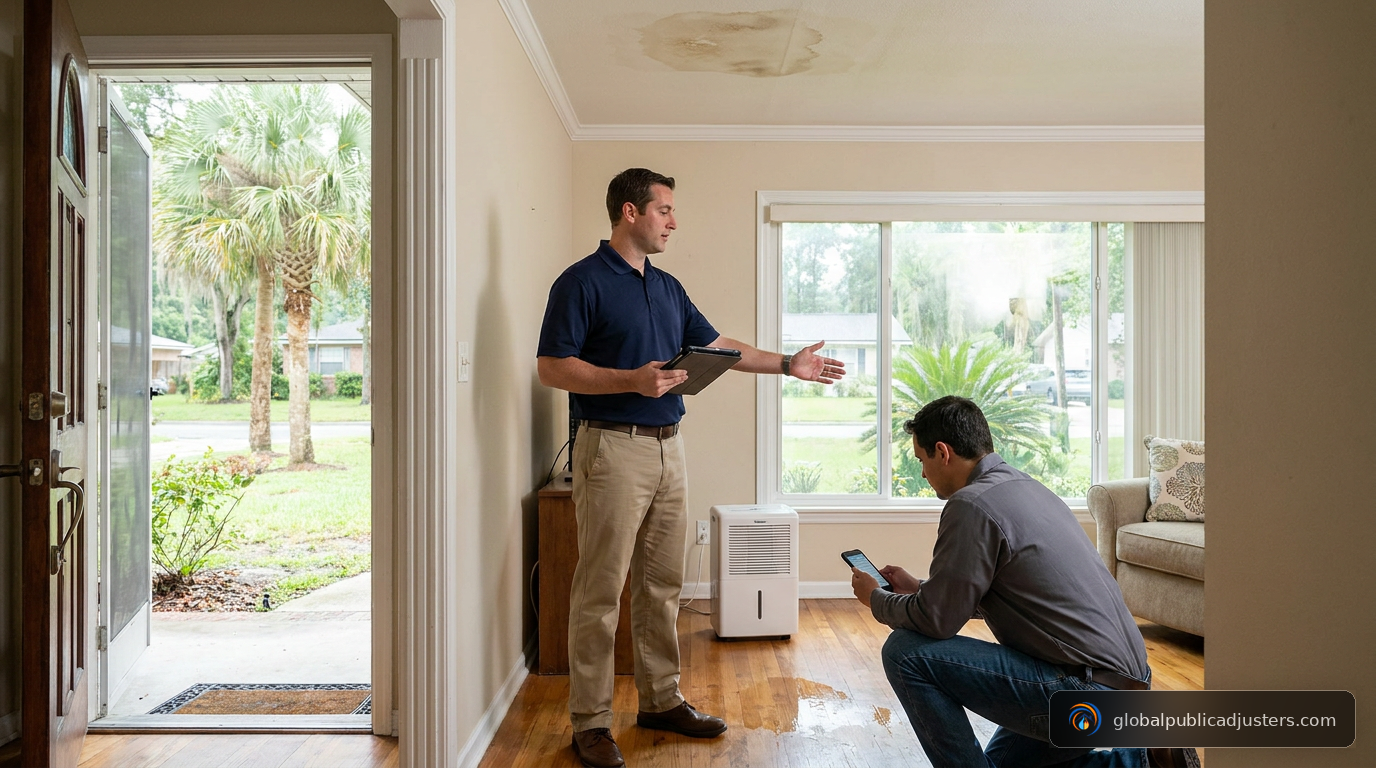
The first 24 to 48 hours after discovering water intrusion largely determine how smoothly your claim proceeds. Florida policies require policyholders to mitigate further damage, meaning you can’t simply wait for an adjuster to show up before taking action.
- Stop the source.Shut off the water supply or main valve if a pipe, appliance, or water heater is involved.
- Photograph and video everythingbefore you move or discard anything, including standing water, damaged belongings, and the suspected source.
- Extract standing waterand begin drying with fans or a dehumidifier to prevent mold growth, which insurers may use to deny secondary damage.
- Keep damaged materials(flooring samples, drywall sections) until the adjuster has inspected, unless they pose a health hazard.
- Save every receiptfor emergency mitigation services, hotel stays, or temporary repairs.
Jacksonville homeowners dealing with suspected flood water, as opposed to internal plumbing failures, should also understand the separate National Flood Insurance Program process outlined atFloodSmart.gov’s claim-filing resource, since standard homeowners policies generally exclude flood water entirely.
What Are Florida’s Deadlines for Filing a Water Damage Claim?
Florida law sets firm statutory windows that Jacksonville homeowners cannot afford to miss. These deadlines tightened significantly after the 2022 and 2023 legislative reforms.
| Deadline Type | Statutory Window |
|---|---|
| Initial notice of claim | 1 year from date of loss (Fla. Stat. § 627.70132) |
| Supplemental or reopened claim | 18 months from date of loss |
| Insurer acknowledgment of claim | 14 days |
| Sworn proof of loss (if requested) | 60 days from insurer’s request |
| Pay or deny decision | Generally up to 90 days, subject to exceptions |
These figures come from statutory guidance summarized by Central Florida Disaster Relief’s breakdown of the Florida water damage claim process and related deadline calculators. Because exceptions apply depending on your date of loss, policy language, and whether a proof of loss was requested, it’s worth asking your insurer for a written deadline calculation specific to your claim, or having a professional review it for you.
What Water Damage Is Actually Covered by My Policy?
Coverage hinges entirely on whether the loss was sudden and accidental versus gradual. Florida carriers are applying increasingly aggressive scrutiny to this distinction in 2026, according to reporting on the state’s ongoing homeowners insurance crisis and its effect on water damage claims.
Washing machine/dishwasher hose failure
Water heater sudden discharge
Plumbing overflow
Wind-driven roof intrusion
Flood water from rising rivers/storm surge
Deferred maintenance or deterioration
Mold resulting from unreported leaks
Groundwater and sewer backup (unless endorsed)
Flood damage, including storm surge from the St. Johns River or heavy rain pooling around homes in low-lying Jacksonville neighborhoods, is not covered under a standard homeowners policy. Residents should check their separate flood policy details, and local guidance such ascounty-level flood insurance resourcescan help explain how NFIP and private flood coverage differ from standard water damage claims.
How Do I Actually File the Claim With My Insurer?
Once mitigation is underway and documentation is collected, the formal filing process follows a consistent sequence in Florida.
- Report the loss promptlythrough your insurer’s claims phone line, app, or agent, ideally within days rather than weeks.
- Request a claim numberand the adjuster’s contact information in writing.
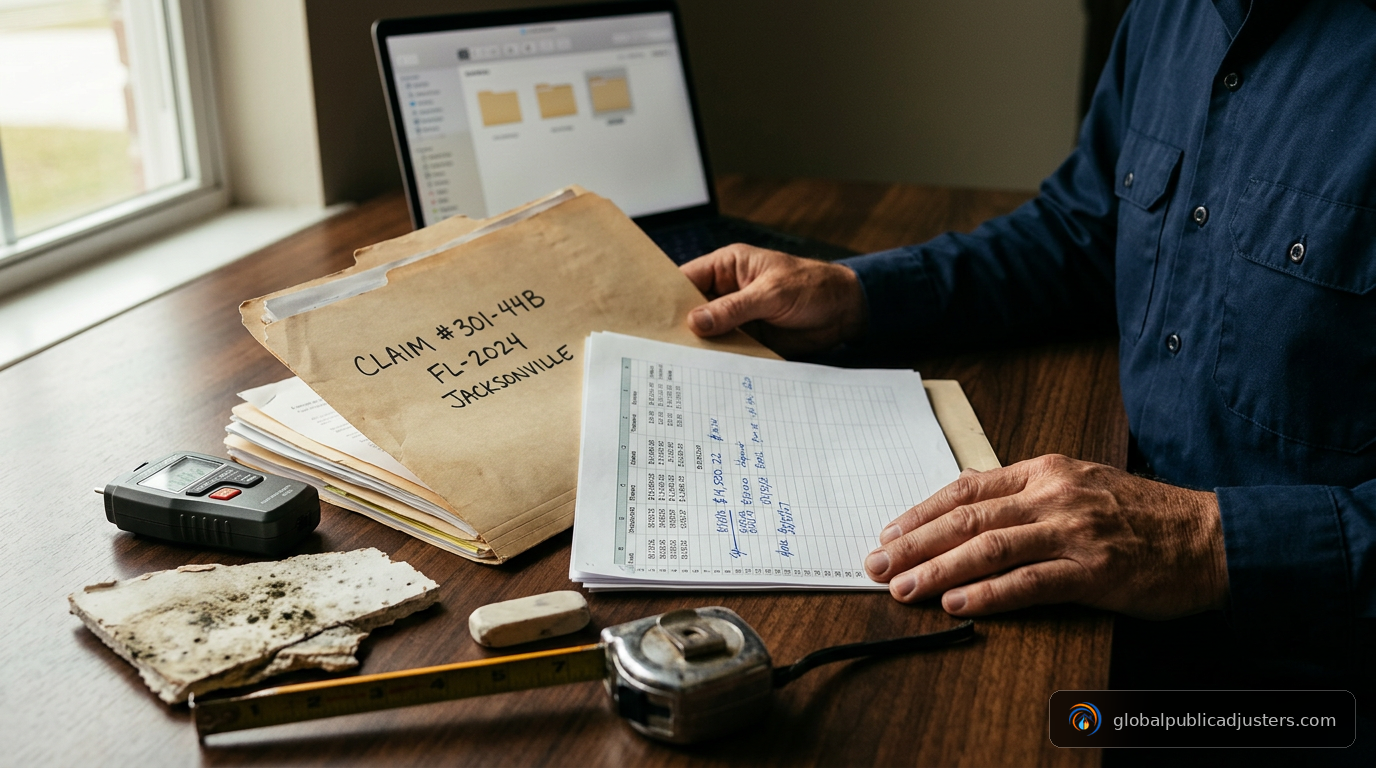
- Submit your documentation packet, including photos, videos, repair estimates, and a written timeline of events.
- Track every communicationin a dedicated folder or email thread, since insurers must acknowledge claim correspondence within 14 days.
- Be cautious with recorded statements, answering only what is asked and avoiding speculation about cause.
Homeowners who want a second set of eyes on their claim strategy before submitting paperwork can review the broaderpublic adjuster servicesavailable for Florida property owners, which cover everything from initial filing support to full claim negotiation.
How Does a Public Adjuster Help With a Water Damage Claim?
A licensed public adjuster works exclusively for the policyholder, not the insurance company, and is trained to document damage in the language insurers use internally. This matters enormously in water claims, where the line between “covered sudden loss” and “excluded gradual damage” is often the entire dispute.
Public adjusters also understand Florida’s statutory timelines in granular detail, including the 1-year notice rule and 18-month supplemental window, which prevents homeowners from accidentally forfeiting legitimate damage claims discovered later, such as hidden mold behind a wall. For Jacksonville homeowners who already had a claim denied or underpaid, it’s worth readingwhat to do when a water damage claim is denied in Floridabefore accepting a final offer.
What Happens If My Water Damage Claim Gets Delayed or Denied?
Average claim handling times statewide run around57 dayson average, with a median closer to27 days, according to the same 2024 stability report data. But delays well beyond that range are common when causation is disputed, and some insurers lean on exclusions language to avoid payment altogether.
If your claim is denied, you generally have options including requesting a detailed written explanation, filing a complaint with the Florida Department of Financial Services through its Division of Consumer Services storm and insurance claims resources, or hiring a public adjuster to reopen and resubmit the claim with stronger documentation. Homeowners who experienced a similar outcome with wind or hurricane-related damage may find useful parallels inhow hurricane damage denials are typically handled in Florida.
Broader market analysis has also noted that Florida’s insurance reforms, while intended to stabilize rates, haven’t fully restored homeowner confidence in the claims process, which is part of why more Jacksonville residents are seeking independent representation before filing.
How Much Does Water Damage Restoration Cost in Jacksonville?
Restoration costs vary enormously depending on the extent of water intrusion, the materials affected, whether mold remediation is required, and the size of the home. Minor single-room drying and drywall repair might fall on the lower end, while whole-home flooring replacement, structural drying, and mold remediation can run into the tens of thousands of dollars or more.
Because every property and loss is different, pricing varies based on your specific project, the extraction equipment needed, and local Jacksonville labor and material costs. Rather than relying on a single average figure, homeowners should request itemized estimates from licensed restoration contractors and have a public adjuster verify that the insurer’s scope of repairs matches the actual damage, not just a surface-level inspection.
Local restoration providers such as those referenced in Jacksonville-area water damage restoration resources can offer scope-specific quotes, but the insurance claim itself should be built around a full, independently verified damage assessment rather than the insurer’s initial number.
- Florida’s statutory notice deadline is 1 yearfrom the date of loss for most residential water damage claims.
- Supplemental claimsfor additional discovered damage must generally be filed within 18 months.
- Roughly 24% of closed Florida property claimsin the most recent stability report involved water damage categories.
- Sudden and accidental lossesare typically covered, while gradual seepage and deferred maintenance are typically excluded.
- Jacksonville’s aging plumbing and river-adjacent flood riskmake early documentation especially critical.
- Public adjusters work for the policyholder, not the insurer, and can strengthen causation evidence before a denial happens.
- Average claim closure takes about 57 days statewide, but disputed water claims often take longer.
People Also Ask
How long do I have to file a water damage claim in Florida?
Under Fla. Stat. § 627.70132, most residential water damage claims must be reported within 1 year of the date of loss, with supplemental or reopened claims allowed up to 18 months after the loss.
Does homeowners insurance cover water damage in Florida?
Standard Florida homeowners policies typically cover sudden and accidental water damage, such as burst pipes or appliance failures, but generally exclude flood water, gradual seepage, and damage from poor maintenance.
What is the difference between flood damage and water damage claims?
Water damage typically refers to internal sources like pipes or appliances and is covered by homeowners insurance, while flood damage comes from external rising water and requires separate flood insurance, often through the NFIP.
Should I hire a public adjuster for a water damage claim?
A public adjuster can be especially valuable for water claims because causation disputes are common, and proper documentation of a sudden loss versus gradual damage often determines whether a claim is paid in full.
What should I avoid saying to my insurance adjuster?
Avoid speculating about the cause of the damage, minimizing the extent of the loss, or agreeing to a repair estimate before an independent assessment, since these statements can be used to limit your payout.
Frequently Asked Questions
How do I start filing a water damage claim in Jacksonville?+
Stop the water source, document the damage with photos and video, begin mitigation to prevent further loss, and then report the claim to your insurer as soon as possible, ideally within days of discovery.
Can I reopen a water damage claim after it was closed?+
Yes, Florida law generally allows supplemental or reopened claims within 18 months of the original date of loss if additional damage is discovered, such as hidden mold or structural issues.
How long does my insurer have to respond to my claim?+
Insurers generally must acknowledge claim communications within 14 days and make a pay-or-deny decision within roughly 90 days, though exceptions apply depending on the policy and date of loss.
What documentation do I need for a water damage claim?+
You’ll need photos and video of the damage and source, moisture readings if available, repair estimates, receipts for emergency mitigation, and a written timeline describing when and how the damage occurred.
Why do Florida insurers deny so many water damage claims?+
Many denials stem from disputes over whether the damage was sudden and accidental versus the result of long-term seepage or deferred maintenance, which standard policies typically exclude from coverage.
Does a public adjuster cost money upfront?+
Most public adjusters work on a contingency basis tied to the settlement amount rather than charging upfront fees, though exact terms vary, so it’s worth reviewing the specifics during a consultation.
Water damage claims in Jacksonville move fast, and so do the deadlines attached to them. Whether you’re dealing with a burst pipe in San Marco, roof intrusion in Mandarin, or slab leaks near the Southbank, getting the documentation and timing right from day one makes the difference between a fair settlement and a frustrating denial. For homeowners who want professional support navigating the process, the team atGlobal Public Adjustersoffers a free claim review to help determine your next best step, and you can learn more about the team’s background on theabout us pageor reach out directly through thecontact pageto discuss your specific situation.