Quick Answer
A water damage claim public adjuster in Florida investigates, documents, values, and negotiates a homeowner’s water-loss claim directly with the insurance carrier, working only for the policyholder rather than the insurer. In Jacksonville, this matters most for large, disputed, underpaid, or complex losses involving hidden moisture, mold, or structural damage, not for a simple leak the insurer pays promptly and fairly.
Nearlyone in four closed property insurance claims in Floridain 2024 involved water, a share so large it reshapes how homeowners should think about filing and negotiating a loss. For a Jacksonville homeowner standing in a flooded living room after a burst supply line or a storm surge event near the St. Johns River, the question of whether to handle awater damage claim public adjuster Floridasituation alone or bring in professional help can determine whether the final settlement covers the real cost of repair or falls thousands of dollars short.
This article explains how public adjusters actually document and negotiate water damage claims in Florida, what the data shows about claim volume and severity, and when hiring one makes financial sense for a Jacksonville property owner.
How Big Is the Water Damage Problem in Jacksonville and Florida?
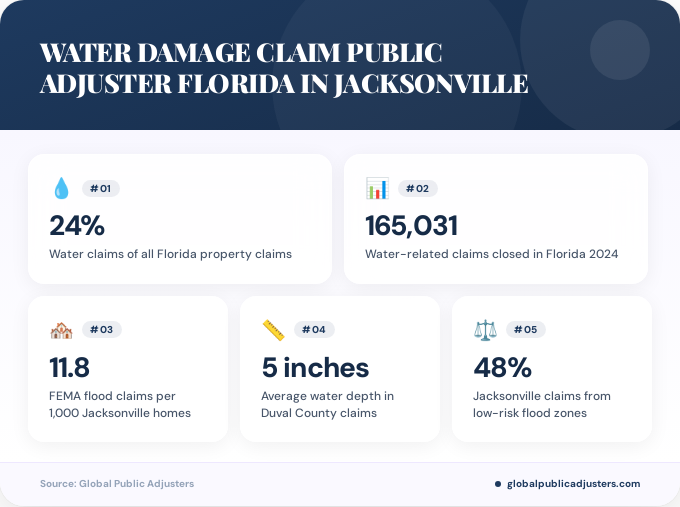
Water damage is not a rare event in Florida homeowners insurance. In 2024, the state closed698,742 property-insurance claims, including60,261 litigated claimsand621,154 non-litigated claims. Within that total, the “accidental discharge, overflow of water, steam” category accounted for82,965 claims, and “other water” added another82,066, combining for roughly165,031 water-related claims, or about24% of all closed claims statewide.
Nationally, water damage and freezing make up approximately22.6% of all homeowners claims, with average claim severity reported above$15,000, according to industry claims data. That national figure is useful context but should not be mistaken for a Jacksonville-specific average, since local construction types, humidity levels, and flood exposure change the math.
Jacksonville’s geography adds another layer. FEMA-derived data show5,076 flood-insurance claims within Jacksonville city limits since 1978, and the city reportedly ranksninth among the 50 largest U.S. cities for FEMA flood claims per home, at roughly11.8 claims per 1,000 homes. Perhaps most important for homeowners who assume they are safe: approximately48% of Jacksonville flood claimsin that dataset originated frommoderate- or low-risk flood zones, a pattern confirmed by local Jacksonville flood zone mapping data. In Duval County claims that reported water depth, the average depth was approximately5 inches, enough to ruin flooring, drywall, and furnishings across an entire first floor.
What Is a Public Adjuster and Who Do They Work For?
A public adjuster is a state-licensed professional who represents thepolicyholder, not the insurance company, during the claims process. This is a critical distinction from the insurer’s own adjuster, who is paid by and reports to the carrier.
In Florida, public adjuster licensing and conduct are governed underFlorida Statute 626.854, which defines the role and sets rules around fees, contracts, and conduct. The Florida Department of Financial Services maintains licensing oversight for all insurance professionals, including public adjusters, and homeowners can verify a license before signing any agreement.
If a homeowner ever has concerns about how a public adjuster is conducting themselves, Florida provides a formal process, detailed in this guide onhow to file a complaint against a public adjuster in Florida. For a broader look at the role itself, see this explainer onwhat a public adjuster does, including cost and process, in Jacksonville.
How Do Public Adjusters Document a Water Damage Claim?
Documentation is where most underpaid water claims go wrong. Insurers pay based on the scope and estimate submitted, so incomplete documentation almost always produces an incomplete check.
A thorough water damage documentation process typically includes:
- Full property inspection:identifying both visible damage and hidden moisture behind walls, under flooring, and inside cabinetry.
- Policy review:checking endorsements, exclusions, sublimits, and deductibles that may apply specifically to water, mold, or flood scenarios.
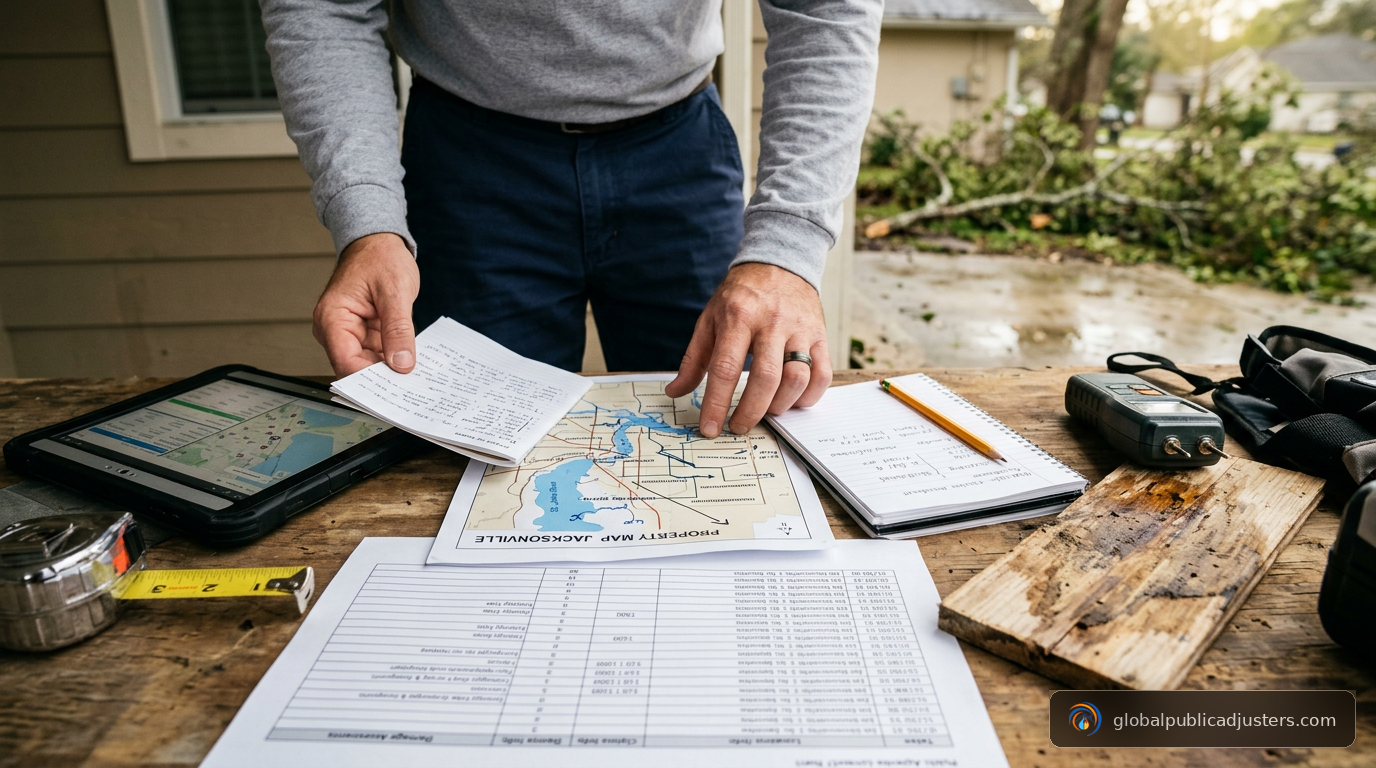
- Moisture mapping and photography:creating a dated, room-by-room record that can be defended later if the claim is disputed.
- Detailed repair estimates:using line-item scopes that match the true cost of materials and labor, not a generic flat estimate.
- Contents inventory:cataloging damaged furniture, electronics, and personal property with replacement cost documentation.
- Secondary damage tracking:documenting mold growth, warped flooring, or electrical issues that develop after the initial water event.
- Additional living expense records:if the home is uninhabitable, tracking hotel, storage, and relocation costs for reimbursement.
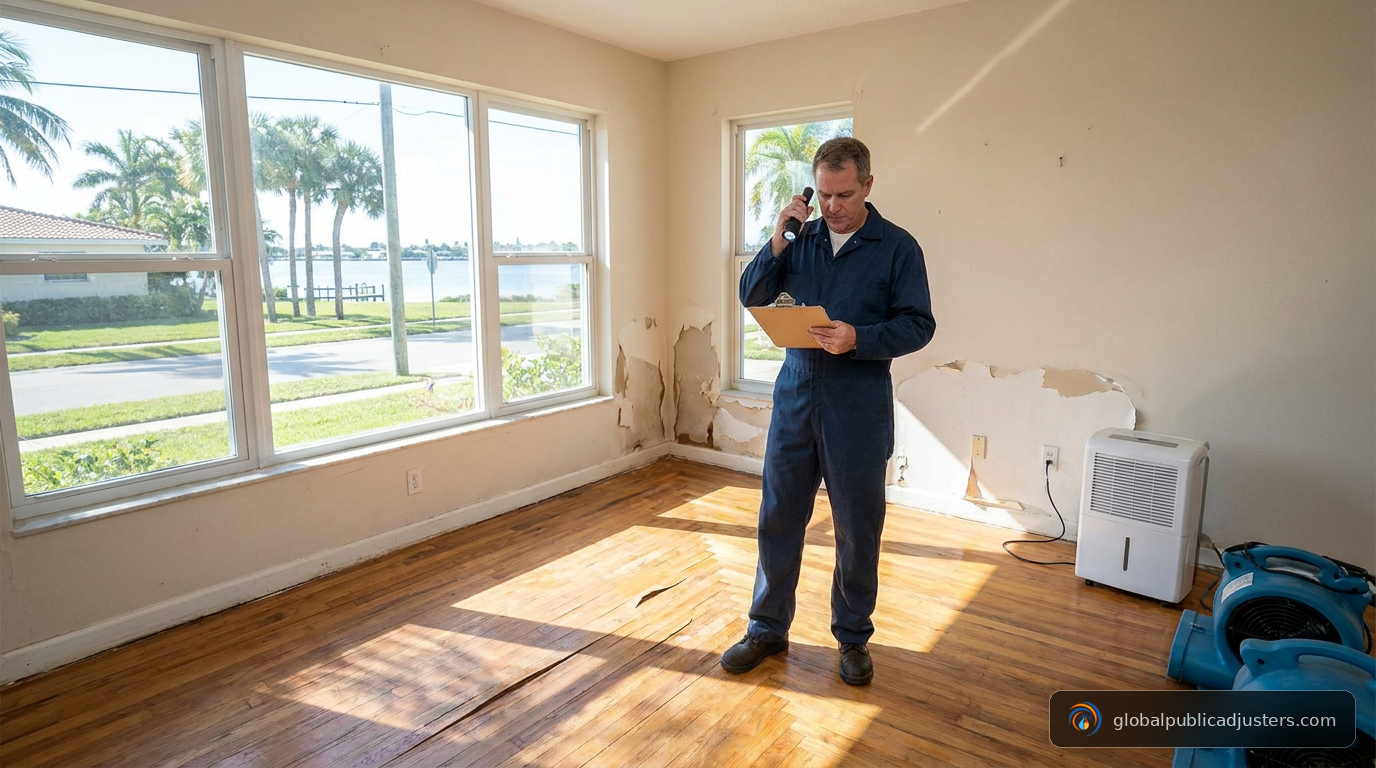
This level of documentation matters because water damage often continues to reveal itself for weeks. A wall that looked dry on day one can show mold growth by week three, particularly in Jacksonville’s humid, subtropical climate where indoor moisture lingers longer than in drier regions.
How Do Public Adjusters Negotiate With the Insurance Company?
Once documentation is complete, negotiation becomes a comparison exercise. The public adjuster’s estimate is placed side by side with the carrier’s estimate, and discrepancies are challenged with evidence, not opinion.
Typical negotiation steps include direct communication with the carrier’s adjuster, submission of supplemental claims when additional damage is discovered during repairs, and escalation through appraisal or other statutory remedies when the two sides cannot agree. Florida’s regulatory framework for licensed adjusters, outlined under Chapter 626 of the Florida Insurance Code, sets the professional boundaries within which this negotiation occurs.
Industry sources note that Florida’s broader insurance market has faced strain from rising claim costs and litigation, a trend discussed in detail in coverage of the Florida homeowners insurance crisis and its connection to water damage claims. That environment has made insurers more cautious about water claim payouts, which raises the value of precise, well-supported documentation during negotiation.
When Should a Jacksonville Homeowner Hire a Public Adjuster?
Not every water event requires a public adjuster. A small, contained leak with a fast, fair insurer payment may not justify the fee. The strongest cases for hiring one involve disputed, underpaid, delayed, or complicated losses.
| Scenario | Public Adjuster Likely Helpful? |
|---|---|
| Small leak, insurer pays promptly and fully | Usually not necessary |
| Large loss with structural or multi-room damage | Yes, strongly recommended |
| Insurer estimate far below contractor quotes | Yes |
| Hidden mold discovered after initial repairs | Yes |
| Claim denied outright | Yes, often combined with legal review |
Homeowners dealing with a denial specifically should review this companion resource on awater damage claim denied in Florida and what to do next, since denial cases often require a different sequence of steps than underpayment disputes. Hurricane-related water intrusion has its own nuances too, covered in this guide forJacksonville homeowners facing a denied hurricane damage claim.
Is This a Flood Claim or a Homeowners Water Claim?
One of the most common and costly misunderstandings in Jacksonville is confusing flood damage with ordinary water damage. A standard homeowners policy typically covers sudden, accidental discharge from an interior plumbing system, such as a burst pipe or failed water heater. It generally doesnotcover rising or accumulating water from outside the home, such as storm surge or overflowing waterways, which requires a separate flood policy.
This distinction matters enormously in a city where local drainage conditions and flat terrain can contribute to standing water during heavy rain events, and where neighborhoods near the St. Johns River, the Arlington area, and parts of the Westside face elevated flood exposure even outside hurricane season. A public adjuster’s policy review step exists precisely to catch this before a homeowner files the wrong type of claim or assumes coverage that was never purchased.
Example:Burst pipe, water heater failure
Policy:Standard homeowners (HO-3)
Example:Storm surge, river overflow
Policy:Separate flood policy (NFIP or private)
For a deeper look at flood-specific coverage options available to Florida homeowners, this overview of Florida flood insurance options explains how NFIP and private flood policies differ from standard homeowners coverage. Local carrier context for Jacksonville specifically is also summarized in this Jacksonville home insurance market overview.
What Does a Public Adjuster Cost in Florida?
Public adjusters typically work on a contingency fee basis, meaning they are paid a percentage of the final settlement rather than an upfront flat rate. Florida law caps and regulates these fee structures, and the exact percentage can vary depending on the type and size of the claim, whether it follows a declared emergency, and the complexity of the negotiation involved.
Because pricing varies based on the specific claim, its complexity, and the carrier involved, homeowners should request a custom fee breakdown before signing any agreement rather than relying on a flat number. For a detailed regional comparison, see this2026 public adjuster fee breakdown for Tampaand this relatedFlorida homeowner pricing guide for 2026, both of which outline the fee ranges and variables that generally apply statewide, including in Jacksonville.
It’s also worth understanding what a public adjuster cannot do: they do not guarantee coverage, cannot eliminate a policy deductible, cannot offer legal advice, and do not replace a licensed remediation contractor, engineer, or plumber. Their role is investigation, documentation, valuation, and negotiation, not construction or legal representation.
Key Takeaways
- Water-related losses made up roughly24% of all closed Florida property claims in 2024, totaling approximately165,031 claimsstatewide.
- Jacksonville ranks among the top U.S. cities for flood claims per home, with nearly48% of claims originating in moderate- or low-risk zones, meaning flood exposure is not limited to mapped high-risk areas.
- A public adjuster works exclusively for thepolicyholder, never the insurance company, and is licensed under Florida Statute 626.854.
- Thorough documentation, including moisture mapping, contents inventory, and hidden damage tracking, is the foundation of a successful negotiation.
- Homeowners should confirm whether their loss is ahomeowners water claimor aflood claim, since coverage sources differ significantly.
- Public adjusters are most valuable for large, disputed, underpaid, or denied claims, not necessarily for small, promptly paid losses.
- Fees are typically contingency-based and vary by claim size and complexity; always request a custom quote rather than assuming a flat rate.
People Also Ask
Is it worth hiring a public adjuster for water damage in Florida?
It’s generally worth it for large, disputed, or underpaid water claims where the gap between the insurer’s estimate and the actual repair cost is significant. For small, promptly and fairly paid claims, the contingency fee may not justify hiring one.
Does homeowners insurance cover water damage in Jacksonville?
Standard homeowners policies typically cover sudden, accidental water discharge from interior plumbing, like a burst pipe, but generally exclude rising floodwater from outside the home. A separate flood policy is usually required for flood-related water intrusion.
How long do I have to file a water damage claim in Florida?
Florida law sets specific statutory deadlines for reporting property claims, and these timeframes can vary depending on the type of loss and when it was discovered. Homeowners should review their policy and applicable statutes promptly rather than delaying the report.
What percentage do public adjusters charge in Florida?
Public adjusters in Florida typically work on a contingency fee based on a percentage of the final settlement, with the exact rate varying by claim type, size, and whether it follows a declared emergency. Always request a written, custom fee agreement before signing.
Frequently Asked Questions
What qualifies as a “large” water damage claim in Jacksonville?+
There’s no fixed dollar threshold, but claims involving multiple rooms, structural drying, mold remediation, or displaced living arrangements typically qualify as large and complex enough to benefit from professional documentation and negotiation.
Can a public adjuster help if my water claim was already denied?+
Yes, a public adjuster can review the denial reason, re-inspect the property, and build supplemental documentation to challenge the decision, though some denials may also require legal counsel depending on the basis for denial.
What’s the difference between a public adjuster and the insurance company’s adjuster?+
The insurance company’s adjuster is paid by and represents the carrier’s interests, while a public adjuster is independently hired by the homeowner to represent their interests exclusively throughout the claim.
Does a public adjuster eliminate my deductible?+
No. A public adjuster cannot waive, reduce, or eliminate a policy deductible; their role is to maximize the documented, covered portion of the loss within the terms of the existing policy.
How do I verify a public adjuster’s license in Florida?+
Homeowners can verify license status through the Florida Department of Financial Services, which maintains licensing records for all public adjusters and other insurance professionals operating in the state.
Why are so many Jacksonville flood claims coming from low-risk zones?+
Flat terrain, drainage limitations, and heavy rainfall events can produce localized flooding even outside FEMA-mapped high-risk zones, which is why nearly half of Jacksonville’s historical flood claims originated in moderate- or low-risk areas.
Understanding how documentation and negotiation work is the first step toward a fair settlement, but every claim situation is different. For homeowners who want a professional review of their specific water damage claim, exploring the full range ofpublic adjuster services available statewideor visitingGlobal Public Adjustersdirectly is a reasonable next step. You can also reviewthe different claim types handled by public adjustersor learn moreabout the firm’s background and experiencebefore reaching out through thecontact pagefor a claim review.