Quick Answer
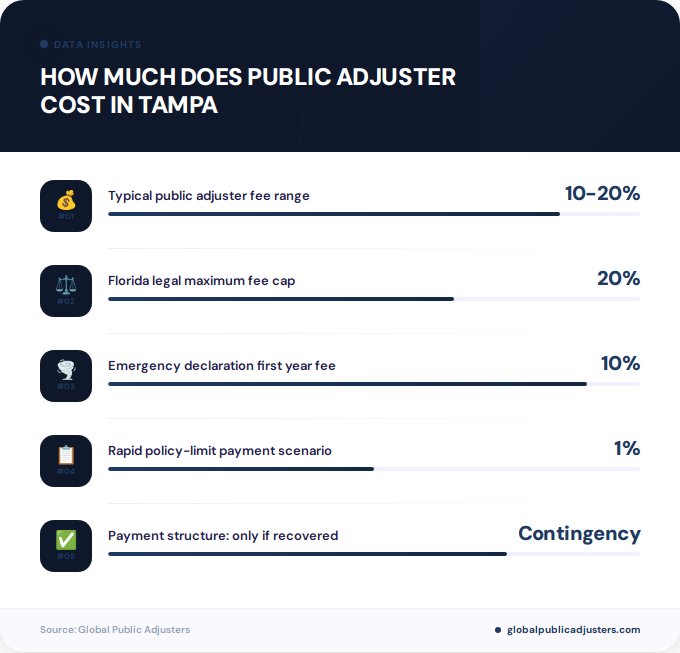
A Tampa public adjuster typically charges10% to 20% of your insurance claim paymenton a contingency basis, meaning you pay nothing unless they recover money for you. Florida law caps fees at20% for standard claims,10% during the first year after a governor-declared emergency, and1% in specific rapid policy-limit payment scenarios, so the exact rate depends on your claim type, size, and timing.
If your roof leaked during last year’s storm season and your insurer offered you $18,000 when repairs will cost $50,000, you’ve probably already searched “how much does public adjuster cost in Tampa” more than once. The honest answer involves percentages, legal caps, and a few numbers insurers hope you never calculate. This guide walks through exactly what Tampa homeowners pay, step by step, so you can decide whether hiring help makes financial sense before you sign anything.
What’s the Real Cost of a Public Adjuster in Tampa?
Most Tampa public adjuster firms work on a contingency fee, charging10% to 20% of whatever the insurance company ultimately pays you. There’s no upfront retainer in most cases. If the adjuster doesn’t recover money, they typically don’t get paid, though the exact terms always live in the written contract, not in a verbal promise.
This fee structure means the adjuster’s income is directly tied to your payout, which aligns their motivation with yours: maximize the settlement. But it also means a 20% fee on a $100,000 claim is a real $20,000, so understanding the math matters more than memorizing a percentage.
| Insurance Payment | 10% Fee | 15% Fee | 20% Fee |
|---|---|---|---|
| $10,000 | $1,000 | $1,500 | $2,000 |
| $25,000 | $2,500 | $3,750 | $5,000 |
| $50,000 | $5,000 | $7,500 | $10,000 |
| $100,000 | $10,000 | $15,000 | $20,000 |
| $250,000 | $25,000 | $37,500 | $50,000 |
Importantly, the fee is calculated from theclaim payment actually made to you, not the full policy limit, and it excludes any attorney fees or litigation costs that might apply separately. For a broader statewide view of these numbers, see our2026 public adjuster pricing guide for Florida homeowners.
What Are Florida’s Legal Fee Caps for Public Adjusters?
Florida doesn’t leave these percentages to chance. UnderFlorida Statute 626.854, public adjuster compensation is capped by law, and any contract exceeding these limits is unenforceable. Here’s the breakdown Tampa homeowners need to know:
- Ordinary property claim:Maximum 20% of the payment or settlement.
- Governor-declared emergency claim:Maximum 10% during the first year following the declaration, which matters a great deal in a hurricane-prone market like Tampa Bay.
- Reopened or supplemental claim:Compensation cannot exceed 20% of that reopened or supplemental payment.
- Early policy-limit payment:A 1% cap can apply when the insurer pays, or agrees in writing to pay, the full policy limit within 14 days of the loss or within 10 days after signing the adjusting contract, whichever is later.
These caps exist specifically to prevent predatory fee arrangements after major storms, when desperate homeowners are most vulnerable. The Florida Department of Financial Services’ consumer guidance on public adjusters confirms these percentage ceilings and reminds policyholders that any adjuster asking for more than the statutory maximum is violating state law.
What Factors Affect Your Public Adjuster’s Fee?
Not every Tampa claim gets quoted the same percentage. Several variables push the rate up or down within the legal range:
- Claim size and complexity:Larger, more document-heavy claims sometimes command negotiated rates.
- Type of damage:Roof, water intrusion, fire, mold, or named-storm damage each require different documentation strategies.
- Denial or underpayment status:Claims that were already denied often require more legwork, including supplemental filings and appraisal.
- Need for experts:Engineers, contractors, and independent estimators add cost and time, which can factor into the agreed percentage.
- Claim stage:New claims, reopened claims, and supplemental claims each fall under different statutory caps.
- Residential vs. commercial:Commercial properties in areas like Westshore or Ybor City sometimes see negotiated rates between 5% and 15% on claims exceeding $500,000, according to industry pricing data for large commercial claims, though these are market estimates rather than guaranteed rates.
Tampa’s exposure to hurricanes, tropical storms, and sudden afternoon thunderstorms off the Gulf means water and wind damage claims are common year-round, not just during named-storm season. That consistent claim volume is part of why local firms like those profiled by Tampa-area public adjusting services structure their fees around claim type and documentation burden rather than a flat rate.
Step-by-Step: What You Can Do Yourself vs. What Needs a Professional
Before paying any percentage, it helps to know which parts of a claim you can realistically handle alone and which parts typically require licensed expertise.
What a Tampa homeowner can do without hiring anyone
- Document the damage immediately.Take dated photos and video of every affected room, the roof if accessible safely, and any standing water.
- Review your policy’s declarations page.Know your coverage limits, deductible, and whether you have hurricane or flood endorsements.
- Report the claim promptly.Most policies require notice within a specific window; delays can jeopardize coverage.
- Mitigate further damage.Tarp a roof, shut off water, or board windows, keeping receipts for any emergency repairs.
- Keep a claim journal.Log every call, adjuster visit, and email with dates and names.
What typically requires a licensed professional
- Estimating full repair scope and cost.Insurance company adjusters work for the insurer; a licensed public adjuster works for you and builds an independent estimate.
- Negotiating a denied or underpaid claim.If your insurer denied coverage or offered far less than repair costs justify, professional negotiation and documentation usually recover more than a homeowner negotiating solo.
- Interpreting ambiguous policy language.Coverage disputes over exclusions, wear-and-tear arguments, or causation often need expert rebuttal.
- Filing supplemental or reopened claims.These require specific procedural knowledge under Florida homeowners insurance consumer guidance from The Florida Bar.
- Deciding between a public adjuster and an attorney.Some disputes are purely valuation issues (a public adjuster’s specialty), while others involve bad-faith or legal breach issues requiring an attorney, a distinction explained well by legal analysis comparing public adjusters and lawyers in Tampa.
If your claim was denied outright, our guide onwhat to do after a water damage claim denial in Floridacovers the next steps in more detail, and homeowners dealing with storm-related denials may also find our breakdown ofwhy Tampa hurricane claims get rejected and how to appealuseful.
How Do You Calculate If Hiring a Public Adjuster Is Worth It?
The percentage alone doesn’t tell you whether hiring help makes financial sense. What matters is the net recovery after fees compared to what you’d likely get on your own.
Consider a realistic Tampa scenario: an insurer initially offers $18,000 for roof and interior water damage after a storm. A public adjuster investigates, documents the full scope of hidden damage, and negotiates the claim up to $50,000.
- Gross increase in payout: $32,000
- Fee at 10% of the final payment: $5,000
- Net payment to homeowner after fee: $45,000
- Net improvement over the original offer: $27,000
Even after paying the contingency fee, the homeowner nets significantly more than the insurer’s original offer. This is the calculation every Tampa policyholder should run before dismissing a public adjuster as “too expensive.” For homeowners weighing similar math on water-related claims specifically, see our guide ongetting a fair water damage settlement in Florida.
Applies to:Non-emergency claims
Basis:Final payment
Applies to:First year post-declaration
Basis:Final payment
Applies to:Fast insurer payment within statutory window
Basis:Specific coverage portion
What Should You Check Before Signing a Contract?
Before signing any agreement with a Tampa public adjuster, review these items carefully:
- Confirm the exact fee percentage in writing, and verify it doesn’t exceed the statutory cap for your claim type.
- Ask about “no recovery, no fee” language.Some contracts still allow charges for inspections, engineering reports, or cancellation fees even without a payout.
- Check licensing statuswith the Florida Department of Financial Services before signing anything.
- Clarify how supplemental or reopened claims are billed, since these may fall under a separate 20% cap calculated independently.
- Understand the cancellation termsif you want to switch adjusters or settle the claim yourself partway through.
Homeowners in Tampa neighborhoods like Davis Islands, Carrollwood, and South Tampa frequently face claims involving older roofing systems and aging plumbing, both of which can complicate documentation. Working with a firm that understands local roof damage insurance claim procedures specific to Tampa can prevent costly documentation gaps. You can also review our fullpublic adjusting servicesor exploreclaim types we handleto see if your situation qualifies for representation.
Key Takeaways
- Tampa public adjusters typically charge10% to 20%of the insurance payment, almost always on contingency.
- Florida law caps fees at20% for standard claims,10% for emergency-declared claimsin the first year, and1%for rapid policy-limit payments.
- The fee is based on theactual payment received, not the policy limit, and excludes attorney costs.
- Large commercial claims over $500,000 sometimes see negotiated rates between 5% and 15%, though this varies by firm.
- Always calculatenet recovery after fees, not just the percentage, when deciding whether to hire help.
- Homeowners can document damage and file initial claims themselves, but negotiating denials, supplements, and complex valuations usually benefits from licensed expertise.
- Always confirm fee terms in writing and verify licensing before signing any contract.
People Also Ask
Is it worth hiring a public adjuster in Florida?
For most underpaid, denied, or complex claims, yes. Studies and industry data consistently show public adjusters recover significantly higher settlements than homeowners negotiating alone, even after the contingency fee is deducted.
Do public adjusters get paid if the claim is denied?
Under most contingency contracts, no payment is owed if there’s no recovery. However, some contracts include separate charges for inspections or engineering reports, so always read the fine print before signing.
What’s the difference between a public adjuster and a lawyer in Tampa?
A public adjuster handles claim valuation, documentation, and negotiation with the insurer, while an attorney handles legal disputes like bad faith or breach of contract. Many Tampa homeowners start with a public adjuster and escalate to an attorney only if litigation becomes necessary.
How much can a public adjuster legally charge in Florida?
By statute, the maximum is 20% for ordinary claims, 10% during the first year after a governor-declared emergency, and 1% in specific rapid policy-limit payment situations. Any contract exceeding these caps is unenforceable under Florida law.
Frequently Asked Questions
How much does a public adjuster cost in Tampa?+
Most Tampa public adjusters charge 10% to 20% of the final insurance payment on a contingency basis. The exact percentage depends on claim type, size, and whether it’s tied to a governor-declared emergency, which caps fees at 10% during the first year.
Do I pay a public adjuster upfront in Tampa?+
Most Tampa firms operate on contingency, meaning no upfront fee is required and payment comes only from the settlement. Always confirm this arrangement in writing before signing any contract.
Is the public adjuster fee based on the policy limit or the actual payout?+
The fee is calculated from the actual claim payment or settlement paid to you, not your full policy limit. This means your fee scales with what you actually receive, not what your policy could theoretically cover.
Why is the fee lower for governor-declared emergency claims?+
Florida law caps fees at 10% during the first year after a state of emergency is declared, such as after a major hurricane, to protect homeowners from inflated fees during high-demand, high-vulnerability periods. This cap reverts to the standard 20% maximum after the first year.
Can a public adjuster charge more than 20% in Tampa?+
No. Florida Statute 626.854 sets 20% as the legal maximum for ordinary claims, and any contract attempting to exceed this cap is unenforceable. Homeowners should verify licensing and fee terms before signing.
Are public adjuster fees negotiable for large claims?+
Yes, particularly for large commercial claims exceeding $500,000, where rates between 5% and 15% are sometimes negotiated. These are market-based estimates rather than guaranteed rates, so always confirm terms directly with the firm.
What should I do if my Tampa claim was already denied?+
Request the denial letter in writing, gather your own documentation, and consult a licensed public adjuster to evaluate whether the denial was justified. Many denials stem from incomplete documentation rather than valid policy exclusions, and a professional reassessment can often reopen the claim.
Understanding public adjuster costs upfront means you can make a clear-eyed decision instead of guessing. If you’re dealing with a denied, delayed, or underpaid claim in Tampa, the team atGlobal Public Adjusterscan review your policy and claim details at no upfront cost. Visit ourabout us pageto learn more about our approach, or reach out directly through ourcontact pagefor a free claim review.