Fire Damage Claim Assistance: Don’t Get Burned! 5 Expert Tips
Why Fire Damage Claim Assistance Is Critical After a Disaster
Fire damage claim assistanceis professional support that helps property owners steer the complex insurance claims process after a fire, ensuring they receive fair compensation. After a fire, the shock and devastation can make dealing with insurance paperwork feel overwhelming. Getting the right help can mean the difference between a fair settlement and thousands of dollars left on the table.
Quick Answer: What You Need to Know About Fire Damage Claim Assistance
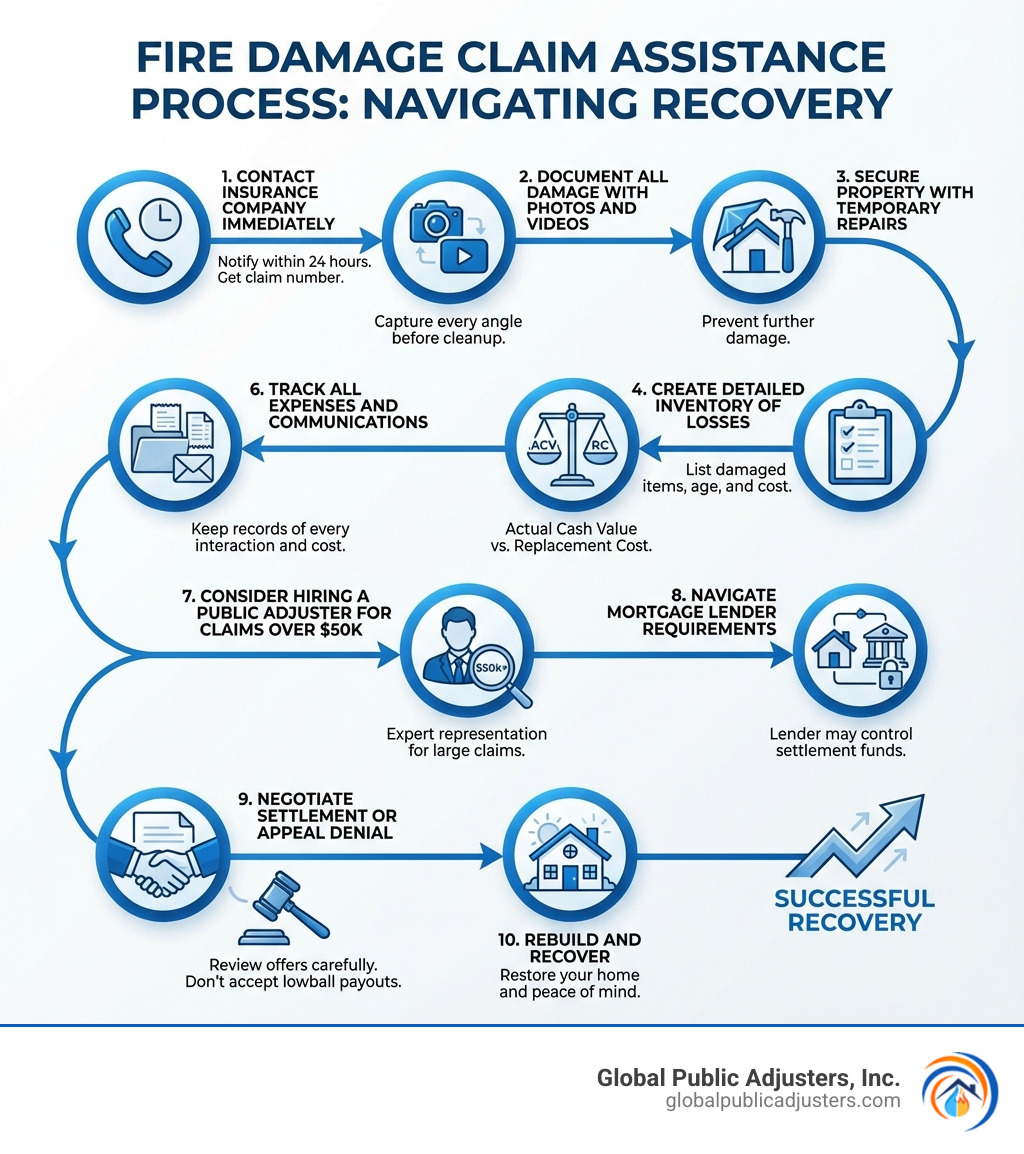
- Immediate Action: Contact your insurance company within 24 hours and document all damage with photos before cleaning up
- Professional Help: Public adjusters work exclusively for you (not the insurance company) to maximize your settlement
- Common Issues: Claims are often denied or underpaid due to policy exclusions, misrepresentation allegations, or disputes over damage extent
- Mortgage Complications: If you have a mortgage, your lender will be involved in the claim process and may hold funds in escrow
- Coverage Types: Understanding Actual Cash Value vs. Replacement Cost affects how much you’ll receive
- Minimum Claim Values: Most professional fire damage claim assistance firms only handle claims over $50,000
According to the National Fire Protection Association, over 330,000 residential fires occurred last year. These events leave property owners facing emotional trauma and the daunting task of navigating insurance claims, which can take 18 to 24 months to settle.
The stakes are high. Insurance companies secured more than $50 million in denied or underpaid claims that were later overturned—representing money that policyholders nearly lost without proper representation. One homeowner’s fire claim was initially denied due to alleged misrepresentation, but with professional assistance, they secured $465,000. Another saw their initial offer of $308,000 increased to $407,000 through expert negotiation.
The reality is stark: your insurance company has professional adjusters working to minimize their payout. You deserve the same level of expertise workingforyou.
First Steps After a Fire: Securing Your Property and Your Claim
When the flames are out, the fight for a fair insurance settlement begins. After ensuring everyone’s safety, you must secure your property and lay the groundwork for a successful claim. This initial phase is critical, as mistakes can jeopardize your entirefire damage claim assistanceprocess.
First, ensure everyone is safe. Once emergency services deem the property safe to approach, you need to act quickly but thoughtfully.
- Contact Your Insurance Company Immediately:Report the loss as soon as possible to officially start your claim. Be ready to provide your policy number, the date and cause of the loss, and a brief description of the damage.
- Mitigate Further Damage:Your policy requires you to take reasonable steps to protect your property from additional damage. This doesn’t mean starting full repairs, but preventing the situation from worsening.
- Secure the Property:This involves boarding up broken windows or doors and tarping damaged roof sections. Keep all receipts for these emergency measures, as they are typically reimbursable.
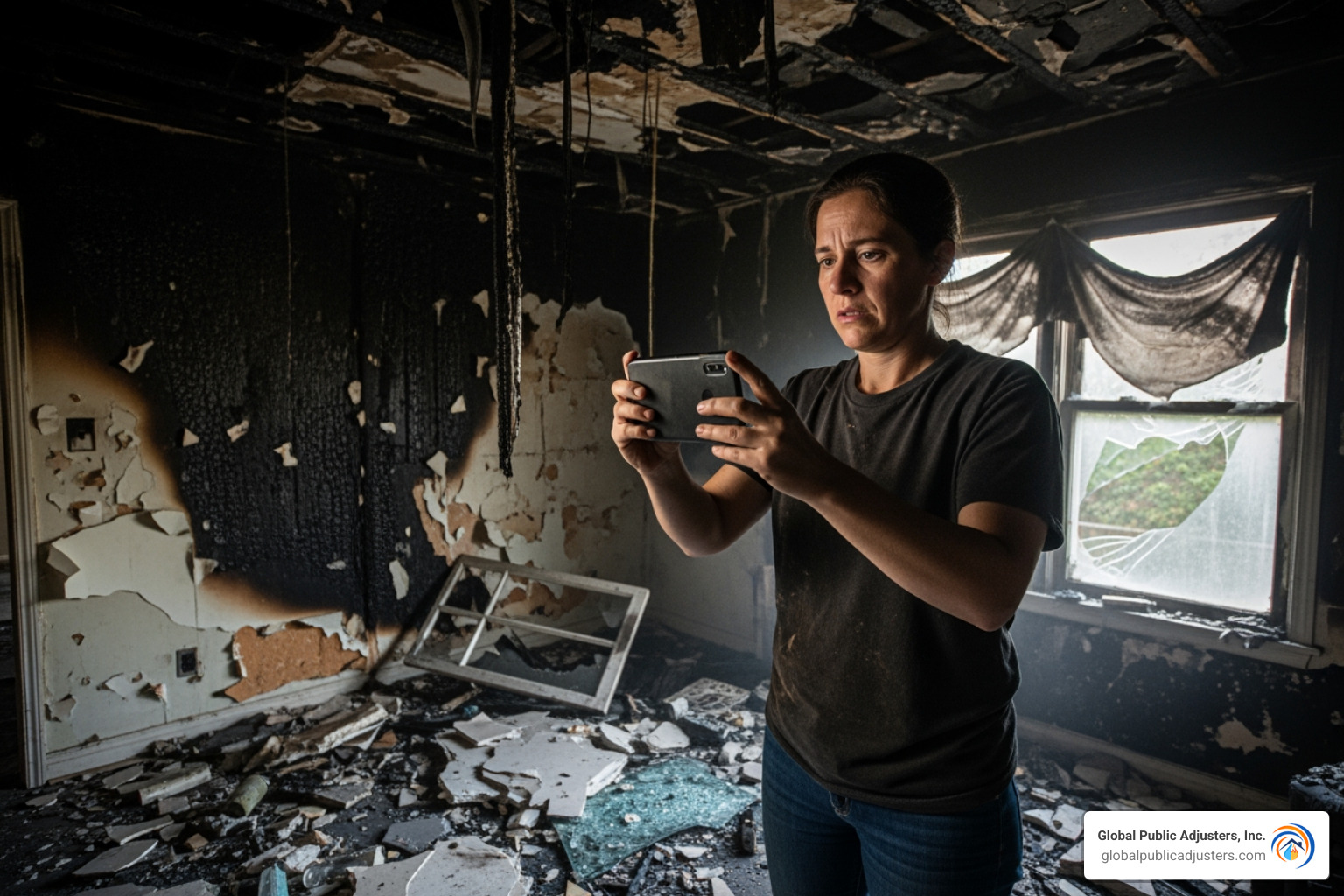
- Document Everything:This is a crucial step. Take extensive photos and videos of all damaged areas before anything is moved or cleaned. Every charred beam, smoke-stained wall, and damaged personal item needs to be recorded.
For a more detailed breakdown, explore our5 Steps to Successfully File a Fire Damage Claim with Global Public Adjusters, Inc..
Here’s a list of essential contacts you’ll want to make after a fire:
- Emergency Services (Fire Department, Police)
- Your Insurance Agent or Company Representative
- Your Mortgage Lender (if applicable)
- Utility Companies (to shut off services if needed)
- Local Disaster Relief Organizations (e.g., Red Cross)
- A trustedfire damage claim assistanceexpert, like Global Public Adjusters, Inc.
Do Not Clean Up Prematurely
We understand the natural urge to clean up and restore order, but restraint is key. As industry expert Steven Vanuga states, “Disposing of the contents before they are accurately documented and proven damaged or destroyed can cost you the claim.”
Every piece of debris and damaged item is evidence vital for proving the full extent of your loss. Compensation for lost contents often significantly contributes to the overall settlement. Without proper documentation, you risk forfeiting your claim for these items.
Instead of cleaning, create a detailed inventory. List each item, its estimated value, and a description of the damage. Photos and videos are invaluable here. Overwhelmed homeowners often miss items, but our team helps create a comprehensive inventory to ensure nothing is overlooked. For guidance, refer to our guide onHow to File a Homeowners Insurance Claim After a Fire.
Protect Your Property and Replace Documents
Protecting your property from further damage is crucial. This includes temporary repairs like boarding up windows and tarping the roof to prevent theft and weather damage. Homeowners policies generally cover additional water damage resulting from a fire. Save all receipts for these temporary repairs, as they are typically covered by your policy.
A fire can also destroy vital paperwork. Replacing important documents is a critical step in your recovery. This includes adoption decrees, birth/death/marriage certificates, driver’s licenses, immigration documents, tax records, insurance policies, mortgage papers, passports, and property deeds. FEMA provides valuable advice on Replacing your Important Papers. Keeping meticulous records of all related expenses is also important for your claim.
Navigating the Claims Process: Documentation and Valuation
Once your property is secured and documented, the claims process deepens. This phase focuses on comprehensive documentation and loss valuation. A thorough approach here can significantly impact your final settlement.

You’ll now deal with various forms and communications. Your insurer will require a “Proof of Loss” form, a sworn statement detailing your loss, which we help clients complete accurately. We also advise keeping a detailed “Claim Diary”—a log of all communications with dates, names, and summaries. This log is invaluable if disputes arise.
You’ll also need to gather contractor estimates for repairs. It’s wise to get at least one licensed contractor’s estimate to get a reasonable sense of the actual cost to rebuild or repair your home. Dealing with insurance adjusters can be a nuanced process. Our insights onUnderstanding How to Deal With an Insurance Adjuster After a House Firecan be very helpful here.
Understanding Your Payout: ACV vs. Replacement Cost
One of the most critical concepts in yourfire damage claim assistancejourney is the difference between Actual Cash Value (ACV) and Replacement Cost (RC). This distinction can mean thousands of dollars in your settlement.
| Feature | Actual Cash Value (ACV) | Replacement Cost (RC) |
|---|---|---|
| Definition | Cost to replace damaged property minus depreciation. | Cost to replace damaged property with new, similar items. |
| Payout | Lower initial payout, reflects current market value. | Higher payout, covers full cost of new items. |
| Depreciation | Deducted from the replacement cost. | Not deducted (or recovered later). |
| Benefit | Generally lower premiums. | Higher premiums, but greater financial protection. |
| Example | 10-year-old couch is paid out at its depreciated value. | 10-year-old couch is paid out at the cost of a new one. |
Actual Cash Value (ACV): This pays the amount needed to replace the item at its current market value, accounting for depreciation. For example, an ACV policy would pay what a 10-year-old refrigerator was worth right before the fire, not the cost of a new one.
Replacement Cost (RC): This pays the amount needed to replace the damaged item with one of similar kind and quality without deducting for depreciation. An RC policy would pay for a brand new refrigerator. Many policies initially pay ACV and then pay the remaining “recoverable depreciation” once you replace the item and submit proof. There are often time limits to claim this.
It’s crucial to know your policy limits and if you have adequate coverage. Many homeowners find they are underinsured, especially with rising home values and construction costs. Home insurance covers rebuilding and contents replacement, not mortgage payments or outstanding mortgage debt.
Covering Your Temporary Needs: Additional Living Expenses (ALE)
If a fire makes your home uninhabitable, Additional Living Expenses (ALE) coverage helps. ALE covers theadditionalcosts you incur from being unable to live in your home.
What ALE typically covers:
- Temporary Housing: Hotel stays, apartment rentals, or other lodging.
- Food Costs: Thedifferencebetween your normal grocery bill and the cost of eating out.
- Relocation Expenses: Moving costs, storage fees for salvaged belongings.
- Other Increased Costs: Extra transportation, pet boarding, and other necessities that exceed your normal expenses.
ALE does not pay for your mortgage or normal expenses. It aims to maintain your pre-fire standard of living. For instance, if you normally spend $500 a month on groceries and now spend $800, ALE would cover the $300 difference.
ALE policy limits are usually a percentage of your dwelling coverage or a specific dollar amount, and often have a time limit. In declared catastrophe areas, your time to collect ALE can be no less than 24 months, and can be extended up to 36 months if delays are beyond your control.
Tracking expenses is vital. Keep every receipt for hotel bills, restaurant meals, and other costs for reimbursement. Our insights intoSmoke Damage Claims Orlandooffer relevant context on how damages can lead to ALE needs.
Dealing with Insurers and Lenders: Common Problems
Even with meticulous documentation, navigating a fire’s aftermath is challenging, especially when dealing with insurers and mortgage lenders. These entities have their own interests, which don’t always align with yours, highlighting the complexity offire damage claim assistance. Insurers often try to minimize payouts, while lenders add another layer of complexity due to their financial stake in your property. These factors can lead to frustrating disputes and underpaid settlements.
Your Mortgage Lender’s Role in a Fire Claim
If you’re still making mortgage payments, your lender has a vested financial interest in rebuilding your home, protected by aStandard Mortgage Clausein your policy. This clause means that insurance claim payments for structural damage are typically made jointly to you and your mortgage lender. The lender will then often hold these funds in an escrow account, releasing them in stages as repairs are completed and verified. This process ensures their investment is protected and the property is rebuilt to a satisfactory standard.
This can sometimes create delays. If the insurance payout is less than the mortgage debt, the bank receives the payout, and you still owe the remaining balance. Conversely, if the payout exceeds the mortgage balance, the lender might hold all funds, and you would need to contact them for the difference. While rare, a lender might use the funds to discharge your mortgage, requiring you to requalify for a new loan at current rates to fund repairs.
Homeowners still owe their lender the outstanding mortgage balance, even if the dwelling is destroyed. If you rebuild, your insurance applies to the rebuild cost, and your mortgage continues. The goal is to return you to your pre-fire financial position regarding the property, but the mortgage debt remains.
Why Claims Get Denied or Underpaid
Fire claims can be denied or underpaid for many reasons, often stemming from the insurer’s interpretation of your policy or their damage assessment. Common denial reasons include:
- Misrepresentation: The insurer might allege you misrepresented facts on your application or during the claim. We helped overturn a denial based on alleged misrepresentation, securing $465,000 for a client.
- Policy Exclusions: Your policy might exclude certain types of fire (e.g., arson by the insured) or conditions (e.g., a home being vacant). We’ve seen a denied fire loss on a commercial building due to vacancy claims overturned, recovering $300,000 for the client.
- Disputing Damage Scope or Cause: The insurer might argue the damage isn’t as severe as you claim, or that some damage was pre-existing.
- Undervaluing Losses: Even if not denied, a claim can be severely underpaid. This often happens with personal property, where the insurer’s adjuster might undervalue or miss damaged goods.
- Insufficient Documentation: If you haven’t thoroughly documented your losses, the insurer has less evidence to support a higher payout.
These tactics highlight the adversarial nature of dealing with insurance companies. This is precisely why obtaining expertfire damage claim assistanceis so crucial. For more on this, consider exploringWhy Hire a Public Adjuster for Fire Damage?.
When to Seek Professional Fire Damage Claim Assistance
The aftermath of a fire is emotionally and financially draining. While some minor claims might be manageable on your own, there are clear indicators that professionalfire damage claim assistanceis not just helpful, but essential.
You should consider hiring a public adjuster when:
- Your Claim is Complex: Fire damage often involves not just burns but also extensive smoke, soot, and water damage from firefighting efforts. Assessing all these layers of damage requires specialized expertise.
- You’ve Suffered Large Losses: The larger the loss, the greater the financial stakes and the more rigorous the insurance company’s scrutiny. Our firm only assists with claims that have an estimated value greater than $50,000, underscoring that significant losses warrant professional intervention.
- Your Claim is Denied or Underpaid: If the insurance company denies your claim outright or offers a settlement that feels inadequate, it’s a major red flag.
- You Feel Overwhelmed: The sheer volume of paperwork, communication, and negotiation can be daunting. You’re dealing with trauma; you shouldn’t also have to become an insurance expert overnight.
- You Want to Maximize Your Settlement: Insurance companies have adjusters working for them. You deserve someone working exclusively for you to ensure you receive every dollar you’re entitled to.
For a deeper dive into why this professional help is indispensable, read aboutThe Essential Role of Public Adjusters in Fire Damage Recovery.
The Role of a Public Adjuster in Your Fire Damage Claim Assistance
A public adjuster is your advocate. Unlike the insurance company’s adjuster, who works for the insurer, a public adjuster works exclusively for you, the policyholder. Our role is to level the playing field.
We bring:
- Damage Assessment Expertise: We carefully inspect your property, identifying all damages—visible and hidden—including those from smoke, soot, and water. Our comprehensive evaluations ensure nothing is overlooked.
- Policy Interpretation: Insurance policies are complex legal documents. We interpret your policy’s fine print, ensuring all applicable coverages, endorsements, and provisions are used to your benefit.
- Strategic Negotiation: We prepare, present, and negotiate your claim with the insurance company. We know their tactics and how to counter them effectively. For instance, we’ve taken an initial offer of $308,000 from an insurance company and, through ongoing negotiations, increased it to $407,000 for our client. This is the kind of difference expert negotiation can make.
- Securing Fair Settlements: Our ultimate goal is to secure the maximum possible settlement, allowing you to fully rebuild your life and property. We have a track record of securing over $50 million in payouts for our clients.
The benefits of hiring a public adjuster are clear: peace of mind, expedited settlement, and significantly higher payouts. For further insights, please refer to our dedicated page on theBenefits of a Public Adjuster for Fire Damage.
Knowing Your Rights and Appealing a Decision for Fire Damage Claim Assistance
As a Florida homeowner, you have specific rights when dealing with insurers after a fire, which is a powerful tool in yourfire damage claim assistanceprocess. These include the right to a timely response, a complete copy of your policy, and the right to appeal a denial or underpayment. By law, your insurer must provide a free copy of your residential homeowner’s insurance policy, including your declarations page, within 30 days of your request.
If your claim is denied or you disagree with the settlement offer, you have the right to appeal. This process typically involves:
- Reviewing the Denial Letter: Understand the specific reasons cited by the insurer for the denial or undervaluation.
- Gathering Additional Evidence: Collect any further documentation, estimates, or expert opinions that support your position.
- Submitting a Formal Appeal: Present your case in writing to the insurance company, addressing their reasons for denial point by point.
- Seeking External Assistance: If internal appeals fail, you can seek assistance from the Florida Department of Financial Services, Division of Consumer Services, which oversees insurance consumer protection in Florida.
Understanding your rights often involves reviewing official claims guides, such as theResidential Property Claims Guide, which outlines general processes for residential property claims. While this specific guide is from California, the principles of understanding your policy, documenting losses, and knowing your appeal options are universally applicable.
When should you consider further professional assistance, beyond a public adjuster? If your claim involves complex legal issues, outright bad faith practices by the insurer, or if you’re considering litigation, consulting an attorney specializing in insurance law might be the next step.
Frequently Asked Questions about Fire Damage Claims
We understand that a fire leaves you with many questions. Here are some of the most common ones we encounter regardingfire damage claim assistance:
What happens to my mortgage if my house is destroyed by fire?
Homeowners will still owe their lender the outstanding balance on their mortgage, even if the dwelling has been destroyed by fire. Your home insurance is designed to cover the costs associated with rebuilding a home and replacing its contents, not to cover mortgage payments after a loss or an outstanding mortgage. If you choose to rebuild the home on the same site, the limit of insurance or full replacement cost applies, and any outstanding mortgage would continue to be in place. You would effectively be returned to the same financial position regarding the property as you were prior to the catastrophe.
What is the difference between an insurance company adjuster and a public adjuster?
A company adjuster works directly for the insurance company and is paid by them. Their primary role is to assess the damage on behalf of the insurer and ensure the company’s financial interests are protected. A public adjuster, on the other hand, is a licensed professional you hire to work exclusively for you, the policyholder. We carefully document your loss, interpret your policy, handle all communications, and negotiate the maximum possible settlement on your behalf, ensuring your interests are prioritized.
How are insurance claim payments made when a mortgage lender is involved?
When a mortgage lender is involved, the insurance company will typically make the claim payment for structural damage jointly in the name(s) of the insured(s) and the mortgage lender. The lender, having a financial interest in the property, will usually hold these funds in an escrow account. They will then release the money in stages as repairs are completed and verified (e.g., upon completion of certain phases of work), ensuring that the property is rebuilt and their investment is protected. Funds for contents and Additional Living Expenses (ALE) are usually sent directly to the policyholder.
Conclusion: Rebuilding Your Life After a Fire
Experiencing a fire is a traumatic event, but navigating the insurance claim shouldn’t add to your burden. The journey to recovery is long, often taking 18 to 24 months, but with the rightfire damage claim assistance, it doesn’t have to be overwhelming.
Our extensive guide has walked you through the critical steps: proactive documentation, understanding the nuances of your policy (like ACV vs. RC and ALE), the complexities of dealing with mortgage lenders, and recognizing why claims get denied or underpaid. We’ve also highlighted the invaluable role of a public adjuster in advocating for your rights and maximizing your settlement.
At Global Public Adjusters, Inc., we bring over 50 years of experience to the table, specializing in representing homeowners and business owners across Florida, including Orlando and Pensacola. Our expertise is in maximizing settlements for various damages, and we stand as your dedicated advocates against insurance companies. We believe you deserve every dollar you’re entitled to under your policy.
Don’t let the stress of a fire insurance claim weigh you down. Let us help you steer this challenging time, so you can focus on rebuilding your life.
Contact us for professional public adjuster servicesand let us help you turn the page from disaster to recovery.