
Workers Comp Adjuster Tricks in Orlando: How Insurance Companies Try to Reduce Your Claim
Quick Answer
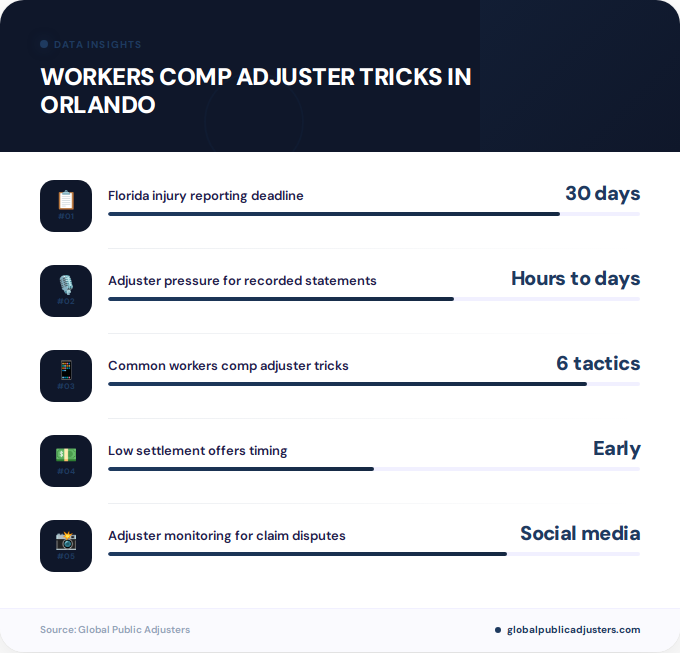
Workers comp adjuster tricks in Orlando typically involve pushing for early recorded statements, requesting broad medical authorizations, downplaying injury severity, delaying claim decisions, offering low lump-sum settlements before treatment is complete, and monitoring social media for evidence to dispute a claim. Florida law requires injury notice within 30 days, and understanding these tactics before speaking with an adjuster can protect the value of your claim.
Nearly every injured worker in Orange County who files a workers’ compensation claim eventually asks the same question: why does the insurance adjuster seem more interested in what I say than in how I’m actually feeling? Understandingworkers comp adjuster tricks in Orlandois critical because Florida’s system puts the insurance carrier, not a neutral judge, in charge of your medical care and benefits from day one. Adjusters are trained professionals whose job is to control claim costs, and that means the tactics used on a warehouse worker in the Orlando industrial corridor or a theme park employee near International Drive often look remarkably similar.
This guide breaks down the most commonly reported tactics, backed by attorney insight and Florida claims-handling rules, so you know exactly what to expect and how to respond.
What Are Workers Comp Adjuster Tricks in Orlando?
“Adjuster tricks” is the shorthand injured workers and attorneys use to describe tactics insurance companies deploy to minimize, delay, or deny valid claims. In Orlando, where tourism, hospitality, construction, and healthcare are among the largest employers, workers get hurt in warehouses off John Young Parkway, on hotel properties near the convention center, and on construction sites throughout Lake Nona and Horizon West. Regardless of industry, the tactics reported are strikingly consistent statewide.
Attorneys describe the same recurring pattern: adjusters focus on statements, documentation gaps, and timing rather than disputing the injury itself outright.One breakdown of common adjuster tacticsnotes that claim handlers are evaluated internally on how much they reduce payout exposure, which shapes nearly every interaction they have with an injured claimant.
Florida law generally requires you to report a workplace injury to your employer within30 days, according to theFlorida Division of Workers’ Compensation system guide. Missing this window, even by a few days, gives adjusters an opening to dispute the entire claim on a technicality rather than on medical merit.
Why Do Adjusters Push for Recorded Statements So Quickly?
The single most-cited tactic across attorney resources is the rush to get an injured worker on a recorded call within days, sometimes hours, of an accident. The goal isn’t to help you, it’s to lock in early statements before you fully understand your injury, your treatment plan, or how the accident actually unfolded.
Attorneys warn that speculation is the biggest danger here.One firm’s breakdown of adjuster tricksspecifically warns injured workers never to guess about how an accident happened or how serious an injury might be, because any inconsistency between that early statement and later medical findings can be used to argue the claim was exaggerated or fabricated.
“Adjusters are trained to ask open-ended questions early in the claim, before the worker has seen a doctor or understands the full scope of the injury. That’s exactly when statements are most likely to contain gaps or guesses that get used against the claim later.”
Legal guidance is nearly unanimous: don’t volunteer a recorded statement without first speaking to an attorney, and never guess at facts you’re unsure of.One legal resource on adjuster tacticsrecommends sticking strictly to known facts and declining to answer questions about topics outside the immediate scope of the injury.
How Do Adjusters Downplay Injuries and Delay Claims?
Delay is one of the oldest tactics in the claims-handling playbook. Slow callbacks, repeated requests for the same paperwork, and vague explanations about “still reviewing” a claim are all designed to wear down an injured worker financially and emotionally until they accept less than they deserve.
- Silence as pressure:Adjusters may go days or weeks without responding, hoping financial strain pushes workers toward a quick settlement.
- Repeated paperwork requests:Asking for the same forms multiple times can create the appearance of noncompliance on the worker’s part.
- Minimizing injury severity:Describing a torn rotator cuff or herniated disc as a “strain” in claim notes can influence how much treatment gets pre-approved.
- Independent medical exams (IMEs):These exams are chosen and paid for by the insurance company, and results sometimes downplay injury severity compared to a treating physician’s findings.
One overview of common adjuster tacticsnotes that delay tactics are particularly effective against workers who are already struggling to pay bills without a paycheck, which is why documenting every missed payment and every communication date matters so much.
Why Are Broad Medical Authorizations a Red Flag?
Shortly after a claim opens, many Orlando workers receive a medical authorization form to sign. Some of these forms are narrowly tailored to the injury in question. Others are written broadly enough to give the insurance company access to your entire medical history, including conditions that have nothing to do with your workplace injury.
Signing a blanket release can allow an adjuster to dig through old medical records looking for any pre-existing condition that could be used to argue your current injury isn’t work-related, or isn’t as severe as you claim. Reviewing every authorization form carefully, and pushing back on anything broader than the specific injury, is one of the simplest ways to protect a claim before it’s compromised.
How Do Low Early Settlement Offers Hurt Orlando Workers?
Perhaps the most financially damaging tactic is the early lump-sum settlement offer. These offers often arrive before a worker has finished treatment, before an impairment rating has been assigned, and before anyone truly understands the long-term impact of the injury.
Attorney analysis of adjuster settlement tacticsconsistently warns that once a settlement is signed, it typically closes out future medical care and wage-loss benefits related to that injury, even if symptoms worsen years later. A construction worker in the Orlando area who accepts a quick payout for a back injury, only to need surgery two years later, may have no recourse if the settlement already closed the claim.
Comparing an early offer against the actual projected cost of future treatment, lost wages, and permanent impairment is essential before signing anything.
Are Adjusters Really Watching Your Social Media?
Yes. It’s increasingly common for adjusters and the investigators they hire to review public social media posts, looking for photos or check-ins that contradict reported physical limitations. A photo from a family gathering at a local park, or a check-in at a gym, can be taken out of context and used to argue an injury isn’t as limiting as described.
One legal resource on adjuster tacticsrecommends setting all accounts to private and avoiding posts about physical activity, travel, or the injury itself while a claim is open.
Tactic Comparison: What to Expect and How to Respond
| Adjuster Tactic | Recommended Response |
|---|---|
| Requesting an immediate recorded statement | Politely decline until you’ve spoken with an attorney or fully understand your diagnosis |
| Sending a broad medical authorization form | Review carefully; limit scope to the specific injury only |
| Offering a quick lump-sum settlement | Wait until treatment and impairment rating are complete before considering |
| Slow responses or repeated document requests | Document every communication date and follow up in writing |
| Monitoring social media activity | Set accounts to private and avoid posting about physical activity |
How Can Orlando Workers Protect Their Claim?
Protecting a workers’ comp claim starts with treating every interaction with the adjuster as part of a formal legal process, not a casual conversation. The most consistent advice across attorney resources is to document everything: doctor visits, prescriptions, physical therapy sessions, missed workdays, and the date and content of every call from the insurance company.
Avoid guessing:never speculate
Review forms:limit authorization scope
Get impairment rating:required
Because Orlando’s economy relies heavily on hospitality, theme parks, warehousing, and construction, injury types vary widely, from repetitive strain in kitchens to falls on job sites in Lake Nona’s growth corridor. Each claim type carries different documentation needs, which is whylocal workers’ compensation legal guidance for Orlando claimantsemphasizes getting case-specific advice early rather than relying on generic assumptions about how a claim should proceed.
If you’re also dealing with property damage alongside a workplace injury, such as storm damage affecting a home-based business, resources likethis guide on denied hurricane damage claims in Floridaorthis breakdown of negotiating insurance settlementscan help you understand how insurers approach claim minimization more broadly. For a wider look at howpublic adjuster servicessupport claimants against these tactics, or to exploredifferent claim typeswhere similar adjuster behavior appears, reviewing your options before signing anything is always the safer path.
People Also Ask
Should I give a recorded statement to a workers comp adjuster?
You are generally not required to give a recorded statement without legal advice, and attorneys widely recommend declining until you’ve spoken with a lawyer. Early recorded statements can lock in details before you understand the full extent of your injury.
Why do workers comp adjusters offer quick settlements?
Quick settlements are typically offered before a worker fully understands their diagnosis or future medical needs, allowing the insurer to close the claim for less than its true long-term value. Accepting one often waives the right to future medical care tied to that injury.
What is an independent medical exam (IME) in a workers comp claim?
An IME is a medical evaluation arranged and paid for by the insurance company, not chosen by the injured worker. Results sometimes minimize injury severity compared to findings from a treating physician, which can affect benefits.
Can social media posts affect a workers comp claim?
Yes, adjusters and investigators commonly review public social media accounts looking for content that contradicts reported physical limitations. Setting accounts to private and avoiding posts about physical activity during a claim is strongly recommended.
Frequently Asked Questions
What are the most common workers comp adjuster tricks in Orlando?+
The most common tactics include pushing for early recorded statements, requesting broad medical authorizations, delaying claim decisions, downplaying injury severity, offering low early settlements, and monitoring social media. These tactics are used statewide, not just in Orlando, but Florida’s 30-day notice rule adds extra pressure on injured workers to act quickly and carefully.
How long do I have to report a workplace injury in Florida?+
Florida generally requires injury notice to your employer within 30 days of the accident, according to the state’s workers’ compensation system guide. Missing this deadline can give adjusters grounds to dispute or deny the entire claim.
Do I have to sign a medical authorization form for my workers comp claim?+
You typically must authorize release of records related to the specific injury, but you are not required to sign a blanket authorization giving access to your entire medical history. Review any form carefully before signing and consider having an attorney check it first.
Why is the adjuster delaying my workers comp claim?+
Delay is often used as a pressure tactic to wear down financially strained workers until they accept a lower settlement. Documenting every communication date and following up in writing can help create a record if the delay needs to be challenged.
Should I accept the first settlement offer from a workers comp adjuster?+
Generally no, especially if treatment isn’t complete or an impairment rating hasn’t been assigned. Early offers are often lower than the true long-term value of future medical care and lost wages.
What should I avoid saying to a workers comp adjuster?+
Avoid speculating about how the accident happened or how serious your injury is if you don’t have confirmed information. Stick to known facts and avoid volunteering extra details beyond what’s specifically asked.
Key Takeaways
- Adjusters commonly push for early recorded statements before workers understand their full diagnosis.
- Florida requires workplace injury notice within 30 days, and missing this window can jeopardize a claim.
- Broad medical authorization forms can expose more of your history than necessary; review before signing.
- Early lump-sum settlements often undervalue future medical needs and lost wages.
- Delay and repeated paperwork requests are frequently used as pressure tactics.
- Social media activity is commonly monitored and can be used to dispute reported limitations.
- Documenting every appointment, missed workday, and adjuster communication strengthens your position.
Navigating a workers’ compensation claim in Orlando without guidance leaves too much room for these tactics to reduce what you’re owed. Whether you’re facing a lowball settlement offer, a denied claim, or overwhelming paperwork demands, getting experienced advocacy on your side early can change the outcome.Reach out for a consultationor learn moreabout our team’s experiencebefore you sign anything an adjuster sends your way.
Further reading:Colorado Insurance Adjuster in Florida: Licensing, Reciprocity, and What Homeowners Need to Know
Further reading:Water Damage Insurance Adjuster in Florida: What Homeowners Must Know Before Filing a Claim
Further reading:How to Negotiate Insurance Settlement in Jacksonville: A 2026 Homeowner’s Guide