How Do I Become an Insurance Adjuster in Florida in Orlando: Complete 2026 Licensing Guide
Quick Answer
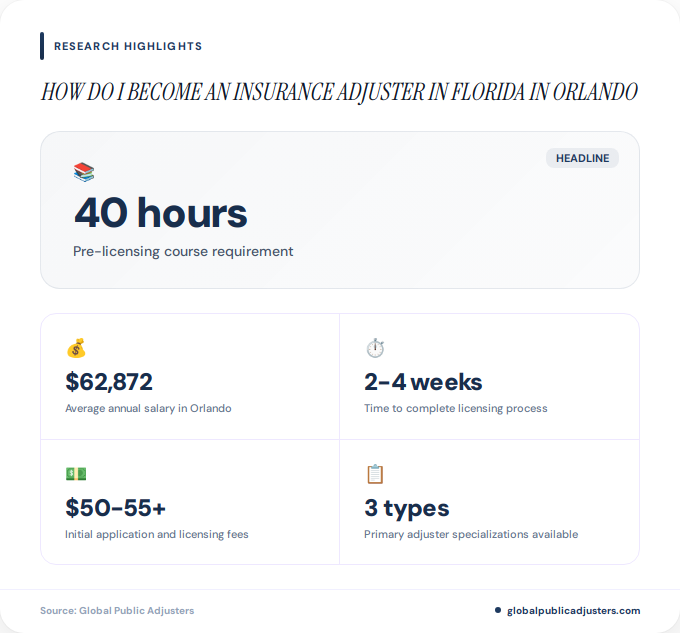
To become an insurance adjuster in Florida, including Orlando, you must complete a 40-hour pre-licensing course, pass the state exam (or obtain a designation that waives the exam), submit fingerprints for a background check, and apply for either a Florida 6-20 All-Lines Adjuster license (residents) or a 70-20 Designated Home State license (non-residents from states without adjuster licensing). The process takes approximately 2 to 4 weeks, with an initial application fee of$50plus$5per line of authority.
Are you considering a career as an insurance adjuster in the thriving Orlando market? Here’s a striking fact: claims adjusters inOrlando earn an average annual salary of $62,872, making it the highest-paying city in Florida for this profession, significantly outpacing the state average of $56,797. With the region’s unique climate challenges, including hurricanes, tropical storms, and frequent water damage claims, Orlando offers exceptional opportunities for licensed adjusters who want to build a rewarding career helping property owners navigate complex insurance claims.
Understanding how to become an insurance adjuster in Florida in Orlando requires navigating specific state licensing requirements, choosing the correct license type, and completing mandatory education. Whether you’re a Florida resident looking to start a new career or an out-of-state professional seeking reciprocity, this comprehensive guide provides the exact roadmap you need to obtain your Florida adjuster license and start working in one of the nation’s most dynamic insurance markets.
The insurance adjusting profession offers flexibility, competitive compensation, and the satisfaction of helping people during their most difficult times. From handlingproperty insurance claims in Orlandoto specializing in catastrophic losses, the career paths are diverse and financially rewarding.
What Is an Insurance Adjuster and Why Choose Orlando?
An insurance adjuster is a licensed professional who investigates, evaluates, and settles insurance claims on behalf of insurance companies, policyholders, or independently. In Orlando, adjusters play a critical role in assessing damage from hurricanes, hail storms, water intrusion, and fire losses that are common throughout Central Florida’s subtropical climate.
Orlando’s robust insurance market creates consistent demand for qualified adjusters. The city’s rapid population growth, expanding residential developments in neighborhoods like Lake Nona, Winter Park, and Dr. Phillips, plus a thriving commercial sector including theme park properties, creates a steady stream of claims that require professional assessment.
The profession offers three primary specializations:staff adjusters(employed directly by insurance carriers),independent adjusters(contractors working for adjusting firms during high-volume periods), andpublic adjusters(advocates who represent policyholders directly). Each path requires the same foundational Florida license but offers different work environments and compensation structures ranging from$45,000 to $85,000+annually depending on experience, specialization, and whether you handle catastrophic claims.
What License Types Are Available in Florida?
Florida offers several adjuster license types, and selecting the correct one immediately is crucial for your career trajectory. TheFlorida Department of Financial Services regulates all adjuster licensingand maintains strict requirements for each category.
Florida 6-20 All-Lines Adjuster Licenseis designed for Florida residents who want to adjust claims as independent or company adjusters. This license allows you to handle all types of property and casualty claims, from residential homeowners policies to commercial property losses. The 6-20 designation is your gateway to working throughout Florida’s insurance market.
Florida 70-20 Designated Home State Licenseapplies to non-residents from states that do not license adjusters (such as Colorado or other non-licensing jurisdictions). If your home state does license adjusters, you must obtain your home state license first and then apply for Florida reciprocity rather than the 70-20 designation.
| License Type | Who Qualifies | Scope |
|---|---|---|
| 6-20 All-Lines Adjuster | Florida residents | All property/casualty claims |
| 70-20 Designated Home State | Non-residents from non-licensing states | All property/casualty claims |
| Public Adjuster License | Residents representing policyholders | Requires $50,000 surety bond |
Public Adjuster Licenserequires additional steps including filing a$50,000 surety bondand represents policyholders exclusively rather than insurance carriers. If you’re interested in this advocacy role, similar tobecoming a public insurance adjuster in Miami, you’ll need to complete the same foundational requirements plus the bonding process.
How Do I Get My Florida Adjuster License: Step-by-Step Process
The path to becoming a licensed insurance adjuster in Florida follows a structured five-step process that typically takes2 to 4 weeksto complete, depending on how quickly you finish the coursework and schedule your exam.
Step 1: Complete the 40-Hour Pre-Licensing Course. You must enroll in and complete a Florida-approved pre-licensing education course.Approved training centers offer both online and in-person optionsthat cover policy provisions, claim handling procedures, ethics, and Florida insurance law. The course costs typically range from$200 to $500depending on the provider and format.
Step 2: Pass the State Exam or Obtain a Waiver Designation. After completing your coursework, you have two options: take the state licensing exam through Pearson VUE, or obtain a professional designation that waives the exam requirement. Designations likeCertified All-Lines Adjuster (CALA)orProfessional Claims Adjuster (PCA)are earned through certain pre-licensing courses and eliminate the need for a separate exam.
Step 3: Submit Fingerprints for Background Check. Florida requires all adjuster license applicants to undergo criminal background screening. You’ll submit electronic fingerprints through an approved vendor, which costs approximately$40 to $75. The background check typically processes within 3 to 5 business days.
Step 4: Complete Your License Application. Submit your application through theNational Insurance Producer Registry (NIPR)or directly through the Florida Department of Financial Services. The initial application fee is$50plus$5per line of authority you’re requesting.
Step 5: Receive Your License and Start Working. Once approved, your license is typically issued within 3 to 7 business days. You can immediately begin working as an adjuster in Orlando and throughout Florida, handling claims for residential, commercial, and specialty properties.
What Does the 40-Hour Pre-Licensing Course Cover?
The Florida-mandated 40-hour pre-licensing course provides comprehensive training across all essential competencies you’ll need as a practicing adjuster.Online training programs offer flexible schedulingwhile maintaining the rigorous curriculum standards required by the state.
Course curriculum includesinsurance policy fundamentals, covering homeowners policies (HO-3, HO-5, HO-6), commercial property policies, dwelling policies, and specialty coverages. You’ll learn to interpret policy language, identify coverage triggers, and determine what is and isn’t covered under various policy forms common in Florida’s market.
Claim investigation techniquesform a substantial portion of the coursework. You’ll study proper documentation methods, interview techniques, evidence preservation, fraud detection, and how to compile comprehensive claim files that withstand scrutiny. Given Orlando’s frequent weather-related claims, the course emphasizes hurricane, wind, hail, and water damage assessment methodologies.
The course also coversFlorida insurance laws and regulations, including Chapter 626 of the Florida Statutes governing adjuster conduct, licensing requirements, prohibited practices, and disciplinary procedures. Understanding these legal boundaries is critical, as violations can result in license suspension or revocation.
Ethics and professional conductreceive particular emphasis, with5 hoursdedicated specifically to law and ethics topics. This foundation establishes the professional standards you must maintain throughout your career, including conflicts of interest, confidentiality obligations, and fair dealing with all parties.
How Do I Pass the Florida Adjuster Exam?
If you choose to take the state licensing exam rather than earning a waiver designation, preparation is key to success. The Florida adjuster exam consists of150 multiple-choice questionscovering all topics from your pre-licensing course, and you’ll have3.5 hoursto complete it.
The exam is administered through Pearson VUE testing centers, including locations in Orlando. You must score at least70%(105 correct answers) to pass. Approximately 40% of questions focus on policy provisions and coverages, 30% on claim handling procedures, 20% on Florida laws and regulations, and 10% on ethics and professional conduct.
Effective exam preparation strategies include reviewing all course materials thoroughly, taking practice exams offered by your training provider, and focusing extra attention on Florida-specific statutes and regulations. Many candidates find success by studying1 to 2 hours dailyfor 7 to 10 days leading up to their scheduled exam.
If you don’t pass on your first attempt, you may retake the exam after waiting30 days. However, most candidates who complete their coursework diligently and dedicate adequate study time pass on their first attempt. The exam fee is$65, which is paid directly to Pearson VUE when you schedule your appointment.
What Are the Costs and Fees to Become Licensed?
Understanding the complete financial investment required to become an insurance adjuster in Florida helps you plan your career transition effectively. Total costs to obtain your license typically range from$400 to $850, depending on which course provider you select and whether you need to retake any exams.
Here’s a comprehensive breakdown of typical expenses:
Varies by provider and format (online vs. in-person)
Often includes study materials
Paid directly to Pearson VUE
Waived if you earn CALA or PCA designation
Electronic submission through approved vendor
Required for all applicants
Typically totals $55 for all-lines authority
Non-refundable processing fee
Annual premium: $300 to $800
Required only for public adjusters
Keep in mind that pricing varies based on your specific situation, educational provider, and whether you pursue additional professional designations. Many training centers offer package deals that bundle coursework, exam preparation materials, and study guides for comprehensive preparation at a slightly discounted rate compared to purchasing components separately.
Beyond initial licensing, budget for professional expenses including continuing education (discussed below), errors and omissions insurance if you work independently (typically$800 to $2,500annually), estimating software subscriptions like Xactimate (approximately$75 to $200monthly), and general business expenses if you establish your own adjusting practice.
Why Are Orlando Adjusters Earning More Than State Averages?
Orlando stands out as Florida’s highest-paying market for insurance adjusters, with the average annual salary reaching$62,872, compared to the state average of$56,797. Several factors contribute to this premium compensation in the Central Florida region.
High claim volume and complexitydrive demand in Orlando. The metro area’s population exceeds 2.6 million residents across Orange, Seminole, Osceola, and Lake counties, generating substantial residential claims. Add the region’s extensive commercial properties, including major theme parks, hospitality facilities, and retail complexes, and the diversity of claims requiring expert adjustment creates consistent work opportunities.
Orlando’sweather patterns and climate risksnecessitate specialized expertise. Central Florida experiences an average of230 days of sunshine annuallybut also faces hurricane season from June through November, frequent afternoon thunderstorms producing hail and lightning damage, and high humidity that contributes to mold and water intrusion issues. Adjusters who develop expertise in these specific loss types command premium rates.
Thecompetitive insurance marketin Orlando includes major carriers, regional insurers, and numerous independent adjusting firms all competing for qualified professionals. This competition for talent drives salaries upward, particularly for experienced adjusters with strong technical skills and customer service abilities. Neighborhoods experiencing rapid development, such as Lake Nona’s Medical City and the Creative Village downtown, generate new construction and renovation claims that require thorough assessment.
For context,Fort Lauderdaleranks second in Florida adjuster compensation at $61,445, followed byMaitland(a suburb just north of Orlando) at $58,174. This geographic premium reflects the concentration of high-value properties and complex commercial claims in Central Florida’s urban corridor.
What Continuing Education Requirements Must I Meet?
Maintaining your Florida adjuster license requires ongoing professional education. License holders must complete24 hours of continuing education every 2 years, with specific content requirements designed to keep adjusters current on evolving laws, technologies, and best practices.
Of the 24 total hours,5 hours must specifically cover law and ethicstopics. These courses update you on changes to Florida insurance statutes, regulatory interpretations, case law affecting claim handling, and emerging ethical considerations in the profession. The remaining 19 hours can cover technical topics including advanced policy interpretation, specific loss types (wind, water, fire), estimating software training, fraud detection, and customer service excellence.
Approved continuing education providers offer flexible online and classroom optionsthat fit working adjusters’ schedules. Most courses are available in 3-hour, 5-hour, or full-day formats, allowing you to accumulate credits gradually throughout your two-year license period.
Your license renewal deadline is based on your birth month, creating a predictable schedule. For example, if you were born in May, your license expires on May 31 of your renewal year. You must complete all continuing education requirements and submit your renewal application (with the$50 renewal fee) at least 30 days before expiration to avoid late penalties.
Failure to complete continuing education on time results in license suspension. You have up to3 monthsafter expiration to complete delinquent education and reinstate your license with late fees. After 3 months, your license becomes null and void, requiring you to restart the entire licensing process from scratch.
What Career Paths Are Available After Licensing?
Obtaining your Florida adjuster license opens multiple career trajectories, each offering distinct advantages in compensation, work-life balance, and professional development opportunities. Understanding these paths helps you align your licensing goals with long-term career objectives.
Staff Adjuster positionswith insurance carriers provide stability, benefits, and structured career advancement. Major carriers operating in Orlando (State Farm, Progressive, GEICO, Allstate, and regional companies) employ staff adjusters to handle their policyholders’ claims directly. Compensation for entry-level staff positions typically starts at$45,000 to $55,000annually, with experienced adjusters earning$65,000 to $85,000+depending on specialization and performance.
Independent Adjuster contractsoffer flexibility and higher earning potential during catastrophic events. Independent adjusters work as contractors through adjusting firms, deployed to handle surges in claim volume after hurricanes, hailstorms, or other widespread events. Daily rates for independent adjusters range from$400 to $800+during catastrophe deployments, though work can be sporadic between events.
Public Adjuster practicesrepresent policyholders exclusively, advocating for maximum claim settlements. Public adjusters typically charge fees ranging from10% to 20%of the final settlement amount, creating significant income potential on large commercial or high-value residential claims. However, this path requires the additional$50,000 surety bondand involves more business development responsibilities.
Specialization opportunities abound within each career path. Many Orlando adjusters develop expertise in specific loss types such ascatastrophic hurricane damage,water intrusion and mold claims,commercial property losses, orspecialty items like fine art and collections. Technical proficiency with estimating software, particularlyXactimate, has become essential across all adjuster roles and significantly impacts employability and earning potential.
Career advancement may lead to senior adjuster roles, claim supervisor or manager positions, underwriting positions leveraging your field experience, or establishing your own independent adjusting firm or public adjusting practice. Many successful adjusters in Orlando work collaboratively with professionals at firms likeGlobal Public Adjusters, learning industry best practices and building their professional networks.
People Also Ask
Do I need to be a Florida resident to get an adjuster license?
No, but non-residents must choose the correct license type. If your home state licenses adjusters, obtain your home state license first and apply for Florida reciprocity. If your home state does not license adjusters, apply for the Florida 70-20 Designated Home State license instead.
How long does it take to become licensed in Florida?
The entire process typically takes 2 to 4 weeks. The 40-hour pre-licensing course can be completed in 1 week with focused effort, the exam can be scheduled within days, background checks process in 3 to 5 business days, and license approval takes 3 to 7 business days after application submission.
Can I work remotely as an insurance adjuster in Orlando?
Some aspects of adjusting work can be performed remotely, including file review, documentation, and estimates. However, the core function requires physical property inspections throughout the Orlando metro area. Many independent adjusters enjoy flexible schedules but must travel to claim sites for inspections.
What is the difference between a public adjuster and a company adjuster?
Company adjusters represent insurance carriers and work to settle claims fairly while protecting the insurer’s interests. Public adjusters represent policyholders exclusively, advocating for maximum settlements and charging fees based on recovery amounts. Both require the same foundational license, but public adjusters need an additional $50,000 surety bond.
Does Florida have reciprocity with other states?
Yes, Florida maintains reciprocity with all states except New York, California, and Hawaii. This means once you hold a Florida license, you can more easily obtain licenses in most other states without repeating pre-licensing education or exams.
What software skills do Orlando adjusters need?
Xactimate proficiency is virtually mandatory in the Orlando market, as most carriers and adjusting firms require it for standardized estimating. Additional valuable skills include Microsoft Office suite, mobile field apps, and claim management software specific to your employer or clients.
Frequently Asked Questions
What happens if I fail the Florida adjuster exam?+
If you don’t pass the exam on your first attempt, you must wait 30 days before retaking it. You’ll need to pay the $65 exam fee again when scheduling your retake appointment. Review weak areas identified in your exam results and dedicate additional study time to those topics before attempting again.
Can I start adjusting claims immediately after passing the exam?+
No, you must wait for your license to be officially issued by the Florida Department of Financial Services after completing your application, background check, and payment of all fees. This typically takes 3 to 7 business days after submitting your complete application, though you can begin applying for positions during this waiting period.
Do I need errors and omissions insurance to work as an adjuster?+
While not legally required for company adjusters (covered by their employer’s policy), independent and public adjusters typically need their own E&O insurance. Most adjusting firms and clients require proof of coverage before contracting your services, with minimum coverage amounts typically ranging from $500,000 to $1 million.
What types of claims are most common in Orlando?+
Orlando adjusters most frequently handle wind and hurricane damage claims, water intrusion and leak claims, mold remediation claims, hail damage (particularly to roofs and vehicles), fire and lightning damage, and theft or vandalism claims. Understanding Central Florida’s specific weather patterns and construction methods is essential for accurate assessment.
How often do adjusters get deployed for catastrophic events?+
Deployment frequency varies significantly by year and hurricane activity. In active hurricane seasons, independent adjusters may be deployed 2 to 4 times for periods lasting 2 to 6 weeks each. In quiet years, deployments may be rare. Staff adjusters typically work their local territory year-round with occasional short deployments during major events.
Can I maintain my license while working another job?+
Yes, many adjusters maintain their licenses while working other positions, either as a side business or to remain qualified for catastrophic deployments. You must complete continuing education requirements and pay renewal fees regardless of how actively you’re adjusting claims. This flexibility makes adjusting attractive for those seeking supplemental income opportunities.
What are the job prospects for new adjusters in Orlando?+
Orlando’s growing population and construction activity create strong demand for qualified adjusters. Entry-level positions are regularly available with major carriers and large adjusting firms. Building Xactimate proficiency, developing strong communication skills, and demonstrating reliability significantly improve hiring prospects for new licensees entering the field.
Key Takeaways
- Orlando offers premium compensationfor insurance adjusters at $62,872 annually, significantly exceeding Florida’s state average and making it the highest-paying city in the state for this profession.
- Choose the correct license type immediately:Florida residents need the 6-20 All-Lines license, while non-residents from states without adjuster licensing need the 70-20 Designated Home State license.
- Total licensing costs range from $400 to $850, including pre-licensing education ($200 to $500), exam fees ($65), fingerprinting ($40 to $75), and application fees ($55 for all-lines authority).
- Complete 24 hours of continuing education every 2 years, including 5 mandatory hours specifically covering law and ethics topics, to maintain your active license status.
- Multiple career paths existincluding staff positions with carriers ($45,000 to $85,000+), independent contracting ($400 to $800+ daily rates during deployments), and public adjusting (10% to 20% fees on settlements).
- Xactimate proficiency is essentialfor competitiveness in the Orlando market, as virtually all carriers and adjusting firms require this standardized estimating software for claim documentation.
- Florida maintains reciprocity with most states(except New York, California, and Hawaii), allowing licensed adjusters to expand their practice across state lines relatively easily.
Conclusion
Becoming an insurance adjuster in Florida, specifically in the thriving Orlando market, offers a rewarding career path with exceptional earning potential, professional flexibility, and the satisfaction of helping property owners during challenging times. With clear licensing requirements, structured education pathways, and strong demand for qualified professionals, now is an excellent time to pursue this career.
The process is straightforward: complete your 40-hour pre-licensing course, pass your exam or earn a waiver designation, submit your background check, and apply for the appropriate license type for your residency status. Within weeks, you can begin a career in one of Florida’s most dynamic insurance markets, handling diverse claims ranging from routine property damage to complex catastrophic losses.
Whether you’re drawn to the stability of staff adjuster positions, the flexibility of independent contracting, or the advocacy role of public adjusting, your Florida license opens doors throughout the insurance industry. Orlando’s combination of high claim volume, complex commercial properties, and weather-related exposures creates consistent opportunities for skilled adjusters who deliver thorough, professional service.
Related:Public Adjuster Illinois in Florida: What You Need to Know Before Hiring Across State Lines
Related:Public Insurance Adjusters in Orlando: Your 2026 Guide to Maximizing Property Insurance Claims
Related:Fire Damage Adjuster in Jacksonville: Your 2026 Guide to Maximizing Fire Claims
Related:Colorado Public Insurance Adjuster in Orlando: What Homeowners Need to Know Before Hiring
Ready to start your journey toward becoming a licensed insurance adjuster in Orlando? Complete your pre-licensing education today and take the first step toward a fulfilling career in the insurance industry. For additional guidance oninsurance claim services and professional support, connect with experienced professionals who can help you navigate your new career path successfully.
Further reading:Can You Negotiate an Insurance Settlement in Orlando? A Complete Guide