Florida Public Adjusters License in Orlando: Complete 2026 Licensing Guide
Quick Answer
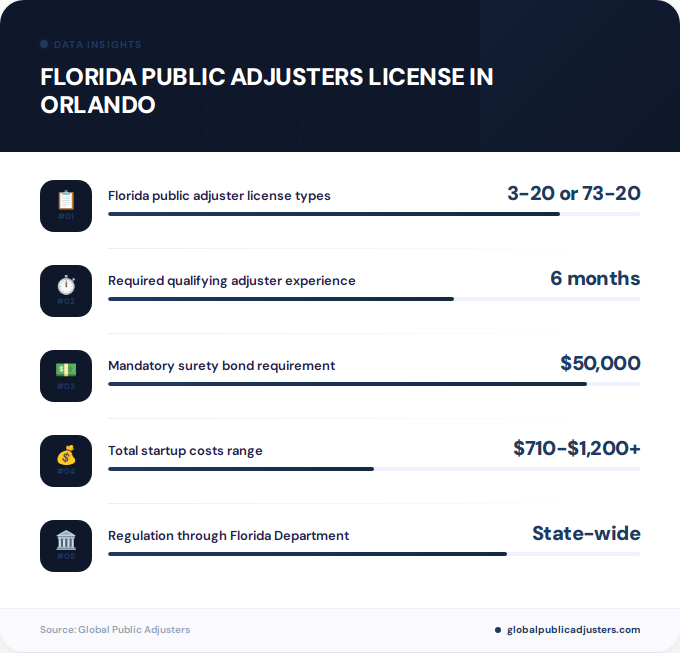
To become a licensed public adjuster in Orlando, Florida, you need a Florida 3-20 public adjuster license (residents) or 73-20 license (non-residents), along with 6 months of qualifying adjuster experience, a $50,000 surety bond, and total startup costs ranging from $710 to $1,200+ depending on exam prep, fingerprinting, and bond provider. Orlando does not issue separate city licenses, all regulation is statewide through the Florida Department of Financial Services.
If you’re considering a career as apublic adjusterin Central Florida, understanding the licensing process is your first critical step. Orlando sits at the heart of a region that experiences some of the nation’s highest rates of property insurance claims, from hurricane damage to water intrusion and roof failures. With Florida’s complex regulatory environment and strict licensing standards, aspiring adjusters need authoritative, up-to-date guidance.
This comprehensive guide breaks down everything you need to know about obtaining aflorida public adjusters license in Orlando, from initial requirements and costs to market opportunities and ongoing compliance. Whether you’re a Florida resident or looking to practice in Orlando from another state, you’ll find the exact roadmap you need to launch or expand your public adjusting career in 2026 and beyond.
What Is a Florida Public Adjuster License?
A Florida public adjuster license is a state-issued credential that authorizes an individual to represent policyholders in insurance claim negotiations. Unlike company adjusters who work for insurance carriers,public adjusters advocate exclusively for the insured, helping property owners document losses, prepare claim submissions, and maximize their settlement outcomes.
TheFlorida Department of Financial Services regulates all adjuster licensing, establishing uniform standards across the state. There is no separate municipal license for Orlando or Orange County. Instead, all public adjusters practicing in Orlando must hold a valid state license issued by Florida’s Division of Agent and Agency Services.
Public adjusters provide essential services in markets like Orlando, where property insurance disputes frequently arise from storm damage, flood claims, and coverage interpretation issues. Their expertise becomes especially valuable when dealing with complex commercial claims or large residential losses that require detailed documentation and professional negotiation.
Who Needs a Public Adjuster License in Orlando?
Anyone who charges a fee or receives compensation for investigating, negotiating, or settling insurance claims on behalf of policyholders in Orlando must hold a validflorida public adjusters license. This includes individuals operating as sole proprietors, employees ofpublic adjusting firms in Florida, and independent contractors working on a commission or fee basis.
The licensing requirement applies whether you maintain a physical office in Orlando or service the area from another Florida location. Even adjusters who primarily work remotely must comply with state licensing standards if they handle claims involving properties located in Florida.
Exemptions are extremely limited. Attorneys licensed to practice law in Florida may negotiate claims as part of their legal representation without a separate adjuster license. However, most professionals engaging in claims adjustment services require proper state licensure regardless of their business structure or fee arrangement.
What Are the Different License Types in Florida?
Florida issues two primary types of public adjuster licenses based on residency status. Understanding which category applies to your situation determines your specific licensing pathway and requirements.
| License Type | Code | Who Qualifies |
|---|---|---|
| Resident Public Adjuster | 3-20 | Florida residents with 6 months Florida adjuster experience |
| Non-Resident Public Adjuster | 73-20 | Out-of-state residents with qualifying home-state experience |
The3-20 resident licenserequires that you establish Florida residency and maintain a principal place of business within the state. This is the most common pathway for professionals planning to build a long-term practice in Orlando and surrounding Central Florida communities.
The73-20 non-resident licenseallows adjusters licensed in other states to practice in Florida without relocating, provided they meet reciprocity requirements.Non-resident applicants must hold an active public adjuster license in their home stateand complete equivalent experience requirements before Florida will grant reciprocal authority.
Important to note: Florida eliminated the public adjuster apprentice license category onJanuary 1, 2018. All new licensees must now meet the full experience requirements before applying, with no intermediate apprentice pathway available.
What Are the Requirements for a Florida Public Adjuster License?
Florida maintains rigorous standards for public adjuster licensure, ensuring that only qualified professionals represent policyholders in claims negotiations. Meeting these requirements demonstrates both competence and ethical fitness to practice.
Basic Eligibility Criteria
All applicants for aflorida public adjusters license in Orlandomust meet several fundamental eligibility requirements. You must be at least18 years oldand possess U.S. citizenship or valid work authorization. Florida conducts thorough background checks, and certain criminal convictions may disqualify candidates or require additional review.
Fingerprinting is mandatory for all first-time applicants. The state uses these fingerprints for both state and federal background screening through the Florida Department of Law Enforcement (FDLE) and the FBI.
Experience Requirements
Perhaps the most significant barrier to entry is Florida’s experience mandate. Resident applicants must complete6 months of qualifying employmentas an all-lines adjuster or company adjuster within Florida. This experience must be verified by a licensed employer and documented on your application.
Non-resident applicants face similar requirements but may satisfy them through6 months of qualifying adjuster experiencein their home state, provided that state has licensing reciprocity with Florida. The experience must be recent and verifiable through official employment records.
Educational and Examination Requirements
Florida does not currently require a pre-licensing course specifically for public adjusters, thoughcontinuing education courses for Florida law and ethics updatesare mandatory once licensed. However, you must pass the state-administered public adjuster examination.
The exam tests knowledge of insurance principles, Florida statutes and regulations, claims documentation, ethics, and public adjuster-specific practices. Many candidates invest inexam preparation courses through providers like WebCEto improve their pass rates and study efficiency.
Surety Bond Requirement
Before receiving your license, you must secure a$50,000 surety bondissued by a company authorized to do business in Florida. This bond protects consumers against potential misconduct, fraud, or failure to comply with licensing laws. The bond must remain active throughout your licensure period.
Bond premiums vary based on your credit history and the bonding company you select, but typically range from $250 to $750 annually for most applicants with good credit.
How Much Does It Cost to Get Licensed in Orlando?
The total investment required to obtain your Florida public adjuster license involves multiple components, and costs can vary significantly based on individual circumstances and vendor selection. Understanding the full financial picture helps you budget appropriately for your licensing journey.
Breakdown of Licensing Costs
| Cost Component | Typical Range | Notes |
|---|---|---|
| State Application Fee | $50 | Non-refundable |
| Line of Authority Fee | $5 | Per line |
| Exam Fee | $50 to $100 | Per attempt |
| Fingerprinting/Background | $60 to $100 | FDLE and FBI screening |
| Surety Bond Premium | $250 to $750 | Annual; varies by credit |
| Exam Prep Materials | $100 to $400 | Optional but recommended |
Remember that Florida application fees arenon-refundable, so ensure you meet all eligibility requirements before submitting your application and payment. If you fail the examination, you’ll need to pay additional exam fees for each retake attempt.
Some applicants also invest in professional licensing assistance services or legal review of their applications, particularly if they have complex background issues or previous licensing problems in other states. These services can add several hundred dollars to your total costs but may be worthwhile for complicated situations.
What Are the Steps to Obtain Your Florida Public Adjuster License?
Navigating the licensing process efficiently requires understanding the proper sequence of steps and preparing all necessary documentation in advance. Here’s the authoritative roadmap to securing yourflorida public adjusters license in Orlando.
Step 1: Gain Qualifying Experience
Before you can apply, you must complete your6 months of verifiable adjuster experience. For Florida residents, this means working under a licensed all-lines or company adjuster within the state. Keep detailed records of your employment, including dates, duties performed, and supervisor contact information.
Non-residents should ensure their home state experience is properly documented and that their state maintains reciprocity with Florida. Contact theFlorida Office of Insurance Regulationif you have questions about whether your out-of-state experience qualifies.
Step 2: Complete Fingerprinting and Background Check
Schedule your fingerprinting appointment through an approved vendor. The state requires electronic fingerprinting, and results are typically available within a few days to two weeks. Address any background issues proactively, as certain offenses may require additional disclosure or explanation.
Step 3: Secure Your Surety Bond
Shop for competitive bond rates from multiple surety companies authorized to do business in Florida. You’ll need proof of the bond in place before your license can be issued, so handle this step early in the process. The bond must specifically meet Florida’s statutory requirements for public adjusters.
Step 4: Register for and Pass the State Exam
Register for your examination through the state’s testing vendor. Schedule your exam at a convenient testing center in or near Orlando. Many candidates find that scheduling within 2-4 weeks of intensive study produces the best results.
The exam covers Florida-specific insurance laws, public adjuster regulations, claims procedures, and ethical standards. Invest time in understandingFlorida Statute 626.8732 and related adjuster regulations, as these form a significant portion of the examination content.
Step 5: Submit Your License Application
Once you’ve passed the exam, submit your complete application through the state’s online portal or by mail. Include all required documentation: proof of experience, bond certification, exam results, and application fees. Incomplete applications create significant delays, so verify that every component is included before submission.
Step 6: Await Processing and License Issuance
Processing times vary but typically range from 2 to 6 weeks for complete applications with no background complications. The state will notify you of any deficiencies that require correction. Once approved, your license will be issued electronically and you can begin practicing immediately.
Why Is Orlando a Major Market for Public Adjusters?
Orlando represents one of Florida’s most dynamic markets for public adjusting services, driven by unique geographic, demographic, and economic factors that create sustained demand for professional claims advocacy.
Central Florida’s climate patterns expose Orlando properties to recurring risks fromhurricanes, tropical storms, severe thunderstorms, and water damage events. The region sits in a particularly vulnerable zone for Atlantic hurricane systems, and summer storm seasons bring frequent wind, hail, and lightning damage to both residential and commercial structures.
The metropolitan Orlando area encompasses diverse property types, from single-family homes in neighborhoods like Lake Nona, Winter Park, and Dr. Phillips to extensive commercial developments, tourist properties, and multi-family complexes. This diversity creates varied claim scenarios requiring specialized expertise inpublic adjuster cost considerationsand service delivery.
Property Insurance Challenges in Central Florida
Orlando property owners face several unique insurance challenges that drive demand for public adjuster services. Florida’s insurance market has experienced significant carrier withdrawals, policy non-renewals, and coverage restrictions in recent years. These market disruptions create confusion about policy terms and increase the likelihood of claim disputes.
Roof damage claims are particularly common in Orlando due to the combination of intense UV exposure, thermal cycling, high winds, and severe weather. Many homeowners discover coverage limitations or depreciation disputes only after filing a claim, making professional representation valuable.
Water damage represents another major claim category, arising from plumbing failures, AC condensation issues, storm-driven water intrusion, and Florida’s high humidity environment. These claims often involve complex causation questions and coverage interpretation that benefits from expert adjuster involvement.
What Continuing Education Is Required in Florida?
Maintaining your Florida public adjuster license requires ongoing education to stay current with regulatory changes, industry developments, and ethical standards. The state imposes specific continuing education (CE) requirements that every licensee must fulfill on a regular cycle.
Florida requires public adjusters to complete24 hours of continuing education every two years, with at least 3 of those hours dedicated to ethics and 2 hours covering Florida laws and regulations. The remaining hours can come from approved courses on claims handling, insurance principles, or other relevant topics.
Quality CE providers offer courses specifically tailored to Florida public adjusters, includingUniversity of Central Florida Extension continuing education programsand specialized insurance education companies. Many adjusters in Orlando prefer online courses for their flexibility, though in-person seminars provide valuable networking opportunities.
Track your CE credits carefully and complete them well before your license renewal deadline. The state does not grant automatic extensions, and practicing on an expired license due to CE non-compliance carries serious penalties including fines and potential license suspension.
What Business Requirements Apply in Orlando?
Beyond individual licensing, operating a public adjusting practice in Orlando involves several business-level compliance requirements. Understanding these obligations prevents costly violations and ensures your practice operates on solid legal footing.
Adjusting Firm Registration
If you operate a business entity (LLC, corporation, partnership) or employ other adjusters, you must register youradjusting firmwith the state. This applies even to solo practitioners operating through a business entity rather than as sole proprietors.
Florida statute requires firm registration when a business location connected to a residence is used for adjusting activities. Many Orlando adjusters work from home offices, making this requirement particularly relevant. The firm registration involves separate fees, proof of business entity formation, and designation of a qualifying adjuster.
Professional Liability Insurance
While not statutorily required, carrying errors and omissions (E&O) insurance is a practical necessity for public adjusters. Most reputable practitioners maintain coverage limits of $500,000 to $2,000,000 to protect against professional liability claims.
E&O insurance costs vary based on your claims history, coverage limits, and years of experience, typically ranging from $1,500 to $5,000+ annually for established practices.
Business Tax and Local Requirements
Orlando public adjusters must comply with Orange County and City of Orlando business tax requirements, which may include local business tax receipts (formerly called occupational licenses). Even home-based businesses generally need these permits.
Consult with a Florida business attorney or CPA familiar with Orange County requirements to ensure full compliance with all local regulations affecting your specific practice structure and location.
How Do You Verify a Public Adjuster License?
Consumers and industry professionals can easily verify whether an individual holds a valid Florida public adjuster license through official state resources. This verification process helps protect against unlicensed practitioners and confirms an adjuster’s credentials.
The primary verification tool is theFlorida Association of Public Insurance Adjusters licensee verification database, which provides real-time license status information. You can search by name, license number, or business entity to confirm active licensure.
The state’s MyFloridaCFO website also maintains a searchable database of all licensed insurance professionals, including public adjusters. These tools show license type, issue date, expiration date, and any disciplinary actions or restrictions on the license.
Before hiring any public adjuster in Orlando, verify their license status and check for any complaints or disciplinary history. This due diligence protects you from potential fraud and ensures you’re working with a properly credentialed professional.
People Also Ask
How long does it take to get a public adjuster license in Florida?
The timeline from starting the process to receiving your Florida public adjuster license typically ranges from 3 to 6 months, depending on how quickly you complete the 6-month experience requirement, pass the state exam, and process your application. The application processing itself usually takes 2 to 6 weeks once submitted.
Can I become a public adjuster in Florida without experience?
No, Florida requires all public adjuster applicants to have 6 months of qualifying adjuster experience before licensure. Residents must complete this experience in Florida working under a licensed adjuster, while non-residents can use qualifying experience from their home state if that state has reciprocity with Florida.
What is the pass rate for the Florida public adjuster exam?
While the state does not publish official pass rate statistics, industry estimates suggest that the Florida public adjuster exam has a pass rate between 60% and 75% for first-time test takers. Candidates who invest in quality exam preparation materials and courses typically achieve higher pass rates than those who study independently without structured resources.
Do public adjusters make good money in Orlando?
Income for Orlando public adjusters varies widely based on experience, client base, and market conditions, with established practitioners in Central Florida earning anywhere from $50,000 to $200,000+ annually. High-volume practices handling hurricane and storm claims during active seasons can generate significantly higher revenues, though income is typically commission-based and fluctuates with claim activity.
Is a public adjuster license reciprocal between states?
Florida does offer reciprocal licensing for public adjusters from certain states, allowing qualified non-residents to obtain a Florida 73-20 license without repeating all requirements. However, reciprocity depends on the home state having equivalent licensing standards and a reciprocal agreement with Florida, so check specific state-to-state agreements before assuming qualification.
When is it too late to hire a public adjuster for my claim?
Florida law allows public adjusters to work on claims at any point before final settlement, thoughtiming can significantly impact the value they can add. The sooner you engage a public adjuster after a loss, the more effectively they can document damages and advocate for maximum recovery, though they can still assist even after initial claim denials or underpayments.
Key Takeaways
- No separate Orlando license exists: All public adjusters practicing in Orlando must hold a statewide Florida license (3-20 for residents, 73-20 for non-residents).
- Experience is mandatory: You must complete 6 months of qualifying adjuster work before applying, with no apprentice pathway available since 2018.
- Total licensing costs range from $710 to $1,200+, including application fees, exam costs, fingerprinting, bond premiums, and optional prep materials.
- Orlando’s climate drives strong market demandfor public adjusters due to frequent hurricane, storm, and water damage claims affecting Central Florida properties.
- A $50,000 surety bond is requiredand must remain active throughout your licensure period to protect consumers and maintain compliance.
- Continuing education requirements mandate 24 hours every two years, including specific hours on ethics and Florida law updates.
- Verify licenses before hiringthrough official state databases to ensure you’re working with properly credentialed professionals and avoid unlicensed practitioners.
Conclusion
Obtaining yourflorida public adjusters license in Orlandorepresents a significant professional investment, but the rewards in Central Florida’s active insurance market can be substantial. From navigating the initial 6-month experience requirement through passing the state exam and maintaining ongoing CE compliance, each step builds the foundation for a credible, ethical practice.
Orlando’s unique position as a hub for property insurance claims, combined with Florida’s rigorous licensing standards, creates opportunities for well-prepared adjusters who understand both the regulatory framework and the local market dynamics. Whether you’re launching your first practice or expanding an existing operation into Central Florida, comprehensive knowledge of licensing requirements ensures you start on solid legal and professional footing.
Ready to advance your public adjusting career in Orlando or need professional guidance on a complex property claim?Contact Global Public Adjusterstoday for expert assistance with your insurance claim needs. Our licensed team serves Orlando and throughout Central Florida, delivering the expertise and advocacy that complex claims demand.
Frequently Asked Questions
Can I work as a public adjuster in Orlando while my license application is pending?+
No, you cannot legally represent policyholders or charge fees for adjusting services until your license is officially issued and active. Working without a valid license violates Florida law and can result in fines, criminal penalties, and permanent disqualification from future licensure.
What happens if I let my Florida public adjuster license expire?+
If your license expires, you must cease all adjusting activities immediately until it is renewed. Florida offers a grace period for late renewals with penalties, but licenses expired beyond certain timeframes may require reapplication, re-examination, or additional requirements to reinstate.
Are there different licenses for residential versus commercial public adjusting in Florida?+
No, Florida issues a single public adjuster license that authorizes you to handle all types of property claims, both residential and commercial. Your license does not distinguish between property types, though many adjusters specialize in specific claim categories based on their expertise and market focus.
Can I transfer my public adjuster license from another state to Florida?+
Florida does not offer direct license transfers, but qualifying non-residents can obtain a Florida 73-20 license through reciprocity if their home state has equivalent standards. You’ll still need to pass Florida’s exam and meet all other requirements, but may not need to repeat the full experience requirement if your home state qualifies.
Do I need separate licenses to operate in different Florida cities?+
No, your Florida public adjuster license is valid statewide, allowing you to represent clients anywhere in Florida without additional city or county licenses. However, you may need local business tax receipts or permits depending on where you establish your business office, similar torequirements in TampaorJacksonville.
What is the difference between a public adjuster and an insurance adjuster?+
A public adjuster works exclusively for the policyholder and is paid by the insured to advocate for their interests, while insurance adjusters (also called company or staff adjusters) work for insurance carriers to evaluate claims on behalf of the insurer. The licensing requirements differ significantly, as do the ethical obligations and client relationships.
How do public adjuster fees work in Orlando?+
Public adjusters in Orlando typically charge a percentage of the final claim settlement, with rates varying widely based on claim complexity, size, and timing. Florida law caps fees in certain circumstances and requires written contracts detailing all compensation terms. For specific information about current market rates, review our comprehensive guide onpublic adjuster costs in Orlando.