
Insurance Claim Re-evaluation 101: Maximize Fair
Insurance Claim Re-evaluation: Your Guide to a Fairer Settlement
Insurance claim re-evaluationis the process of challenging your insurer’s initial settlement when you believe it doesn’t adequately cover your damages. Whether you’ve received a lowball offer or an outright denial, you have options to fight for fair compensation.
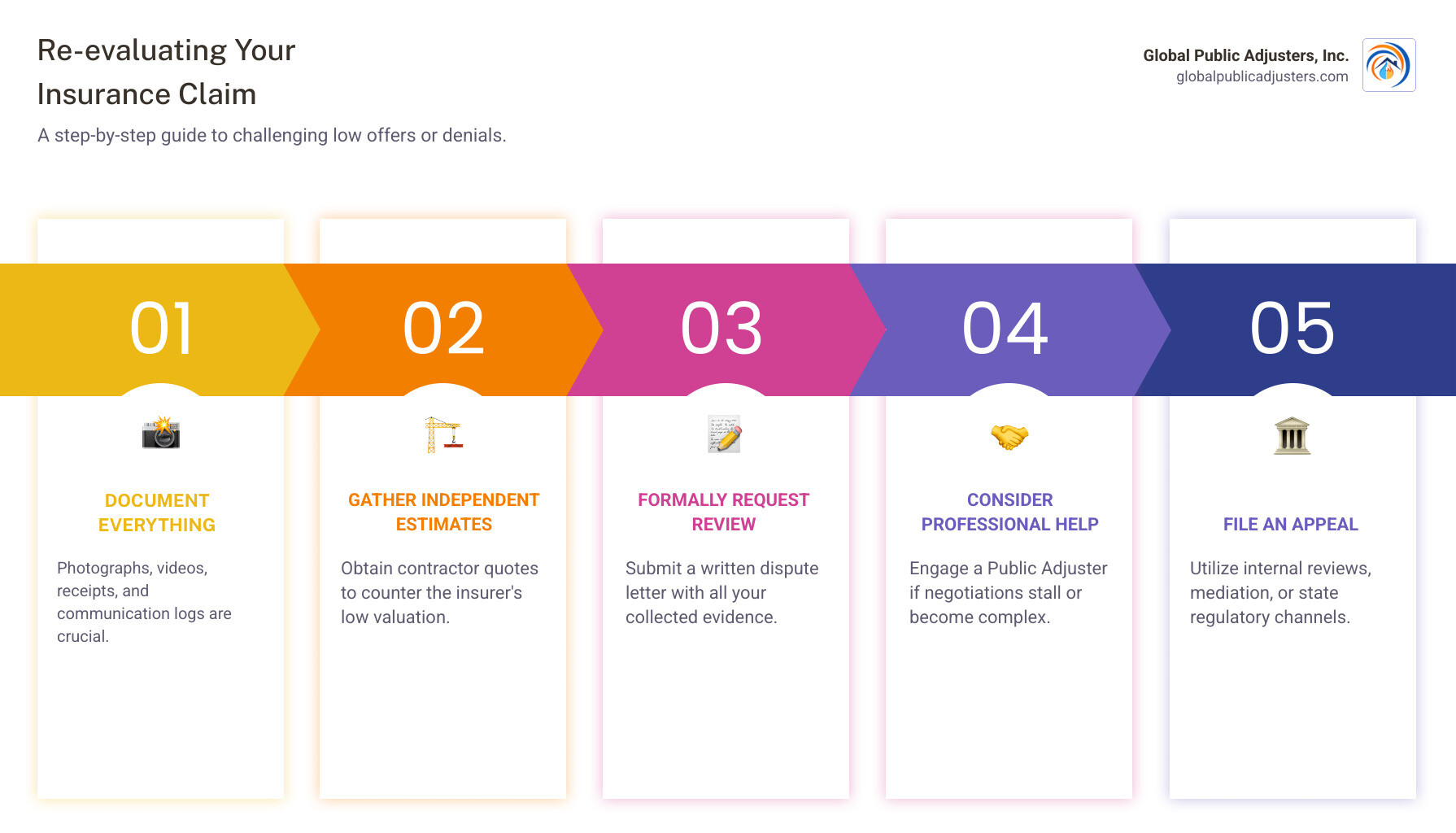
Quick Answer: How to Re-evaluate Your Insurance Claim
- Document everything– Take photos, videos, and keep all receipts related to damages
- Gather independent estimates– Get repair quotes from licensed contractors
- Request a formal review– Submit a written dispute letter with supporting evidence
- Consider professional help– Hire a public adjuster if negotiations stall
- File an appeal– Use internal reviews, mediation, or state regulators if needed
If you’re unsatisfied with your insurance claim result, you’re not alone. State insurance departments receive millions of inquiries and complaints annually. However, a study by the Consumer Federation of America found that a significant percentage of consumers who appeal claim denials are successful. The re-evaluation process can work if you know how to steer it.
Insurance companies are for-profit businesses. Their adjusters often use standardized software and conservative valuations to minimize payouts, potentially overlooking hidden damages or misinterpreting your policy. This guide will walk you through how to challenge a low settlement, what documentation you need, and when to seek professional help to maximize your chances of a fair payout.
Understanding the Initial Estimate: Why Is It So Low?
You’ve received the adjuster’s estimate, and the number is shockingly low. This is a common experience for policyholders, buta low initial estimate is often just a starting point for negotiation, not the final word.Understanding why these offers are low is the first step toward getting the settlement you deserve.

At Global Public Adjusters, Inc., we’ve seen this scenario thousands of times. Let’s break down what’s happening behind that disappointing number.
The Role of the Insurance Adjuster
Theinsurance adjusterassesses your damage and determines the payout. Crucially,they work for the insurance company, not for you.Their primary role is to protect the company’s financial interests, creating a potentialconflict of interest.
Acompany adjusteris a direct employee of your insurer, unlike apublic adjuster, who works exclusively for you. Company adjusters use standardized software and protocols designed for efficiency, which can lead to conservative estimates that miss important details. To learn more about the different types of adjusters, see our guide on7 Types of Claims Adjusters and Their Duties in Florida.
Common Reasons for a Lowball Offer
Understanding these common issues is essential for anyinsurance claim re-evaluation.
- Omitted or underreported damages:Adjusters on tight schedules can easily miss hidden issues like water damage behind walls, mold in an attic, or compromised structural integrity.
- Under-scoped repairs:The estimate may account for a simple patch when a full replacement is needed, or specify basic materials when your home had premium finishes.
- Outdated pricing data:The adjuster’s software may not reflect current labor and material costs, which can change rapidly, especially after a storm in Florida.
- Misinterpretation of your policy:The adjuster might overlook endorsements, misunderstand coverage terms, or incorrectly apply your deductible.
- Strategic negotiation:A low initial offer is often a tactic to see if you’ll accept it without pushing back. Insurers are prepared to negotiate.
- Incorrect valuation:An insurer might unfairly reduce a claim by stating you undervalued your contents, as seen in a case reviewed by the Financial Ombudsman Service:Insurer reduced claim, saying contents were undervalued.
These are common issues we address in our article on5 Overlooked Factors About Property Damage Claims in Orlando, FL.
How Policy Limits and Exclusions Impact Your Settlement
Your settlement is always constrained by your policy. Understanding yourpolicy limitsandexclusionsis crucial.
- Coverage caps:Your policy has maximum payout limits for your dwelling, personal property, and other structures. If damages exceed these limits, your settlement is capped.
- Per-item limits:Many policies have low limits for valuables like jewelry or electronics unless you’ve purchased additional coverage.
- Specific exclusions:Standard policies often don’t cover events likeflood damage(which requires a separate policy) or mold, unless it’s from a covered peril like a burst pipe.
Yourpolicy declarations pageis your contract. Read it carefully to understand how its terms apply to your claim. For more tips, see our guide onNavigating Property Damage Claims: Tips for a Smoother Process. A low estimate is often more about the insurer’s process than your actual damages. Understanding this empowers you to challenge their number.
The Insurance Claim Re-evaluation Process: Contesting a Low Offer
When you receive a low estimate, don’t despair. You have the right to challenge the offer, and this is where yourinsurance claim re-evaluationtruly begins. Think of it as building a case with evidence, organization, and clear communication to prove your side of the story.

Step 1: Document Everything Immediately After the Incident
Your documentation efforts should start the moment a disaster occurs, not when you disagree with an estimate. Strong evidence gathered immediately is your best asset.
- Photos and Videos:Take extensive, timestamped photos and videos of all damage from multiple angles before touching anything.
- Receipts:Save all receipts for emergency repairs, such as tarping a roof or boarding windows. These costs should be reimbursed.
- Communication Log:Note the date, time, person, and topic of every conversation with your insurer, adjuster, or contractors.
- Official Reports:Gather witness information and obtain police reports for incidents like theft or vandalism.
For a complete guide, see our walkthrough of theHomeowners Claim Process Orlando, FL.
Step 2: Gather Documentation to Challenge the Estimate
To prove the adjuster’s estimate is wrong, you need concrete facts. This is the core of yourinsurance claim re-evaluation.
- Independent Contractor Estimates:Get detailed, itemized estimates from at least two reputable, licensed contractors. These are your most powerful tool forassessing damages.
- Expert Opinions:For complex issues like foundation cracks or extensive mold, hire specialists like structural engineers or mold remediation experts.
- Related Expenses:Document all costs, including hotel stays (Additional Living Expenses), storage units, and increased utility bills from drying equipment.
- Proof of Value:Find receipts, appraisals, or old photos to prove the value of damaged personal property. A home inventory is invaluable here.
- Your Policy:Keep your policy handy and highlight the specific coverages and endorsements that support your claim.
Step 3: Formally Request an Insurance Claim Re-evaluation
With your evidence organized, it’s time to formally request that the insurance company re-evaluate your claim. This creates a crucial paper trail.
Write a clear, professionaldispute letterthat includes your claim number and states that you disagree with the initial estimate. Be specific, citing discrepancies between their offer and your contractor’s quotes. For example: “Your estimate allocates $1,200 for flooring, but fails to account for subfloor damage. The attached contractor estimate shows the true cost is $4,800.”
Attach all your supporting documentation, organized and clearly labeled. Explicitly request a re-inspection, perhaps by a different adjuster. Send your letter via certified mail with a return receipt or an email with a read receipt to prove they received it. Follow up if you don’t hear back within two weeks. This formal request puts the ball back in their court to justify their low number or revise it.
Appealing a Denied Claim: From Internal Review to Professional Help
A denial letter feels final, but it’s often just the beginning of the appeals process. Many denied claims are successfully overturned. A denial means the insurer says your damage isn’t covered at all, which is different from a low offer, where they agree it’s covered but dispute the cost. This distinction requires a different approach.
Understanding the common reasons for denials can help you prepare. Our article onReasons Why Your Property Insurance Claim Can Be Deniedprovides insight into what you might be facing.
Level 1: Internal Appeal with the Insurance Company
Your first step is the insurer’s internal appeal process. Your denial letter should explain how to file an appeal and the deadlines—do not miss these deadlines.
Your appeal letter must be thorough.Cite specific policy languagethat supports your claim and explain why the insurer’s reason for denial is incorrect.Submit new evidence, such as an expert report from an engineer or new contractor estimates, that directly refutes the denial. Send your appeal via certified mail to create a paper trail. For more detailed steps, review our guide:What to Do When Your Home Insurance Claim Is Denied.
Level 2: Mediation and the Appraisal Clause
If the internal appeal fails, alternative dispute resolution methods can help you avoid court.
- The appraisal clause, found in most Florida property policies, is used to resolve disputes over theamountof loss. You and the insurer each hire an appraiser. If they disagree, they select a neutral umpire. A decision by any two of the three is binding. This is often faster and cheaper than a lawsuit for aninsurance claim re-evaluationfocused on valuation.
- Mediationinvolves a neutral third-party mediator who helps you and the insurer negotiate a settlement. The mediator does not make a binding decision but facilitates an agreement.
Florida’s Department of Financial Services offers free or low-cost mediation programs for property insurance disputes. You can learn more about these options here:Mediation and Neutral Evaluation.
Level 3: Filing a Complaint with State Regulators
If you believe your insurer has acted unfairly or in bad faith, you can escalate your complaint to state regulators. In Florida, this is theDepartment of Financial Services (DFS)and theOffice of Insurance Regulation (OIR).
A formal complaint triggers an investigation into the insurer’s handling of your claim. While regulators typically can’t force payment on a specific claim, they can take action against companies for violating state law, which can pressure them to reconsider. TheNational Association of Insurance Commissioners (NAIC)also provides resources and can guide you to the correct state agency. Navigating these processes is complex, which is why professional help from a public adjuster is often essential.
When to Seek Professional Help for Your Claim
Navigating aninsurance claim re-evaluationcan be overwhelming. When thousands of dollars are at stake against a large insurance company, bringing in a professional who is onyourside can level the playing field.
| Feature | Company Adjuster | Public Adjuster |
|---|---|---|
| Allegiance | Works for the insurance company | Works for the policyholder |
| Primary Goal | Protect insurer’s financial interests | Maximize policyholder’s settlement |
| Payment | Salaried by the insurance company | Fee (percentage of settlement) paid by policyholder |
| Expertise | Assessing damage for the insurer | Assessing damage, policy interpretation, negotiation for policyholder |
| Conflict of Interest | Potential, as they serve the insurer, not you | None, as they serve only the policyholder |
Hiring a Public Adjuster for Your Insurance Claim Re-evaluation
A public adjuster works exclusively for you, the policyholder. Their job is to maximize your settlement, not minimize the insurer’s payout. They conduct a thorough inspection, uncover hidden damages, prepare detailed estimates, and negotiate directly with the insurance company on your behalf. Learn more in our guide onWhat Can a Public Adjuster Do For Me?.
Consider hiring a public adjuster if:
- The insurance company’s offer is significantly lower than your contractor’s estimates.
- Your claim has been denied, but you believe it should be covered.
- The damage is extensive or complex (e.g., fire, hurricane, major water damage).
- You lack the time or expertise to manage the claim yourself.
A study by Florida’s OPPAGA found that policyholders who hired public adjusters received significantly higher settlements. These professionals understand insurance tactics and how to counter them. Explore the benefits in our article onWhy Hire a Public Adjuster?.
Public adjusters work on a contingency fee, meaning they are paid a percentage of your settlement and only if you get paid. There are no upfront costs. Before hiring, be sure to review our guide onQuestions to Ask Your Public Adjuster.
When Legal Action May Be Necessary
While public adjusters resolve most disputes, some cases require an attorney. Consult a lawyer if your claim involves complex legal issues, or if you suspect the insurer is acting inbad faith.
Bad faith isn’t just a disagreement over value; it’s when an insurer unreasonably fails to honor its obligations. Examples include unreasonable delays, refusing to investigate properly, or misrepresenting policy terms. In Florida, a successful bad faith claim can result in penalties against the insurer, including payment of your attorney’s fees.
Litigation can be costly and time-consuming. An attorney can help you analyze the risks versus rewards. At Global Public Adjusters, Inc., we strive to resolve claims without litigation but work with experienced attorneys when necessary to protect your rights, as detailed in our article onhow a public adjuster can reverse a denied property claim.
Proactive Measures: Ensuring Fair Evaluations in the Future
The best way to handle aninsurance claim re-evaluationis to prepare before you ever need one. A little proactive work now can prevent major headaches later, especially in a state like Florida where storms are a common threat.
Regularly Review Your Insurance Policy
Many people file their policy away and never look at it again, only to be surprised by coverage gaps after a disaster. Don’t be that person.
Your life changes, and your policy should too. Review your policy’s declarations page annually. Key actions include:
- Understanding Your Coverage:Know your limits, deductibles, and exclusions before you need to file a claim.
- Updating Policy Limits:Ensure your dwelling coverage reflects the current cost to rebuild, not just the market value. Update personal property limits after major purchases.
- Adding Endorsements:Consider extra coverage for risks like mold or for valuable items like jewelry and art.
- Communicating Life Changes:Inform your agent about renovations, a new home-based business, or other significant changes that could affect your coverage needs.
If you’re unsure about your coverage for scenarios common in Florida, we can help. At Global Public Adjusters, Inc., we handleInsurance Claims Orlando, FLand can review your policy to identify potential gaps.
Create and Maintain a Home Inventory
Imagine trying to list everything you own from memory after a fire. A home inventory provides undeniable proof of your possessions and their value, which is essential for a smooth claims process.
- Video Walkthroughs:The easiest method is to walk through your home with a smartphone, narrating what you see and its approximate value.
- Photos and Receipts:Take individual photos of valuable items and keep digital copies of receipts for major purchases.
- Cloud Storage:Store your inventory video, photos, and receipts in a secure cloud service (like Google Drive or iCloud) so they are safe from the disaster that affects your home.
- Specialized Apps:Many insurers offer free apps to help you create and maintain an inventory.
A detailed inventory dramatically speeds up the claims process, which is crucial forProperty Damage Claims Orlandowhen insurers are overwhelmed after a major event. Update your inventory annually or after significant purchases.
Frequently Asked Questions about Insurance Claim Re-evaluation
Can I reopen a claim after I’ve accepted a settlement?
Maybe, but it’s difficult. When you sign a release form, you waive your right to seek more money for that claim. However, you may be able to reopen it under specific circumstances.
Your best chance is findingnew evidenceof damage that was genuinely hidden and directly caused by the original incident (e.g., mold appearing weeks later). The principle of reconsidering a decision based on new evidence is a recognized administrative process, as detailed in thisReconsider a previous decision (new evidence) procedure. You might also have a case if you can provefraud or misrepresentationby the insurer during the settlement. Time is critical; if you find new damage, contact a public adjuster or attorney immediately.
How much does a public adjuster charge?
Public adjusters work on acontingency fee basis, so there are no upfront costs. They are paid a percentage of your final settlement, meaning they only get paid if you do. This aligns their interests with yours.
In Florida, fees are capped by state law, typically at10% of a new claim’s settlementand 20% for supplemental claims. Studies show that policyholders who hire public adjusters often receive settlements large enough to cover this fee and still end up with more money than if they had handled the claim alone. Always get the fee structure in writing. For more guidance, see our list ofQuestions to Ask Your Public Adjuster.
What is considered “bad faith” by an insurance company?
Bad faithis when an insurance company fails to uphold its legal duty to treat you fairly. It’s more than just a low offer; it’s about the insurer putting its financial interests so far ahead of your legitimate claim that it crosses legal and ethical lines.
Common examples of bad faith include:
- Unreasonable delaysin investigating or paying a claim without justification.
- Failure to conduct a thorough investigationby ignoring evidence or skipping inspections.
- Misrepresenting your policyby deliberately misleading you about what’s covered.
- Making lowball offers without justificationthat are not based on a reasonable evaluation of your damages.
- Refusing to pay a clearly valid claimor using coercive tactics to force a low settlement.
If you suspect bad faith, document every interaction with your insurer. An experienced public adjuster can spot these tactics and help you decide on the next steps for yourinsurance claim re-evaluation.
Conclusion: Taking Control of Your Insurance Claim
Dealing with property damage is stressful, but remember:you have power in this process. Theinsurance claim re-evaluationis your right as a policyholder to challenge an unfair outcome and demand the compensation you deserve.
Your strongest weapons are documentation and knowledge. Document everything from the start, and understand your insurance policy—it’s a contract. Never automatically accept the first lowball offer; it’s often just a starting point for negotiation. Challenging it with your own evidence frequently leads to a higher settlement.
Most importantly,you don’t have to fight this battle alone.When the process is overwhelming, professional help is critical. A public adjuster works exclusively for you, not the insurance company. We speak their language, understand their tactics, and know how to present your claim for maximum impact.
At Global Public Adjusters, Inc., we have over 50 years of experience representing Florida homeowners and businesses. We’ve seen every trick and know how to counter them. Our job is to be your advocate and expert, negotiating to get you the best possible outcome. We work on a contingency basis, so you don’t pay us unless we get you paid.
Don’t let a low offer or denial be the final word. You worked hard for your property, and your insurance should be there to help you rebuild. If it’s not, we are.
Take control of your claim today. Whether you’re just starting or are stuck in a dispute, professional help can turn things around.Learn how a public adjuster can reverse a denied property claimand get the settlement that reflects your true loss.