Quick Answer
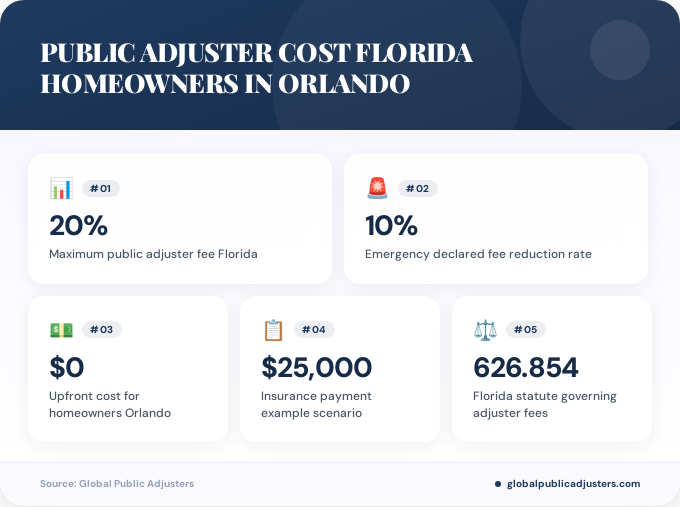
Florida law caps public adjuster fees at20% of the insurance paymentobtained for most claims, dropping to10% during the first year after a governor-declared emergency. Orlando homeowners pay nothing upfront because the fee is a contingency percentage deducted only from money the adjuster actually recovers, not an hourly rate or flat charge.
If you ask ten Orlando homeowners what a public adjuster costs, most will guess wrong. There’s no invoice, no hourly rate, and no bill mailed to your house. Thepublic adjuster cost for Florida homeownersis built entirely around a contingency percentage set by state statute, meaning the adjuster only gets paid when you do. Yet confusion about this fee structure stops many Orlando residents from getting help on claims that could be worth tens of thousands of dollars more than the insurer’s first offer.
This guide breaks down exactly how public adjuster pricing works under Florida’s 2026 rules, what the math looks like on real claims, and when the cost is actually worth it for homeowners in neighborhoods from College Park to Lake Nona.
What Is the Actual Cost of a Public Adjuster in Florida?
Public adjusters in Florida are paid through acontingency fee, a percentage of the insurance payment they help you recover. There is no retainer, no hourly billing, and no flat consulting fee under a standard contract. The fee is defined byFlorida Statute 626.854, which governs public adjuster conduct and compensation statewide, and mirrored in the official House version atFlorida House Statute 626.854.
Under the 2026 rules, the standard maximum fee is20% of the insurance payment or settlementobtained on the homeowner’s behalf. That cap drops to10% during the first year after a governor-declared state of emergency, a provision designed to protect homeowners filing hurricane-related claims in the immediate aftermath of a storm. The Florida Department of Financial Services’ consumer guidance on public adjusters confirms these percentage caps and requires every public adjuster contract to disclose the fee in writing before work begins.
How Do Contingency Fees Work on a Real Claim?
The fee is calculated on theclaim payment actually delivered, not on the policy’s overall coverage limit, and the deductible is excluded from that calculation. In plain terms, if your insurer pays $25,000 toward a damaged roof, the adjuster’s 20% maximum fee applies to that $25,000, not to your $500,000 dwelling coverage limit.
| Insurance Payment Obtained | 20% Maximum Fee | Homeowner Receives |
|---|---|---|
| $10,000 | $2,000 | $8,000 |
| $25,000 | $5,000 | $20,000 |
| $50,000 | $10,000 | $40,000 |
| $100,000 | $20,000 | $80,000 |
These figures assume the contract uses the statutory maximum and that the fee applies strictly to the claim payment, excluding the deductible, exactly as Florida law requires. A lower negotiated percentage, which many firms offer, would reduce these fee amounts proportionally. For homeowners dealing with ongoing water intrusion, understanding this math pairs well with learninghow a water damage claim adjuster in Orlando builds a fair settlement.

What Are the Special Fee Limits Homeowners Should Know?
Florida’s fee structure isn’t one-size-fits-all. The statute carves out several specific scenarios that change the math significantly.
Applies to: Standard non-emergency claims
Basis: Insurance payment received
Applies to: First year after a gubernatorial emergency declaration
Basis: Insurance payment received
Applies to: Insurer pays at or above a sublimit within the statutory early-payment window
Basis: That coverage part only
Applies to: Only the additional payment obtained
Basis: No fee on prior payments for the same loss
The supplemental claim rule often surprises homeowners the most. Suppose an insurer already paid $30,000 for roof and water damage before a public adjuster was hired. If the adjuster later secures an additional $20,000 in underpaid damages, the 20% fee applies only to that new $20,000, producing a fee of$4,000, not 20% of the combined $50,000. This supplemental-claim framework is detailed further under Florida Statute 626.8698 governing public adjuster compensation on supplemental and reopened claims.
What Kinds of Claims Do Orlando Homeowners File?
Orlando’s climate and housing stock create a distinct claims profile. Central Florida sees frequent severe thunderstorms, tropical systems moving inland from both coasts, and aging roof stock in older neighborhoods like Delaney Park and Conway. Common claim types in the area include:
- Wind and hail damage to roofing and screened enclosures
- Hurricane-related roof, siding, window, and water intrusion damage
- Plumbing leaks and resulting secondary water damage
- Mold-related losses, often limited by policy sublimits and exclusions
- Fire and smoke damage
- Tree impact from storm-felled oaks and pines common in mature Orlando neighborhoods
- Losses on investment or rental properties, common given Orlando’s large short-term rental market
Florida’s broader insurance market context matters here too. Recent consumer sentiment data reported by a statewide survey on Floridians’ views of the property insurance market found growing skepticism about insurers’ claim-handling practices, which is one reason more homeowners are researching professional claim representation before accepting a first settlement offer. Homeowners comparing coverage options in the metro area can also review Orlando-specific homeowners insurance rate data to understand how local premiums and claim patterns interact.
Complexity, not ZIP code, is what determines whether professional help pays off. A straightforward, promptly-paid pipe leak may never justify a 20% fee. A disputed roof claim, a hidden water intrusion issue discovered during a gut renovation, or a large fire loss involving code-upgrade requirements is a different story entirely, and that’s wherepublic adjuster services built for Florida homeowners seeking fair claim payoutstend to deliver the clearest return.
When Does Hiring a Public Adjuster Make Financial Sense?
The cost-benefit question comes down to a simple comparison: what the insurer offers on its own versus what a documented, professionally negotiated claim is likely to recover, minus the contingency fee. Industry claims data referenced in a 2026 industry claims report shared by insurance professionals highlights persistent gaps between initial insurer estimates and final settlement values on complex property losses, reinforcing why many homeowners pursue a second opinion before signing off on a payout.
- Large or disputed losses:Fire, major roof failure, or claims exceeding $20,000 to $30,000 often justify professional documentation and negotiation.
- Denied or underpaid claims:If an insurer denies coverage or offers a settlement that doesn’t match visible damage, a public adjuster’s inspection and estimate can reopen the conversation.
- Hurricane and named-storm claims:Because of the reduced 10% post-emergency fee cap, storm-related claims after a declared emergency can be especially cost-effective to professionally manage. See how this plays out in practice whenfiling a hurricane damage insurance claim in Florida.
- Simple, fast-paid claims:A small, clearly covered loss paid quickly and fairly by the carrier may not need a public adjuster at all.
Comparable markets back this out further. The Orlando homeowners insurance market overview from Kin Insurance shows how localized storm exposure and roof-age underwriting rules in Central Florida directly affect claim complexity, which is one more reason the size and nature of the loss matters more than a flat rule of thumb.
How Should Homeowners Choose a Public Adjuster in Orlando?
Licensing and transparency matter as much as the fee percentage itself. Florida public adjusters must be licensed through the state, and homeowners can confirm credentials through resources like the Florida Association of Public Insurance Adjusters licensing information. Before signing anything, ask these questions:
- Is the fee the statutory maximum, or a negotiated lower percentage?
- Does the contract include any non-contingency charges, such as inspection or cancellation fees?
- How does the fee change if this becomes a supplemental or reopened claim?
- What happens to the fee if the claim was filed during a declared emergency period?
- Can the contract be canceled, and under what terms?
Working with an established, locally experienced firm also reduces friction. Homeowners can review background and credentials on thefirm’s about us pageor compare the full scope of claim support available throughpublic adjuster services across Florida. For homeowners still deciding whether their specific loss qualifies, browsingclaims types commonly handled by public adjustersis a useful starting point, and theGlobal Public Adjusters homepageoutlines the full range of markets served statewide.
Key Takeaways
- Florida caps standard public adjuster fees at20%of the insurance payment obtained, not the policy limit.
- Claims tied to a governor-declared emergency are capped at10%during the first year after the declaration.
- Very early payments at or above a sublimit can carry a reduced1%fee under specific statutory conditions.
- Supplemental or reopened claims only generate a fee on thenew, additional payment, never on prior insurer payouts.
- Deductibles are excluded from the fee calculation under Florida law.
- Orlando’s wind, hurricane, and plumbing-related claims are the most common scenarios where professional claim representation pays for itself.
- Always confirm whether a contract includes non-contingency charges before signing.
People Also Ask
Do I need a public adjuster in Florida?
Not for every claim. Small, promptly paid losses often don’t need one, but disputed, denied, or large losses involving roof damage, water intrusion, or fire typically benefit from professional documentation and negotiation.
How much does a public adjuster charge in Florida?
Florida law caps fees at 20% of the insurance payment obtained for standard claims, dropping to 10% during the first year after a declared emergency, with special lower limits for very early payments and supplemental claims.
Is a public adjuster worth it for a denied insurance claim in Orlando?
Often yes, since a denial usually means the insurer’s own documentation didn’t support payment, and a public adjuster can produce a new, more thorough estimate and negotiate directly with the carrier on the homeowner’s behalf.
What percentage do public adjusters take in Florida?
Up to 20% of the insurance payment for ordinary claims, or up to 10% for claims arising from a governor-declared emergency during the first year after that declaration.
Frequently Asked Questions
Does the public adjuster fee apply to my deductible?+
No. Florida law excludes the deductible from the fee calculation, so the percentage applies only to the insurance payment amount actually received, not the total repair cost or policy limit.
What happens if a public adjuster doesn’t recover any additional money?+
Under a genuine contingency contract, no percentage fee should be owed if no additional insurance proceeds are obtained. Homeowners should still confirm in writing whether inspection, cancellation, or administrative charges could apply separately.
How is the fee calculated on a supplemental claim?+
The fee applies only to the additional payment obtained after the public adjuster is hired, not to any amount the insurer already paid before representation began, capped at 20% of that new amount.
Why is the fee lower after a declared emergency?+
Florida reduces the maximum fee to 10% during the first year following a governor-declared emergency to protect homeowners filing high volumes of storm-related claims from excessive charges during vulnerable recovery periods.
Can a public adjuster charge an hourly rate instead of a percentage?+
Standard Florida public adjuster contracts use contingency fee percentages, not hourly billing. Any deviation from the statutory fee caps or additional charges must be clearly disclosed in the written contract before work begins.
Are public adjuster fees negotiable in Orlando?+
Yes, the statutory caps are maximums, not fixed rates, and many firms offer percentages below 20% depending on claim complexity, size, and scope of work required.