Hurricane Damage Claim Denied in Florida: What Homeowners Need to Know
Quick Answer
A hurricane damage claim denied in Florida is most often tied to deductible thresholds, flood exclusions, late reporting, or coverage disputes rather than outright bad faith. State data shows41% of Hurricane Milton closed-without-payment claimsand33% of Hurricane Helene closed-without-payment claimswere below the policy deductible, meaning coverage may technically exist even though the payout was zero. Homeowners who understand these patterns and act quickly can often appeal, reopen, or litigate a denied claim successfully.
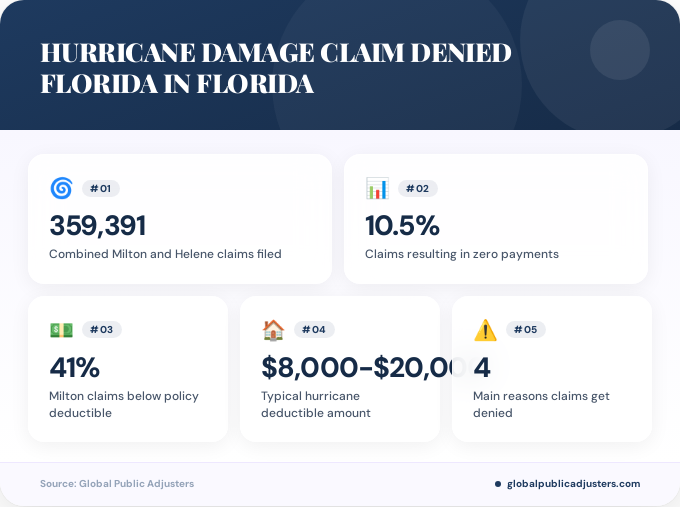
If yourhurricane damage claim denied Floridaletter just landed in your mailbox, you are far from alone. Across the state, tens of thousands of homeowners from Pensacola to Miami-Dade have opened similar letters after Hurricanes Helene and Milton, only to discover their insurer paid nothing at all. In fact, state regulators confirmed that by late October, the combined total for Milton and Helene reached359,391 claims, with37,796 claims (10.5%) resulting in no payments, according to reporting on Florida Office of Insurance Regulation data covered byNewsweek’s analysis of the denial figures.
That is a staggering number of families left to fund repairs out of pocket, disputing adjusters, or wondering whether their policy failed them. This article breaks down exactly why Florida hurricane claims get denied, what the newest state data reveals, and what steps homeowners in Tampa, Jacksonville, Orlando, and beyond can take next.
Why Do Hurricane Damage Claims Get Denied in Florida?
Most Florida hurricane claim denials trace back to four recurring issues: damage fallingbelow the policy deductible, losses attributed toflood or storm surge(which standard homeowners policies exclude), disputes overpre-existing wear and tear, and claims filedlate or with incomplete documentation. None of these require an insurer to act in bad faith, but all of them can leave a homeowner with a $0 check after a storm that clearly damaged their roof, fences, or interior.
Florida’s hurricane deductibles are often calculated as a percentage of the dwelling’s insured value rather than a flat dollar figure, which means a policyholder with a $400,000 home might face a $8,000 to $20,000 hurricane deductible before any payment kicks in. That structure alone explains a huge share of “denials” that are, technically, coverage decisions rather than misconduct.
“Most hurricane insurance denials in Florida are not due to misconduct,” Florida’s insurance regulator has stated, pointing instead to deductible thresholds and coverage exclusions as the leading drivers behind unpaid claims, according toInsurance Business Magazine’s coverage of the regulator’s findings.
Still, homeowners in coastal communities like St. Petersburg, Naples, and the Florida Keys report a different experience on the ground. Reporting fromNBC News’ investigation into Helene and Milton insurance disputesfound families waiting months for inspections, receiving lowball estimates, or being told damage was “pre-existing” despite having no prior claims history. If you’re preparing to file, reviewingthese nine tips for filing a hurricane damage claim in Floridabefore you submit documentation can prevent many of the errors that lead to denial.
What Do the Latest Florida Hurricane Claim Statistics Show?
The Florida Office of Insurance Regulation’s 2025-2026 data releases paint a detailed picture of exactly how hurricane claims are resolved statewide. These numbers matter because they show denial patterns are consistent across storms, not isolated incidents.
Closed without payment:121,985
Below deductible:41%
Flood-related:4%
Closed without payment:17,652
Below deductible:33%
Flood-related:20%
Closed:68,097
Closed without payment:34,645
Unpaid share of closed claims:49%
Nearly half of all closed Citizens Property Insurance claims across three storms ended without a single dollar paid out, a figure highlighted in Florida news coverage examining why so many homeowners feel shortchanged after filing in good faith. Insurance industry pressures are compounding the issue too;PR Newswire’s report on Florida’s insurance market turmoilnotes that repeated catastrophic storm seasons have strained carriers’ capacity to process claims quickly and fairly.
Local frustration is loud in hard-hit areas. One Tampa-area homeowner told reporters, as covered byTampa Bay 28’s report on denied hurricane claims, that insurers seemed to be “making straight profit” off delayed and denied payouts. Whether or not that’s the full picture, the numbers show homeowners in Tampa, Sarasota, and the Gulf Coast bear a disproportionate burden from these closures.
What’s the Difference Between a Denial and a Claim Closed Without Payment?
Not every unpaid claim is technically a “denial” in the legal sense, and this distinction matters enormously when you’re deciding whether to appeal, litigate, or accept the outcome. Florida regulators have pushed insurers toward more transparent reporting to separate these categories clearly.
| Outcome Type | What It Means |
|---|---|
| Below deductible | Coverage exists, but the estimated damage falls under your hurricane deductible amount |
| Flood exclusion | Damage caused by rising water or storm surge, which standard homeowners policies exclude |
| True denial | Insurer disputes coverage entirely, citing exclusions, late notice, or alleged misrepresentation |
| Underpayment | Insurer pays, but the amount is far below actual repair or replacement cost |
Homeowners often lump all four categories together as “denied,” but the strategy for challenging each is different. A below-deductible closure may require a public adjuster’s re-inspection to prove the damage estimate was too low, while a flood exclusion dispute might hinge on whether the damage was actually wind-driven rain versus surge. Realtor.com’s coverage of Florida’s insurance climate notes thatRealtor.com’s analysis of Florida hurricane claim trendsfound homeowners are increasingly confused by these category distinctions, which fuels the perception that insurers are simply denying everything.
For homeowners in the Tampa Bay area still navigating post-storm paperwork, ourTampa homeowner’s complete guide to filing a hurricane claimwalks through documentation standards that can prevent a below-deductible miscategorization in the first place.
How Long Do You Have to Sue an Insurer in Florida?
Florida’s statute of limitations for suing over a denied or underpaid hurricane claim depends heavily on when the storm occurred and which law applied at the time. Legislative reforms shortened the window for newer storms, but older claims still fall under longer deadlines.
- Hurricane Ian (2022):Policyholders who filed timely claims may have untilSeptember 28, 2027to sue over an underpaid or denied claim, since Ian claims fall under Florida’s older five-year limitations period.
- Storms after 2023 reform:Newer legislation shortened notice-of-claim windows significantly, making prompt filing essential.
- Appraisal and mediation deadlines:Many policies require invoking appraisal or mediation clauses within a set window after denial, separate from the lawsuit deadline.
Missing these windows can permanently forfeit your right to recover, even if your claim was wrongly closed. Legal analysis fromHunton’s insurance recovery blog on Florida’s Fourth DCA rulingillustrates how appellate courts have reversed hasty dismissals when policyholders demonstrated timely notice, underscoring how critical documentation timing is to preserving your legal options.
What Should You Do After a Hurricane Claim Denial?
The first 30 days after a denial letter are the most important. Acting methodically, rather than emotionally, dramatically improves your odds of a reversal or successful appeal.
- Request the denial letter in writingwith the specific policy language cited as the basis for denial.
- Pull your policy’s deductible and exclusion sectionsto compare against the insurer’s stated reason.
- Document all damage with photos, videos, and contractor estimatesbefore any repairs begin.
- Request your claim fileincluding the adjuster’s inspection notes and photos.
- Consider a second, independent inspectionthrough a licensed public adjuster or contractor.
- File a complaint with the Florida Department of Financial Servicesif you suspect the denial doesn’t match your policy terms.
- Consult an attorney or public adjusterbefore signing any settlement release.
Homeowners in Jacksonville facing similar disputes can find step-by-step guidance in ourJacksonville homeowner’s guide to hurricane damage claims, which covers regional adjuster expectations and common local denial patterns along the St. Johns River corridor.
How Can a Public Adjuster Help With a Denied Claim?
A licensed public adjuster works exclusively for the policyholder, not the insurance company, which changes the entire dynamic of a disputed claim. Instead of relying solely on the carrier’s inspection, a public adjuster performs an independent damage assessment, cross-references it against your policy language, and builds a supplemental claim package designed to withstand scrutiny.
Pricing for public adjuster services varies based on your specific claim size, property type, and complexity, and reputable firms work on a contingency basis tied to the amount actually recovered rather than charging steep upfront fees. When comparing options, it helps to understandhow insurance settlement negotiation works in Floridabefore signing any representation agreement.
Industry commentary shared on LinkedIn by insurance executive Chris Griffith notes that two recent regulatory reports on Florida’s claims landscape reveal a system under strain, reinforcing the case for independent policyholder advocacy, as discussed inChris Griffith’s LinkedIn analysis of Florida’s insurance reports.
Florida’s coastline sees an outsized share of the nation’s hurricane losses, and NOAA’s own cost data confirms hurricanes remain the most expensive natural disaster type in the U.S. by far, according toNOAA’s hurricane cost fast facts. That scale is exactly why homeowners in Orlando, Tampa, and coastal Southwest Florida benefit from professional representation rather than negotiating alone against a well-resourced carrier. Exploreour public adjusting servicesorcontact our team for a free claim reviewif your hurricane claim was closed without payment.
Key Takeaways
- 41% of Miltonand33% of Heleneclosed-without-payment claims were below the policy deductible, not outright denied on merits.
- 359,391 combined claimswere filed for Milton and Helene, with37,796 (10.5%)resulting in zero payment.
- Citizens Property Insurance closed49% of claims without paymentacross Debby, Helene, and Milton combined.
- Hurricane Ian policyholders may have untilSeptember 28, 2027to sue over denied or underpaid claims under the older five-year limitations period.
- Flood damage from storm surge is excluded under standard homeowners policies and requires separate flood insurance to be covered.
- Requesting your full claim file and comparing it against policy exclusions is the fastest way to identify a wrongful denial.
- Public adjusters and attorneys can help homeowners in Tampa, Jacksonville, Orlando, and statewide challenge unfair claim closures.
People Also Ask
Why are so many Florida hurricane claims closed without payment?
The largest share of unpaid claims fall below the homeowner’s hurricane deductible, meaning coverage exists but the payout amount is zero. Flood exclusions, late reporting, and disputes over pre-existing damage account for most of the remaining closures.
Can I still file a claim if I missed the initial deadline?
It depends on your policy’s notice requirements and the applicable statute of limitations for that storm year. Some older storms like Hurricane Ian still allow claims or lawsuits into 2027, but newer legislation has shortened these windows considerably.
Is flood damage ever covered under a standard homeowners policy in Florida?
No, standard homeowners policies exclude flood and storm surge damage entirely. Homeowners need a separate flood insurance policy, typically through the National Flood Insurance Program or a private flood carrier, to be covered for that type of loss.
What percentage of Florida homeowners appeal a denied hurricane claim?
Exact statewide appeal rates aren’t publicly tracked in detail, but consumer advocates and regulators have noted rising complaint volumes following Helene and Milton, prompting the state to launch a public claims transparency dashboard.
Frequently Asked Questions
What should I do first if my hurricane damage claim is denied in Florida?+
Request the full written denial letter citing specific policy language, then compare it against your policy’s deductible and exclusion sections. Document all damage independently and consider a second inspection before accepting the insurer’s decision as final.
How long do I have to sue my insurer after a denied Florida hurricane claim?+
It depends on when the storm occurred. Hurricane Ian claims filed on time may have until September 28, 2027 under the older five-year limitations period, while storms after the 2023 legislative reforms carry shorter notice windows, so checking your specific storm year is essential.
Does a “closed without payment” claim mean my claim was denied?+
Not always. State data shows a large share of these closures are due to damage falling below the policy deductible rather than an outright denial of coverage, though the practical result for the homeowner, no payment, is the same either way.
Can a public adjuster help reverse a denied hurricane claim?+
Yes, a licensed public adjuster performs an independent inspection, documents damage the insurer’s adjuster may have missed, and builds a supplemental claim package to challenge the denial or underpayment. Many work on contingency, so pricing varies based on your specific claim.
Why do so many Citizens Property Insurance claims close without payment?+
Reporting shows Citizens closed 49% of its claims across Debby, Helene, and Milton without payment, largely tied to below-deductible losses and flood exclusions rather than widespread misconduct. High hurricane deductibles common to Citizens policies contribute heavily to this pattern.
What is the most common reason hurricane claims are denied in Florida?+
Related:Workers Comp Adjuster Tricks in Orlando: How Insurance Companies Try to Reduce Your Claim
Related:Water Damage Insurance Adjuster in Florida: What Homeowners Must Know Before Filing a Claim
Damage falling below the policy’s hurricane deductible is the single largest factor, accounting for 41% of Milton’s and 33% of Helene’s closed-without-payment claims. Flood exclusion and late notice of loss round out the other leading causes.
Further reading:Hurricane Damage Claim Adjuster Florida in Orlando: What Homeowners Need to Know
Further reading:Water Damage Claim Denial Florida: Why Insurers Say No and How to Fight Back
Further reading:Hurricane Damage Insurance Claim Denied in Florida: What Homeowners Need to Know