Central Florida Tornado Damage 2025: Critical Fury
Understanding the Reality of Central Florida Tornado Damage
Central Florida tornado damageis an urgent concern for property owners. While many associate tornadoes with “Tornado Alley,” Florida experiences a higher frequency of tornadoes per 10,000 square miles than any other state.
Key Facts About Central Florida Tornadoes:
- Recent Event: An EF-2 tornado with 115 mph winds struck Lake Mary and Longwood.
- Path of Destruction: The storm carved a nearly 4-mile path of widespread property damage.
- Typical Damage: Includes home collapses, overturned vehicles, uprooted trees, and severe roof damage.
- Peak Season: June has the highest frequency, with spring and summer being most active.
- Geographic Hotspots: Tampa Bay to Fort Myers coast, the western panhandle, and Atlantic Coast areas.
The recent tornado in Lake Mary demonstrates how severely these storms can impact communities. It causeda home to suffer 80% structural collapse in Longwoodandoverturned a semi-truck at Commerce Street and Lake Emma Road.
Central Florida’s vulnerability stems from geographic factors that create ideal conditions for tornado formation. The region’s location at the intersection of Gulf moisture and Atlantic weather patterns generates the atmospheric instability needed to spawn these storms.
For property owners, understanding the frequency of tornado damage is crucial for bothpreparedness and recovery. These storms cause devastating damage that requires immediate action and complex insurance claims.

The Science Behind Florida’s Twisters
Florida produces more tornadoes per square mile than any other state. These violently rotating columns of air form when specific weather ingredients combine, with the main culprit beingatmospheric instability.
Keyweather factorscontribute to tornado formation in Florida. Whencold frontsmove through, they often createsquall lines—long bands of powerful thunderstorms. These storms form where warm, moist air from the Gulf and Atlantic meets cooler, drier air.Hurricanesare also significant tornado producers, spinning off numerous twisters as they cross the state. Additionally,upper-level shear(wind moving at different speeds at different heights) helps thunderstorms rotate, increasing tornadic potential.
TheNational Weather Servicemonitors these conditions and issuestornado warningswhen radar indicates rotation, signaling that a tornado has been spotted or is likely forming and that it’s time to take cover.
| EF Rating | Wind Speed (mph) | Typical Damage Examples in Florida |
|---|---|---|
| EF0 | 65-85 | Light damage; tree branches broken, shallow-rooted trees pushed over, minor roof damage. |
| EF1 | 86-110 | Moderate damage; roofs peeled, mobile homes overturned, cars pushed off roads, attached garages destroyed. |
| EF2 | 111-135 | Considerable damage; roofs torn off well-constructed homes, mobile homes demolished, large trees snapped or uprooted, cars lifted off ground. |
| EF3 | 136-165 | Severe damage; entire stories of well-constructed homes destroyed, trains overturned, cars thrown, structures with weak foundations swept away. |
| EF4 | 166-200 | Devastating damage; well-constructed homes leveled, cars thrown and disintegrating, large objects become flying projectiles. |
| EF5 | >200 | Incredible damage; strong frame houses swept clean off foundations, steel-reinforced concrete structures critically damaged, incredible phenomena. |
How Tornadoes are Rated: The EF Scale
To determine a tornado’s strength, experts use theImproved Fujita Scale (EF Scale). Introduced in 2007, this scale rates tornadoes based on the destruction they cause. After a storm,NWS survey teamsconduct detaileddamage assessmentandstructural damage analysis. By examining how buildings failed and trees fell, they perform a carefulwind speed estimationto assign an EF rating from EF0 (weakest) to EF5 (strongest).
Most Florida tornadoes are EF0 or EF1. However, as recentCentral Florida tornado damageshows, even an EF2 tornado can collapse homes and flip trucks. Understanding these ratings helps property owners grasp the scope of destruction. You can learn more about what to expect atCommon Types of Tornado Damage.
Why Florida is a Tornado Hotspot
Florida’s hightornado frequency—averaging 46 tornadoes per year—is due to its unique geography. Surrounded by the warm waters of the Gulf of Mexico and the Atlantic Ocean, the state has abundant moisture, a key ingredient for severe thunderstorms.
Certaingeographic hotspotsare more prone to activity, including theTampa Bay to Fort Myers coastand thewestern panhandle. These areas are often where different air masses collide.Monthly tornado trendsshow that June is typically the most active month, while November is the quietest. However, strong tornadoes have occurred in nearly every month.
Spring and summer are peak seasons for powerful storms, as strong cold fronts create the instability needed to spawn events like the recentCentral Florida tornado damage. For a deeper dive into our tornado history, check outHistorical tornado events in Florida.
A Closer Look at Recent Central Florida Tornado Damage

TheCentral Florida tornado damagefrom a recent EF-2 storm serves as a powerful reminder of their destructive potential. The tornado carved a path through Seminole County, affecting Lake Mary, Longwood, and areas toward Sanford. While officials noted “widespread minor damage,” the reality was far more severe for those in the tornado’s direct path.
Timeline and Impact of the Lake Mary & Longwood Tornado
At9:40 a.m., the National Weather Service confirmed the tornado touched down in Lake Mary. It moved northeast at30 mphwith winds up to115 mphalong its nearly four-mile journey.
The storm’s impact was immediate and dramatic. AtCommerce Street and Lake Emma Road, it flipped a semi-truck. The driver and his dog inside were thankfully unharmed. As the tornado moved into Longwood, it caused an80% structural collapseofa home on the 2100 block of Blue Iris Place. The two occupants survived by taking shelter in a sturdy part of the house.
TheFOX 35 News Stationalso sustained damage, including a fallen tree on a news vehicle and a lifted roof lining on their building. The full scope of the destruction is visible in thisChopper 2 video of damage.
Assessing the Central Florida Tornado Damage in Longwood and Lake Mary

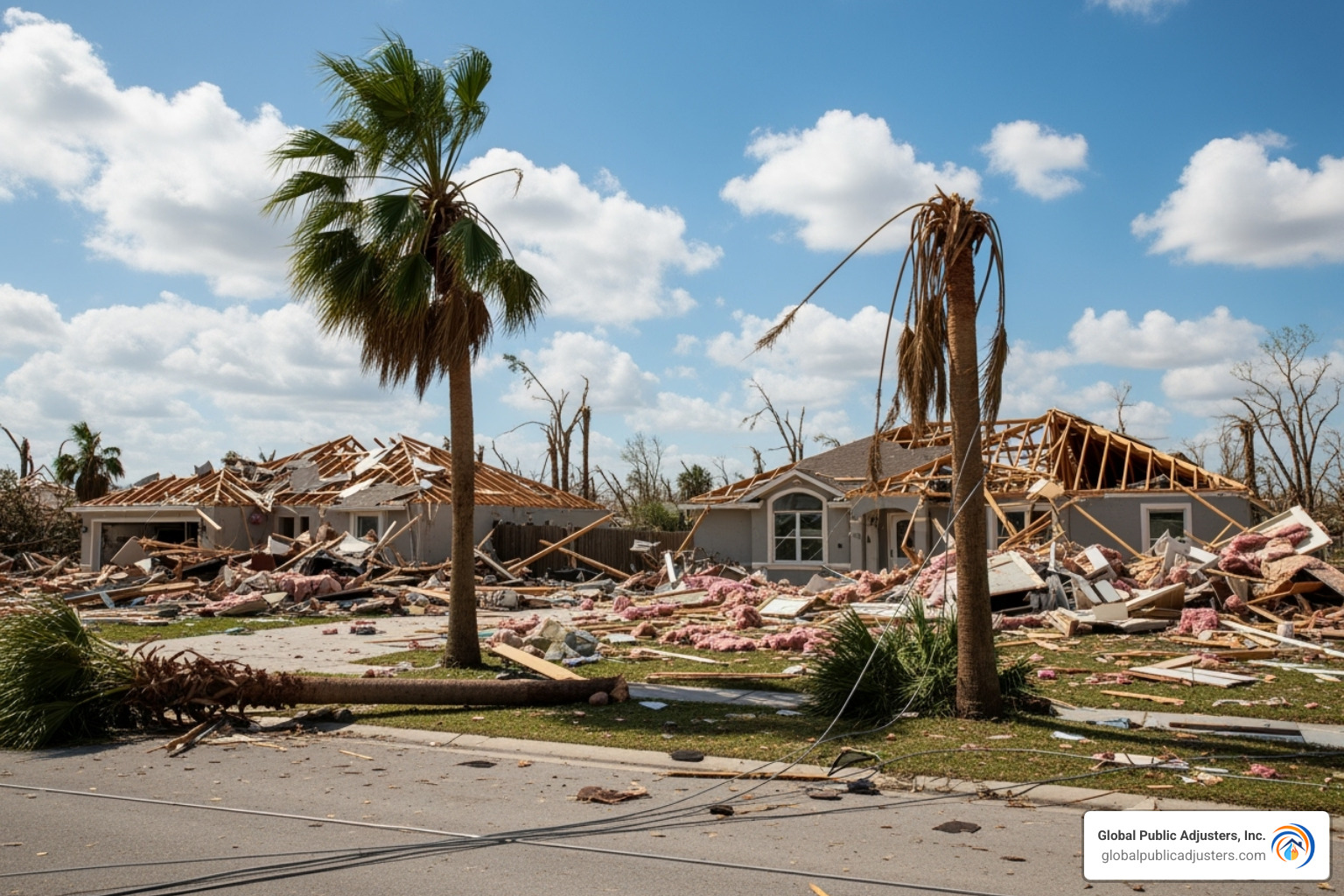
The aftermath revealed a landscape of destruction. Thecollapsed home on Blue Iris Placewas a stark symbol of the tornado’s power.Debris fieldsof roof shingles, garage doors, and car parts littered neighborhoods.Uprooted treesblocked roads and damaged property.
The damage was not confined to homes.Damaged news vehicles, alifted roof liningat the FOX 35 station, and damage to commercial buildings showed the tornado’s indiscriminate path. NearMarkham Woods Road in Lake Mary, residents reported downed trees and damaged structures.
One resident noted this single tornado caused more damage to their property thanthree previous hurricanes combined, highlighting the concentrated destructive power of these storms. Theextensive damageled to power outages, blocked roads, and widespread disruption for residents.
Florida’s History with Major Tornado Events
While the recent EF-2 tornado was significant, Florida has a history of devastating tornado events. These storms provide valuable lessons about preparedness and the reality ofCentral Florida tornado damage.
Hurricane Milton Outbreak (October 2024):This historic event produced45 confirmed tornadoes in a single day, a state record. The outbreak caused 6 deaths, over 30 injuries, and an estimated $681.8 million in damage. Notably, it spawned three EF3 tornadoes, a rarity for a tropical cyclone in Florida. You can readMore on the record-breaking Hurricane Milton outbreak.
2007 Groundhog Day Outbreak:This tragic event claimed 21 lives, injured 76, and caused $218 million in damage. One tornado killed eight people in Lady Lake, damaging or destroying over 1,200 structures. Another killed 13 in the Lake Mack area, impacting over 500 homes.
Kissimmee F3 Tornado (1998):This powerful storm killed 25 people, with the worst destruction concentrated in mobile home communities. This event highlighted thatmobile homes are particularly vulnerable to severe tornado damage.
Notable Outbreaks and Their Lasting Impact
The scale of these outbreaks is staggering. During Hurricane Milton, the NWS issued a record126 tornado warningsacross Florida in one day. The economic impact of such events is immense, with Milton’s outbreak alone causing over $681.8 million in damage, straining community resources.
Each major outbreak underscores the importance of robust building codes and efficient disaster response. These events remind us that while rare, EF3+ tornadoes have a life-changing impact on communities, shaping how we approach tornado safety today.
Understanding the Scope of Central Florida Tornado Damage
Tornado damage is often unpredictable, with one home flattened while its neighbor is untouched. This“widespread damage vs. localized destruction”is a hallmark of tornado behavior.

The immediate aftermath brings challenges beyond structural damage.Power outagescan last for days, and debris-blocked roads complicate rescue efforts. The strain on local infrastructure and emergency services can be overwhelming.
Thelong-term recovery processis perhaps the most difficult aspect. It involves navigating complex insurance claims, finding reputable contractors, and dealing with the emotional toll. Many families find their insurance policies have gaps in coverage, or the settlement offered is insufficient for rebuilding. This is where professional guidance becomes crucial. For help with complex property damage claims, our experienced team atPublic Adjusterscan ensure you receive the settlement you deserve.
Navigating the Aftermath: Response and Recovery
In the overwhelming moments after a tornado, community response systems are activated to manage the chaos. First responders, including sheriff’s deputies and firefighters, arrive to ensure public safety, search for injured individuals, and secure dangerous areas.
Damage assessment crews, often working with organizations like the American Red Cross, quickly evaluate the needs of affected residents, arranging temporary shelter and emergency supplies.Power restorationbecomes a top priority, with utility crews working around the clock to restore service. Debris cleanup begins almost immediately, with officials urging caution.
Official Response and Safety Guidance
In the hours and days following a tornado, follow crucial safety information from local officials:
- Stay away from downed power lines. They pose a deadly risk of electrocution. Report them by calling 911.
- Treat every dark intersection like a four-way stop. Be extra cautious while driving.
- Resist the urge to go sightseeing in damaged areas. This hinders emergency crews and puts you at risk from unstable structures, live wires, and falling debris. Law enforcement will often secure the hardest-hit neighborhoods for safety.
Starting Your Property Damage Claim
Once the immediate danger has passed, the recovery process begins, which for most involves filing an insurance claim for property damage.
First, document everything.Before cleaning up, take extensive photos and videos of all damage, both inside and out. Create a detailed written inventory of damaged or destroyed items. This documentation is critical for your insurance claim.
Next, understand your insurance policy.While complex, knowing what your policy covers, including deductibles and limits for wind damage, is essential. This is where a public adjuster can be invaluable.
At Global Public Adjusters, Inc., we are Orlando-based public claims adjusters who specialize in representing property owners.With over 50 years of experience, we steer the insurance claim process to fight for the maximum settlement you deserve for yourCentral Florida tornado damage. We act as your advocate, leveling the playing field against insurance companies so you can focus on rebuilding. To learn more, seeWhy Hire a Public Adjuster for Property DamageandWhat Can a Public Adjuster Do For Me?.
Frequently Asked Questions about Florida Tornadoes
Here are answers to common questions from Central Florida residents about tornadoes and property damage.
What areas in Central Florida were most recently affected by a tornado?
The most recent significant event wasan EF-2 tornado that struck Lake Mary and Longwoodin Seminole County. The storm stayed on the ground for nearly four miles, carving a path of destruction near the I-4 corridor. It damaged homes, businesses, and a local news station, with some residents reporting that theCentral Florida tornado damagewas worse than what they had experienced from multiple hurricanes combined.
Were there any injuries from the Lake Mary tornado?
Remarkably,officials reported no serious injuries or fatalitiesfrom this tornado, despite severe damage that included a home with 80% structural collapse and an overturned semi-truck. This outcome is credited totimely tornado warnings from the National Weather Serviceand residents taking those warnings seriously. The occupants of the collapsed home survived by taking shelter, as did the driver of the overturned truck.
How common are strong tornadoes in Florida?
Florida experiencesmore tornadoes per 10,000 square miles than any other state, averaging about 46 per year. However,most are rated EF-0 or EF-1, causing relatively minor damage.Stronger tornadoes (EF-2 and higher) are much less commonbut are far more destructive.
Strong tornadoes are most likely during thespring and summer months, often linked to powerful cold fronts or landfalling tropical systems like Hurricane Milton, which produced rare EF3 tornadoes.June typically has the highest tornado frequency, but powerful tornadoes can occur in any month. While the chance of a strong tornado is low, the potential for severe property damage makes preparedness and proper insurance coverage essential.
Conclusion

The reality ofCentral Florida tornado damagerequires every property owner to be prepared. As we’ve seen from the science of Florida’s tornado frequency to the destructive path of the recent EF-2 tornado in Seminole County, these storms can change lives in an instant.Tornado preparedness is essentialfor all residents.
While community resilience is strong, the path to recovery involves navigating the overwhelming process of insurance claims.Understanding your rightsas a property owner is the first step. You should not have to face the insurance company alone after your home or business suffers tornado damage. The claims process is complex and intimidating, especially during such a stressful time.
Securing a fair settlement is crucial for rebuilding. If you’re facing the complex process of filing aTornado Damage Claims Orlandoclaim, expert guidance can make all the difference.
At Global Public Adjusters, Inc., we have over 50 years of experience helping Central Florida property owners recover from disasters. We understand the challenges ofCentral Florida tornado damageand are here to fight for the settlement you deserve. We handle the insurance battle so you can focus on rebuilding your life.