
Insurance Settlement Negotiation: Master 5 Stages
Introduction: Preparing for the Negotiation Battlefield
When disaster strikes, the initial insurance settlement offer is often insultingly low. This is whereinsurance settlement negotiationbecomes crucial.
It’s the process where you and the insurer agree on a claim payment after property damage or an injury. The goal is to secure fair compensation without going to court, which is how over 95% of claims are resolved. The process involves defining the damage, exchanging offers, and reaching an agreement.
This guide will empower you to steer this complex process, stand up for your rights, and aim for the compensation you truly deserve.
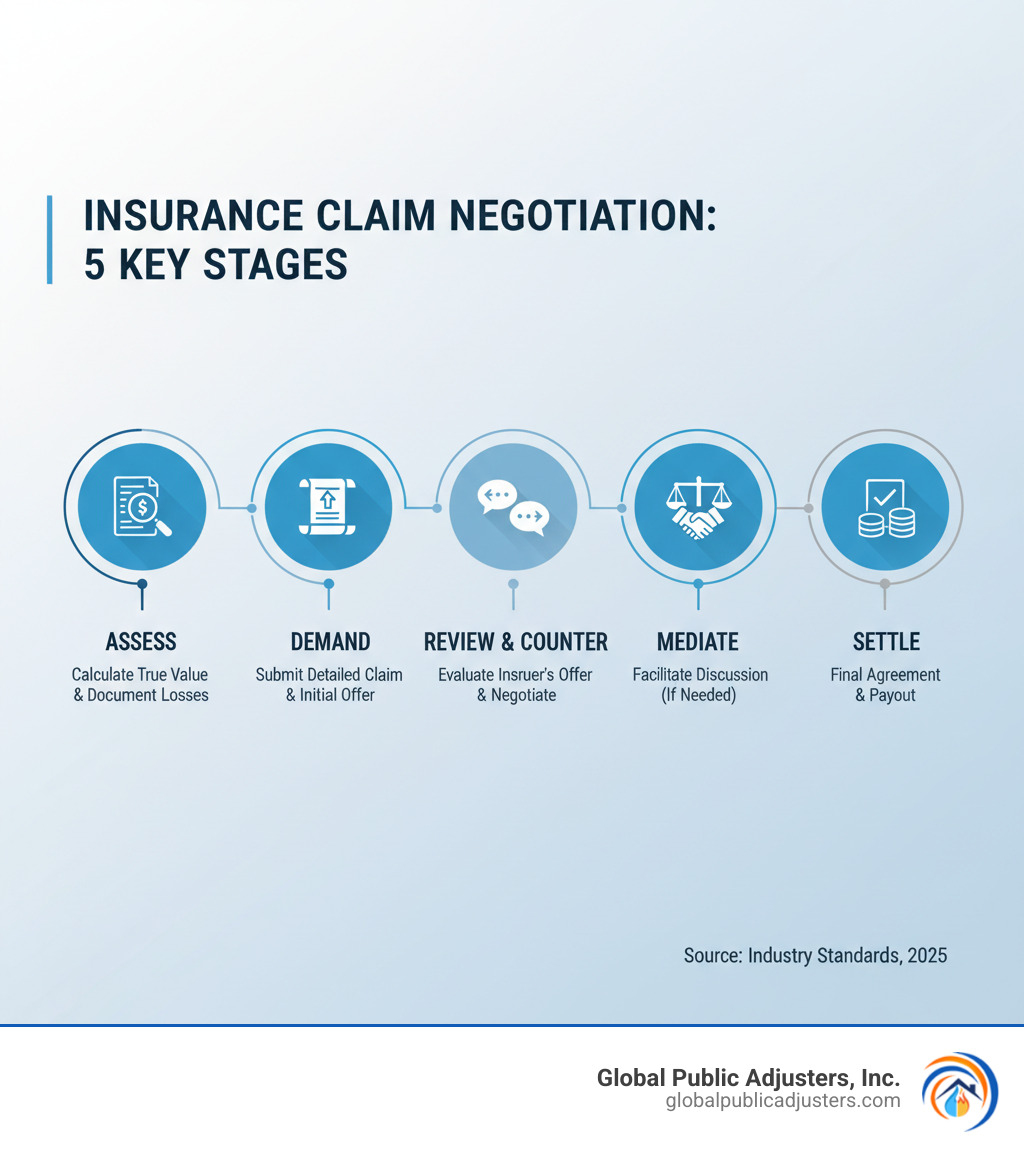
Step 1: Calculating the True Value of Your Claim

The first step in any successfulinsurance settlement negotiationis calculating what your claim isreallyworth. This means adding up every loss, big and small, to build a strong foundation for your claim.
Economic Damages(or ‘special damages’) are losses with a clear dollar amount. For property claims, this includes:
- Property Repair/Replacement Costs: Get estimates to fix or replace damaged structures and belongings. Understand if your policy coversActual Cash Value (ACV)(factoring in depreciation) orReplacement Cost Value (RCV)(the cost of a new item).
- Additional Living Expenses (ALE): Covers costs like temporary housing if your home is unlivable.
- Business Interruption: For business owners, this covers lost profits and operating expenses.
- Other Out-of-Pocket Expenses: Includes temporary repairs, emergency services, and increased utility costs.
For personal injury claims, economic damages also includemedical billsandlost wages.
Non-Economic Damages(‘general damages’) are harder to quantify but are just as real, especially in personal injury cases. These includepain and suffering,emotional distress, loss ofenjoyment of life, andfuture damageslike ongoing medical care or long-term lost income.
How to Determine a Fair Settlement Amount
To arrive at a fair number, you must be strategic. First,understand your policythoroughly—know your coverage limits, deductible, and whether you have ACV or RCV coverage. This is the starting point forclaim valuation.
Next,document all losses carefully. This is non-negotiable. Use photos, videos, repair estimates, receipts, medical records, and police reports. Without solid proof, even valid claims can be challenged. A lack of paperwork is a common reason why your property insurance claim can be denied.
For complex claims,consult with experts. Get multiple quotes from contractors or consider hiring a public adjuster for an unbiased, thorough assessment that insurers take seriously.
Finally,know your bottom line—the absolute minimum you will accept. Keep this number to yourself as a strategic guide.
The Importance of Patience and Documentation
Patience is a superpower in negotiations. Insurers often hope you’ll get stressed and accept a low offer just to be done with it. Don’t fall for it. Rushing hurts your claim, as you might settle before the full extent of your damages is known. Once you sign a release, you can’t go back for more.
Your documentation is your best friend. Keep a detailed file with:
- Medical recordsand apain journalfor injury claims.
- Police reportsandwitness statementsfor accidents.
- Photos and videosshowing the damage (before and after, if possible).
Thorough documentation and patience are essential for securing the compensation you deserve.
Step 2: The Demand, The Lowball, and The Counteroffer
The negotiation process is a back-and-forth exchange. It begins with your demand letter, which sets the anchor point for the entireinsurance settlement negotiation.
Crafting a Powerful Demand Letter
Your demand letter is a persuasive document that formally tells the insurance company what happened, why they are liable, and how much compensation you seek. It shows you’ve done your homework and are serious about a fair settlement.
A strong letter includes:
- A clear introduction with your policy number and the incident date.
- A chronological narrative of the event.
- A detailed breakdown of your damages, listing every loss with its specific dollar value and attaching supporting evidence.
- A request for a specific settlement amount. Don’t be vague; name your number and justify it with your documentation.
Why Insurance Companies Make Lowball Offers
Expect the first offer to be disappointingly low. It’s not personal; it’s a business strategy. Insurers make lowball offers to test your knowledge and patience, hoping you’ll accept a small amount out of stress or desperation. By starting low, they also set a psychological anchor, making any subsequent small increase feel like a win, even if it’s far below your claim’s actual value.
Be aware of common adjuster tactics:
- Delaying and denying: They may stretch out the process, request endless documentation, or deny parts of the claim. If your claim is denied, learnwhat to do when your home insurance claim is denied.
- Requesting a recorded statement: This can be used against you. Any misstatement can reduce your settlement. It’s often wise to decline or provide a written statement instead.
- Acting overly friendly: A sympathetic adjuster still works for the insurance company. Their job is to minimize the payout, regardless of how nice they seem.
How to Respond to a Counteroffer
Do not accept the first offer.It is almost never a fair one. When a lowball offer arrives, take a breath and respond strategically.
First,ask the adjuster to justify their number in writing. Request a point-by-point explanation of how they arrived at their figure. This forces them to show their reasoning and gives you specific points to refute.
Next,formulate your counteroffer. Always negotiate down from your original demand, not up from their low offer. If you demanded $50,000 and they offered $10,000, your counter should be closer to your number (e.g., $45,000), reinforcing your anchor.
Your counteroffer shouldaddress each point they raisedwith factual, documented responses. Stick to the facts and remain professional. This back-and-forth may take several rounds, but persistence and solid documentation will strengthen your position.
Step 3: Mastering Your Insurance Settlement Negotiation Strategy
Now you’re in the heart of theinsurance settlement negotiation. Success at this stage depends on professionalism, persistence, and clear communication. It’s not about aggression, but about being smart and steady.
Best Practices for a Successful Insurance Settlement Negotiation
Dealing with insurance companies can be frustrating, but a calm, planned approach is most effective.
- Stay calm and polite: An emotional reaction won’t help. A professional attitude often gets better results. Just don’t let their friendliness make you lower your guard.
- Keep detailed notes: Document every conversation: date, time, who you spoke with, and what was discussed. Follow up phone calls with a summary email to create a paper trail.
- Get all offers in writing: Verbal promises are unreliable. Insist on written offers before making any decisions.
- Emphasize life impact: For personal injury claims, explain how the injury has affected your daily life. For property claims, you can mention the stress and disruption caused.
- Know your minimum number: Decide on your “walk-away” point before negotiating. Keep it to yourself, but use it to stay firm.
- Leverage professional expertise: For complex property claims, public adjusters level the playing field. Companies like Global Public Adjusters, Inc. can takethree crucial steps to bring success to your property damage claimby expertly documenting, interpreting policy language, and negotiating for you.
Common (and Costly) Mistakes to Avoid
Knowing whatnotto do is just as important.
- Giving a recorded statement unprepared: You are not required to give one immediately. If you do, be calm and prepared. Never give one while stressed, in pain, or on medication, as your words can be twisted.
- Signing a broad medical release: Insurers need records for an injury claim, but a standard release gives them access to your entire medical history. Use a limited release that only covers records related to the incident.
- Posting on social media: Adjusters check social media. A single post could be used to argue your damages aren’t as severe as you claim. Set profiles to private and avoid discussing your case online.
- Appearing too eager: Desperation can lead to a lower offer. Patience is key.
- Failing to document everything: Lack of proof weakens your case. Keep every receipt, photo, and email.
- Arguing with the adjuster: It’s unprofessional and unproductive. Stick to the facts, and if you hit a wall, consider bringing in professional help.
Step 4: When to Call for Backup
Even with thorough preparation, some negotiations require professional help. For complex claims involving serious injuries or large-scale property damage, bringing in an expert is a strategic move that can make the difference between an adequate settlement and the one you truly deserve.
Deciding When to Seek Professional Help
It’s normal for theinsurance settlement negotiationprocess to feel overwhelming. Here are clear signs it might be time to call for backup:
- Negotiations have stalled: The insurance company refuses to budge from a low offer or has stopped communicating.
- The insurer is acting in bad faith: You suspect they are intentionally delaying your claim, misrepresenting policy terms, or pressuring you unfairly. These are serious actions that may constituteinsurance bad faithand require an expert response.
- There are significant disputes: The insurer disputes who is at fault or drastically undervalues your damages despite your evidence.
- The statute of limitations is approaching: Every state has a time limit for filing a lawsuit. If you’re nearing this deadline without a fair settlement, you need immediate professional advice to protect your rights.
- The claim is too complex: If your claim involves catastrophic damage, multiple parties, or confusing policy language, an expert is invaluable.
The Benefits of Working with a Public Adjuster
For property damage claims in Florida, a public adjuster is your advocate. Unlike the insurer’s adjuster, a public adjuster works exclusively for you, the policyholder. This iswhy you should consider hiring a public adjuster.
Key benefits include:
- Leveling the playing field: A public adjuster brings the same level of expertise to your side that the insurance company has, ensuring fair treatment.
- Expertise in valuation and policy: We understand complex policy language and can identify hidden damages that an insurer’s adjuster might overlook, ensuring every loss is accounted for.
- Handling all communications: A public adjuster takes over the stressful process of dealing with the insurance company, freeing you to focus on recovery.
- Maximizing your final settlement: We prepare detailed estimates, present compelling evidence, and negotiate skillfully on your behalf. Our expertise has helped countless policyholders recover millions that were initially delayed, denied, or underpaid.
Frequently Asked Questions about Insurance Settlements
How long does it take to negotiate a settlement?
The timeline for aninsurance settlement negotiationvaries. Straightforward claims with clear liability and simple damages might settle in a few months. However, complex cases involving extensive damage, disputed liability, or an uncooperative insurer can take a year or longer. If a lawsuit becomes necessary, the process can extend for years. Patience is crucial; rushing often means accepting less than you deserve.
What happens after a settlement agreement is reached?
Reaching an agreement is a major step, but a few final actions are required.
First, you willsign a final release form. This is a binding legal document where you agree not to pursue any further claims for this incident in exchange for the settlement amount. Read it carefully before signing, and don’t hesitate to ask questions. Once signed, you cannot seek more money later.
After the release is processed, you willreceive the settlement check. From these funds, anyoutstanding liens or billsmust be paid. This could include medical bills or contractor invoices. If you’re working with a professional, they will help manage these payments before you receive the remaining funds.
How do I know if a settlement offer is truly fair?
Determining if an offer is fair requires comparing it against your documented losses.
A fair settlement should cover all yourcurrent and future economic costs, including repairs, replacements, lost income, and any other documented expenses. For personal injury claims, it must also provide reasonable compensation fornon-economic damageslike pain and suffering.
A fair offer will align with thewell-researched claim valueyou established in Step 1. If an offer is significantly lower than your supported valuation and the insurer cannot provide a compelling, evidence-based reason for the difference, it is likely an unfair offer. Trust your preparation and documentation.
Conclusion: Securing the Compensation You Deserve
Dealing with an insurance claim is a heavy burden, but understandinginsurance settlement negotiationempowers you. By knowing what to expect, you significantly improve your chances of a fair outcome.
The key strategies arethorough preparation,accurate claim valuation, and unwaveringpatience. These are the foundations for a successful negotiation.
The goal is to be “made whole”—to receive enough compensation to fully repair, rebuild, and recover from your losses. While the process is complex, it is manageable when you are well-informed.
For tough property damage claims in Florida—from storms, fires, or water damage—you don’t have to go it alone. The expertise of a firm like Global Public Adjusters, Inc. can be your strongest ally. We specialize in standing up to insurance companies for homeowners and business owners in Orlando, Pensacola, and throughout the state.
Don’t let your financial recovery be a struggle. Let us help you secure the compensation you deserve.
Learn more about how our public adjusters can maximize your claimand let’s work together to get you back on your feet.