Quick Answer
In Jacksonville, insurance company adjusters are typically salaried employees with compensation varying based on experience and whether they are desk or field adjusters, while independent adjusters are paid per claim and public adjusters work on contingency, earning a percentage of the homeowner’s settlement. These differing pay models directly influence how claims get evaluated, which is why understanding who benefits from a lower or faster payout matters to every policyholder. Call for a free written quote to discuss your specific claim.
What Is the Basic Pay Structure for Insurance Adjusters?
Here’s a question most Jacksonville homeowners never think to ask until after a hurricane rips shingles off their roof: who is paying the person deciding how much your claim is worth?How does an insurance adjuster get paid in Jacksonvilleis not a trivial question. It shapes how fast a claim moves, how thoroughly damage gets documented, and sometimes how low an initial offer lands.
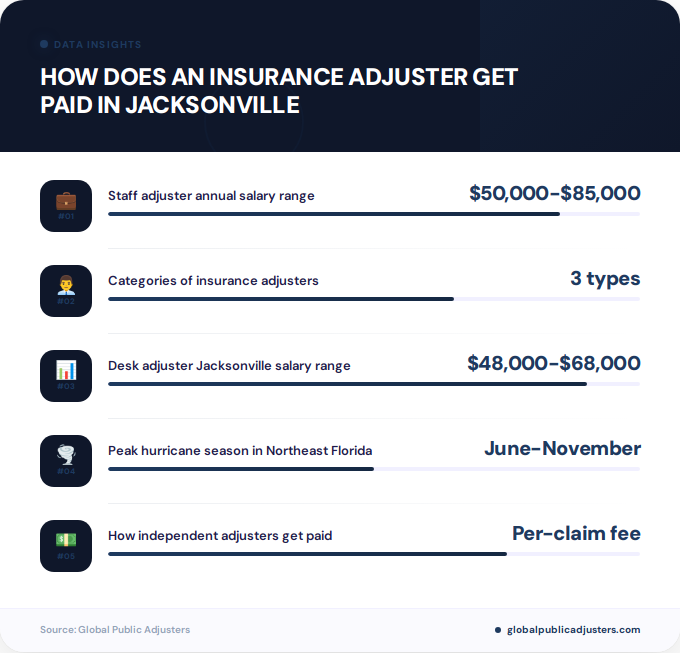
There are three broad categories of adjusters working Florida claims: company staff adjusters, independent adjusters hired on contract, and public adjusters hired by the policyholder. Each is compensated through a completely different model, and each model creates different pressures.
Compensation for desk adjusters and trainees in the Jacksonville, FL metro area varies based on experience level, with those in higher-volume roles earning more than entry-level positions. Understanding these structures helps homeowners read between the lines of every settlement letter they receive. Contact us for a free written quote to learn what your claim may be worth.
How Do Staff Adjusters Get Paid in Jacksonville?
Staff adjusters are direct employees of an insurance carrier. They receive compensation through a fixed salary structure, sometimes supplemented by performance bonuses tied to claim volume, accuracy, or customer satisfaction scores rather than claim payout size.
Desk adjusters, who review claims remotely using photos, estimates, and software like Xactimate, tend to earn salaries in the lower-to-middle range because their workload is largely administrative. Field adjusters, who physically inspect properties across Jacksonville neighborhoods such as Mandarin, San Marco, and Arlington after storm events, often command higher pay due to travel demands and the technical skill required to assess structural and water damage.
Because staff adjusters are salaried, they are not directly incentivized to lowball a claim for personal profit. However, they are still employees of the carrier, evaluated on how efficiently they close files and how well they manage the company’s loss ratio, which can create subtle pressure toward conservative payouts.
| Adjuster Type | Typical Pay Model | Who They Represent |
|---|---|---|
| Staff (Desk/Field) | Annual salary with performance-based compensation | The insurance company |
| Independent (IA) | Per-claim fee or daily rate | The insurance company (via contract firm) |
| Public Adjuster (PA) | Contingency percentage of settlement | The policyholder |

How Do Independent Adjusters Get Paid After a Storm?
When a major hurricane or severe thunderstorm system pushes through Northeast Florida, as frequently happens between June and November, insurance carriers often cannot handle the surge in claims with staff alone. That’s whenindependent adjusters (IAs)get deployed.
IAs are not direct employees. They contract through independent adjusting firms and get paid a fee per claim, sometimes a flat rate and sometimes a percentage of the estimated repair cost. This arrangement means the faster an IA closes files, the more claims they can process, and the more compensation they earn in a given catastrophe cycle.
This volume-based compensation structure is efficient for insurers during disaster response, but it can also mean less time spent scrutinizing every line item of damage. A roof inspection after a late-season tropical system might get a cursory fifteen-minute look rather than the thorough assessment a complex claim deserves.
“Most homeowners assume the adjuster standing on their roof has no financial stake in the outcome. In reality, volume-based pay for independent adjusters can mean speed is rewarded over thoroughness, which is exactly why policyholders need their own advocate reviewing the numbers,” says a senior claims consultant with Global Public Adjusters.
How Is a Public Adjuster’s Pay Different?
Public adjusters work for the policyholder, not the carrier, and their pay model flips the incentive structure entirely. A public adjuster earns compensation through a contingency fee, a percentage of whatever settlement they successfully recover for the homeowner. If the claim pays nothing, the public adjuster earns nothing.
This is a fundamentally different relationship than the one Jacksonville residents have with a staff or independent adjuster. Because the public adjuster’s income rises and falls with the client’s settlement, their motivation aligns with documenting every bit of legitimate damage, not minimizing it.
For a full breakdown of how these percentages work and what Florida law allows, see this detailed explanation ofFlorida public adjuster contingency fees. Readers wanting a broader look at the role itself can also reviewwhat a public adjuster does exactly in Jacksonville.
Incentive:Efficiency and loss ratio
License:Florida 6-20 or company credential
Incentive:Claim volume and speed
License:Florida 6-20 license
Incentive:Maximizing settlement
License:Florida 5-20 license
What Licensing Rules Apply to Adjusters in Florida?
Florida regulates all three adjuster categories through the Department of Financial Services. Staff and independent adjusters typically hold a6-20 all-lines adjuster license, requiring pre-licensing education, a state exam, and continuing education to maintain active status.
Public adjusters must hold a separate5-20 public adjuster license, which has stricter requirements, including a one-year apprenticeship period for new licensees in many cases and additional background checks. This distinction matters because it legally separates who an adjuster is allowed to represent.
Florida law also caps and regulates public adjuster contingency fees, particularly during state of emergency declarations, which happen often in Jacksonville given the Atlantic hurricane season running June through November. For homeowners confused about complaints or misconduct, this guide onfiling a complaint against a public adjuster in Floridaoutlines the regulatory process.
Why Do Pay Incentives Matter to Your Claim?
Pay structure is not just an HR detail, it is a predictor of behavior. An adjuster compensated for volume has different incentives than one compensated for accuracy, and one compensated for the client’s recovery has incentives that differ from both.
This matters enormously after events like coastal flooding near the St. Johns River or wind damage in older Jacksonville homes near Riverside and Avondale. A rushed inspection by a volume-paid independent adjuster might miss hidden moisture intrusion that only shows up weeks later as mold.
- Staff adjustersmay face pressure to settle quickly within carrier-set reserve estimates.
- Independent adjustersmay prioritize closing many files over deep investigation of one.
- Public adjustersare financially motivated to find every eligible dollar of damage.
None of this means staff or independent adjusters act in bad faith. Most are professionals doing honest work. But understanding the pressure built into their pay model helps homeowners know when a second, independent review is worth pursuing, something explored further in this guide ondocumenting and negotiating a water damage claim in Jacksonville.
How Can Understanding Adjuster Pay Protect Your Reimbursement?
Knowing how the person across the table gets paid is leverage. If a staff adjuster’s bonus depends on closing claims within budget targets, a homeowner should expect to push back with thorough documentation: photos, contractor estimates, and moisture readings.
If an independent adjuster is working a catastrophe queue of dozens of homes per week, a homeowner should not assume the first visit was comprehensive. Repair costs and rebuilding expenses vary enormously based on scope, materials, permitting requirements, and the extent of hidden damage, which is exactly why a second opinion from a licensed public adjuster can surface costs the initial inspection missed.
For homeowners dealing with a denied or underpaid claim, reviewingwhat to do next after a water damage claim denial in Floridais a useful next step before accepting a final number.
- Staff adjustersin Jacksonville earn salaries based on experience level, with performance bonuses available.
- Independent adjustersare paid per claim, often incentivizing speed and volume during storm season.
- Public adjusterswork on contingency, earning a percentage only when the policyholder’s claim is paid.
- Florida requires separate licensing: 6-20 for company-side adjusters and 5-20 for public adjusters.
- Pay structure directly shapes how thoroughly a claim gets investigated and documented.
- Homeowners can request a second, independent review before accepting a settlement offer.
- Understanding these incentives helps Jacksonville policyholders negotiate from an informed position.
People Also Ask
What is the average salary of a claims adjuster in Jacksonville, FL?
Claims adjuster compensation in Jacksonville varies based on experience level and role specialization, with desk adjusters and trainees earning at different rates. Field adjusters with hands-on inspection experience typically command higher compensation due to travel demands and technical expertise. Call for a free written quote to discuss what factors may affect your claim value.
Do insurance adjusters get commission on claims?
Staff adjusters generally do not earn commission based on claim payout size, but independent adjusters are often paid per claim handled, which can create incentive around volume rather than payout amount.
Is a public adjuster worth it in Jacksonville?
For complex or underpaid claims, a public adjuster’s contingency-based pay model aligns their interest with maximizing the homeowner’s settlement, which often makes the fee worthwhile relative to the recovered difference.
What license do you need to be an adjuster in Florida?
Company-side adjusters generally need a Florida 6-20 all-lines license, while public adjusters must hold a separate 5-20 license with additional requirements, both regulated by the Florida Department of Financial Services.
How much do independent adjusters make per claim?
Independent adjuster compensation per claim varies widely based on complexity, region, and the contracting firm’s fee structure, with catastrophe season claims often paid at higher rates due to urgency and demand. Call for a free written quote to understand the factors driving your specific claim.
Frequently Asked Questions
How does an insurance adjuster get paid in Jacksonville?+
Staff adjusters receive an annual salary plus possible bonuses from the insurance company, independent adjusters are paid per claim under contract, and public adjusters earn a contingency fee based on the homeowner’s settlement. Each structure creates a different set of incentives that can affect how a claim is handled. Call for a free written quote to discuss your specific situation.
Does the insurance company’s adjuster work for me or for them?+
An insurance company adjuster, whether staff or independent, is paid by and represents the carrier, not the policyholder. Only a public adjuster is hired directly by and legally represents the homeowner’s interests.
What is the difference between a desk adjuster and a field adjuster?+
A desk adjuster reviews claims remotely using submitted documents and photos, while a field adjuster physically inspects the property. Field adjusters typically command higher compensation due to travel requirements and hands-on technical assessment skills.
Can I hire my own adjuster in Jacksonville?+
Yes, Florida homeowners can hire a licensed public adjuster to represent them independently of the insurance company. Public adjusters work on contingency, meaning they only earn a fee if the claim is successfully settled. Call for a free written quote to learn how this partnership could work for your claim.
Why do adjuster pay structures matter after a hurricane?+
During hurricane season, independent adjusters handling high claim volumes are often paid per file, which can mean less time spent on each inspection. This makes thorough documentation and, when needed, a second professional review especially important for Jacksonville homeowners.
Is it normal for a claims adjuster trainee to earn less than an experienced adjuster?+
Yes, claims adjuster trainees in Jacksonville typically start at a lower salary range while learning claim evaluation and software tools, then move into higher-paying roles as they gain field experience and licensure.
Related:Hurricane Season Claims: Understanding Adjuster Pay and Your Payout in Orlando
Understanding the pay structure behind every adjuster who touches your claim is one of the most underused tools a Jacksonville homeowner has. If you want a licensed professional whose compensation is tied to your recovery rather than the carrier’s bottom line, explore thepublic adjusting servicesavailable throughGlobal Public Adjusters, review differentclaim types we handle, or learn moreabout our team. Ready to get a second opinion on your settlement?Contact us todayfor a free claim review.