Public Adjuster License Requirements Florida in Tampa: Complete 2026 Licensing Guide
Quick Answer
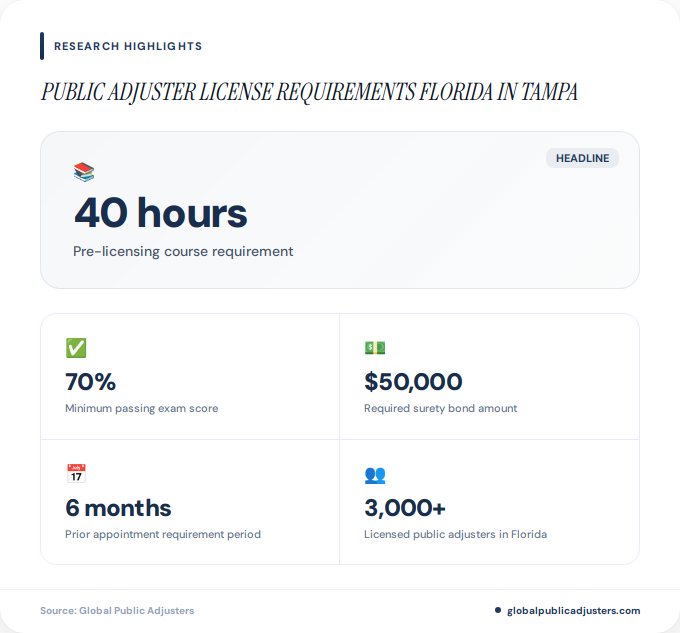
To obtain a public adjuster license in Florida, including Tampa, you must be at least 18 years old, complete a 40-hour pre-licensing course, pass the state exam with 70% or higher, maintain a $50,000 surety bond, and meet a 6-month prior appointment requirement as either a nonresident public adjuster or apprentice. All applications are processed through the Florida Department of Financial Services MyProfile portal, with no Tampa-specific variations to the statewide requirements.
Did you know that Florida is home to more than3,000 licensed public adjusters, yet the state maintains some of the strictest licensing requirements in the nation? For aspiring professionals in Tampa looking to help policyholders navigate complex insurance claims, understanding thepublic adjuster license requirements Florida in Tampais your critical first step toward a rewarding career.
Whether you’re responding to hurricane damage claims in South Tampa, handling property losses in Westchase, or assisting commercial clients in the downtown business district, the licensing process remains consistent across the state. Florida’s Department of Financial Services (DFS) oversees all public adjuster licensing with uniform standards that apply equally to Tampa residents and applicants throughout the Sunshine State.
This comprehensive guide breaks down every requirement, fee, exam preparation strategy, and renewal obligation you’ll face on your path to becoming a licensed public adjuster in Florida’s competitive insurance market.
What Is a Public Adjuster and Why Does Florida Require Licensing?
Apublic adjusteris a licensed professional who works exclusively for policyholders, not insurance companies, to assess damage, document losses, and negotiate insurance claim settlements. Unlike company adjusters or independent adjusters who represent insurers, public adjusters advocate solely for property owners to maximize their recovery.
Florida mandates strict licensing because public adjusters handle significant financial transactions and possess specialized knowledge of construction, damage assessment, policy language, and insurance law.Florida Statute §626.8732establishes the regulatory framework protecting consumers from unqualified practitioners who might mishandle claims or engage in fraudulent practices.
The state’s vulnerability to hurricanes, tropical storms, and severe weather events makes qualified public adjusters essential. Tampa’s coastal location exposes properties to wind damage, flooding, and storm surge, creating consistent demand for professionals who understand bothhurricane damage claimsand local building codes.
What Are the Core Eligibility Requirements for Florida Public Adjusters?
Florida’sresident public adjuster license (3-20)requires applicants to meet specific eligibility criteria before even scheduling the state examination. These prerequisites ensure candidates possess foundational knowledge and experience before representing policyholders in claim negotiations.
Age and Residency Requirements
All applicants must beat least 18 years oldand either reside in Florida or maintain a principal place of business within the state. You must also be a U.S. citizen or legal alien with valid work authorization documented through proper federal channels.
These requirements apply uniformly whether you’re establishing your practice in Tampa’s Channelside district, Brandon, or any other Florida municipality. No local variations exist for age or residency standards.
Prior Experience Pathways
Before applying, you must satisfy one of two experience prerequisites for a minimum ofsix consecutive months:
- Nonresident public adjuster route:Hold an active nonresident public adjuster license in Florida with continuous appointment for the previous 6 months
- Apprentice/adjuster route:Maintain licensure as an all-lines adjuster with continuous appointment for 6 months as either a public adjuster apprentice (§626.8561), independent adjuster (§626.855), or company employee adjuster (§626.856)
This experience requirement ensures applicants understand claims handling procedures, policy interpretation, and professional standards before working independently. Many Tampa-area firms offer apprenticeship opportunities that fulfill this prerequisite while providing practical field experience assessing damage from events like the 2017 Hurricane Irma or subsequent severe weather.
According toFlorida licensing specialists, some sources mention an alternative pathway requiring1,000 hours of practical experienceunder a licensed public adjuster, though the official DFS documentation emphasizes the 6-month appointment requirement as the primary qualification method.
What Pre-Licensing Education and Examination Do You Need?
Education and examination components form the knowledge foundation for public adjuster licensing. Florida requires structured coursework and a comprehensive exam covering both general insurance principles and Florida-specific regulations.
The 40-Hour Pre-Licensing Course
You must complete a40-hour pre-licensing coursespecifically designed for public adjusters. This course covers insurance fundamentals, Florida insurance statutes, claims handling ethics, property insurance policies, damage assessment techniques, construction terminology, cost estimating, and negotiation strategies.
Approved education providers offer these courses through classroom instruction, online formats, or hybrid models. Tampa residents can access numerous approved providers throughout the greater Tampa Bay area, or complete requirements entirely online from home.
The course must be completed through a DFS-approved provider, and you’ll receive a completion certificate required for your license application. This education typically costs between$200 to $500, depending on the provider and delivery format.
The Florida Public Adjuster Examination
After completing your pre-licensing education, you must pass theFlorida public adjuster examwith a minimum score of70%. The exam is administered by Pearson VUE at testing centers throughout Florida, including multiple locations in the Tampa metropolitan area.
The multiple-choice examination covers:
- General insurance principles and terminology
- Florida insurance laws and regulations (Title XXXVII)
- Professional ethics and consumer protection
- Property insurance policy analysis
- Claims handling procedures and documentation
- Construction knowledge and damage assessment
- Cost estimating and valuation methods
- Negotiation techniques and settlement practices
No exemptions exist for the public adjuster exam, even for attorneys or individuals holding other insurance licenses. The exam fee is typically around$50 to $75paid directly to the testing vendor.
How Do You Apply for a Public Adjuster License in Tampa?
The application process forpublic adjuster license requirements Florida in Tampafollows a standardized online procedure managed entirely by the Florida Department of Financial Services. Tampa applicants use the same portal and follow identical steps as candidates throughout the state.
Step-by-Step Application Process
Step 1: Create Your MyProfile Account
Visit theDFS MyProfile portaland establish your account. This secure platform manages your entire licensing lifecycle from initial application through renewals.
Step 2: Submit Required Documentation
Upload proof of your prerequisite experience, pre-licensing course completion certificate, and exam passage confirmation. Your MyProfile dashboard guides you through each required document.
Step 3: Complete Background Check
Schedule fingerprinting through an approved vendor (typically$40 to $60). The background check reviews criminal history and identifies any disqualifying offenses under Florida insurance law.
Step 4: Obtain Surety Bond
Secure your$50,000 surety bondfrom an approved surety company and file it with DFS. This financial guarantee protects consumers from potential misconduct or financial harm.
Step 5: Pay Application Fees
Submit your application fee and initial licensing fee through the MyProfile portal. Total fees typically range from$100 to $200depending on current DFS fee schedules, excluding fingerprinting and bond costs.
Processing times vary but generally take4 to 6 weeksonce all materials are submitted. Tampa applicants receive their licenses electronically through the same timeline as other Florida residents.
What Is the $50,000 Surety Bond Requirement?
Florida mandates that all public adjusters maintain a continuous$50,000 surety bondas financial protection for consumers. This bond serves as a guarantee that if you violate licensing requirements, engage in fraud, or cause financial harm to policyholders, they have recourse to recover damages.
The bond must be obtained from a surety company authorized to do business in Florida and filed with the Department of Financial Services. You’ll need to maintain this bond throughout your entire licensing period, not just during initial application.
Surety Bond Costs and Factors
The annual premium for a $50,000 surety bond typically ranges from$200 to $1,000+, depending on several factors:
- Credit score:Applicants with excellent credit may pay as little as $200 annually, while those with poor credit history could pay $500 or more
- Experience level:New adjusters without claims history often face higher premiums than established professionals
- Business structure:Individual practitioners versus incorporated firms may receive different rate calculations
- Claims history:Previous bond claims or licensing violations significantly increase premiums
Tampa-area bonding companies understand local market conditions and can provide quotes specific to your circumstances. Shopping among multiple providers helps secure competitive rates while ensuring compliance with DFS requirements.
How Do You Renew and Maintain Your License?
Florida public adjuster licenses operate on a24-month renewal cycletied to your birth month. Maintaining active status requires completing continuing education and paying renewal fees before your compliance deadline.
Continuing Education Requirements
Every two years, you must complete24 hours of approved continuing education (CE)specific to public adjusters. These CE courses (designated CE3-20 or CE5-320) cover updates to insurance law, emerging claims trends, professional ethics, new construction methods, and evolving technology in damage assessment.
The 24 hours must include at least3 hours of ethics trainingapproved by the DFS. The remaining 21 hours can cover technical topics relevant to claims handling, policy interpretation, or professional development.
Tampa adjusters can complete CE requirements through classroom courses at local insurance education centers, online platforms offering Florida-approved content, or industry conferences featuring DFS-certified sessions. Your MyProfile account tracks completed hours and alerts you to upcoming deadlines.
Renewal Process and Fees
Renewal occurs entirely online through your MyProfile portal. The system sends automated reminders beginning 90 days before your birth month compliance date. You must:
- Confirm completion of 24 CE hours
- Verify your surety bond remains active
- Update any changes to contact information or business structure
- Pay the renewal fee (typically$75 to $150)
Failure to renew by your deadline results in license expiration. You have a limited grace period to complete late renewal with additional fees, but working with an expired license constitutes a violation subject to penalties and potential license revocation.
Are There Tampa-Specific Requirements or Considerations?
Whilepublic adjuster license requirements Florida in Tampamirror statewide standards without local variations, Tampa’s unique characteristics create specific practical considerations for adjusters operating in this market.
Tampa’s Coastal Risk Profile
Tampa sits on Florida’s Gulf Coast with significant hurricane and flood exposure. Public adjusters practicing in the Tampa Bay area benefit from specialized knowledge of:
- Wind versus water damage:Understanding coverage distinctions between windstorm policies and flood insurance (NFIP)
- Storm surge impacts:Assessing damage patterns unique to coastal flooding in neighborhoods like Davis Islands and Bayshore Beautiful
- Local building codes:Familiarity with Hillsborough County construction standards and windstorm mitigation requirements
- Historical claims data:Knowledge of how Tampa properties performed during events like 2004’s Hurricane Charley or 2017’s Hurricane Irma
Tampa’s subtropical climate also creates ongoing challenges with moisture intrusion, mold, and roof deterioration that differ from claims patterns in northern Florida or inland regions.
Tampa Market Opportunities
The Tampa metropolitan statistical area encompasses over3.1 million residents, creating substantial demand for qualified public adjusters. Growth in communities like New Tampa, Wesley Chapel, and South Shore presents opportunities for both residential and commercial claims work.
Many Tampa adjusters develop specializations in commercial property claims serving the downtown business district, Westshore business hub, or the expanding Port Tampa Bay industrial corridor. Others focus on high-value residential properties in Palma Ceia, Beach Park, or waterfront estates throughout the area.
Professional networking through local organizations like the Tampa Bay Insurance Professionals Association provides valuable connections and continuing education opportunities beyond minimum CE requirements.Global Public Adjustersand similar firms often participate in local industry events that help new adjusters establish their practices.
What Does It Cost to Get Licensed as a Public Adjuster?
Understanding the complete financial investment helps aspiring public adjusters in Tampa budget appropriately for initial licensing and ongoing operations. Costs vary significantly based on individual circumstances, but typical ranges include:
| Expense Category | Typical Cost Range | Notes |
|---|---|---|
| 40-Hour Pre-Licensing Course | $200 to $500 | Varies by provider and format |
| State Examination Fee | $50 to $75 | Paid to Pearson VUE |
| Fingerprinting and Background Check | $40 to $60 | One-time initial requirement |
| Application and Licensing Fees | $100 to $200 | Initial DFS fees |
| $50,000 Surety Bond (Annual) | $200 to $1,000+ | Credit-dependent, ongoing |
Yourtotal initial investmenttypically ranges from$590 to $1,835before considering study materials, practice exams, or professional association memberships. This investment provides entry into a profession where successful Tampa public adjusters can earn substantial income through percentage-based fees on settled claims.
Similar to how professionals in related fields understand cost structures (such as thevarying costs in specialized repair services), licensing expenses represent an investment in professional credentials that enable you to deliver expert services commanding premium fees.
Ongoing Annual Costs
Beyond initial licensing, Tampa public adjusters face recurring expenses:
- Continuing education:$150 to $400 every two years for 24 CE hours
- Surety bond renewal:$200 to $1,000+ annually
- License renewal:$75 to $150 every 24 months
- Professional liability insurance:$500 to $3,000+ annually (highly recommended though not legally required)
- Professional association dues:$100 to $500 annually for organizations like NAPIA or state associations
These ongoing costs ensure you maintain current knowledge, financial protection for clients, and professional networking opportunities that support business growth throughout Tampa and surrounding communities.
Key Takeaways
- Uniform statewide requirements:Public adjuster license requirements Florida in Tampa are identical to those throughout Florida, with no local variations or Tampa-specific rules
- Six-month prerequisite:You must complete 6 continuous months as either a nonresident public adjuster or apprentice/all-lines adjuster before qualifying for resident licensure
- 40-hour education plus exam:Complete approved pre-licensing coursework and pass the Florida state exam with 70% or higher, with no exemptions for any candidates
- $50,000 surety bond required:Maintain continuous bonding throughout your licensing period, with annual premiums ranging from $200 to $1,000+ based on creditworthiness and experience
- 24-month renewal cycle:Complete 24 hours of continuing education (including 3 ethics hours) every two years aligned with your birth month
- Tampa market advantages:Coastal exposure creates consistent demand for public adjusters with expertise in hurricane damage, flood claims, and windstorm losses
- Total initial investment:Expect to invest $590 to $1,835 for education, examination, application, bonding, and initial licensing before starting your practice
People Also Ask
How long does it take to get a public adjuster license in Florida?
The timeline typically takes 3 to 6 months from starting your pre-licensing course through receiving your active license. This includes completing 40 hours of education, passing the state exam, and waiting 4 to 6 weeks for application processing after submitting all required documentation and fees.
Can you work as a public adjuster in Florida without a license?
No, Florida law strictly prohibits anyone from acting as a public adjuster without proper licensure. Unlicensed practice constitutes a felony offense subject to criminal prosecution, civil penalties, and permanent prohibition from future licensing. You may work as an apprentice under a licensed public adjuster while pursuing your license.
What is the pass rate for the Florida public adjuster exam?
While the DFS doesn’t publish official pass rates, industry sources estimate that 60% to 70% of first-time candidates pass the Florida public adjuster examination. Thorough preparation using approved study materials, practice exams, and focused review of Florida statutes significantly improves your chances of passing on the first attempt.
Do I need errors and omissions insurance as a Florida public adjuster?
Florida does not legally require professional liability (E&O) insurance for public adjusters, though the $50,000 surety bond is mandatory. However, most successful adjusters carry E&O coverage ranging from $500,000 to $2,000,000 in limits to protect against negligence claims and provide credibility with clients and legal professionals.
Can a public adjuster license from another state transfer to Florida?
Florida offers reciprocity for licensed public adjusters from other states through the nonresident license pathway. You must provide certification from your home state confirming continuous licensure for at least 6 months, then apply for a Florida nonresident license. After 6 months with the nonresident license, you can apply for resident status if you establish Florida residency.
How much do public adjusters earn in Tampa, Florida?
Public adjuster earnings vary widely based on claim volume, complexity, and fee structures. Most charge 10% to 20% of the final settlement amount, meaning income fluctuates with claim size and frequency. Established Tampa adjusters handling hurricane claims and commercial losses can earn $75,000 to $200,000+ annually, while new practitioners building their client base may earn considerably less initially.
Frequently Asked Questions
What happens if I let my Florida public adjuster license expire?+
If your license expires, you have a limited grace period (typically 90 days) to complete late renewal with additional penalties and fees. Beyond that window, you must reapply as a new applicant, potentially repeating education requirements and examinations. Working with an expired license violates Florida law and subjects you to disciplinary action.
Can I hold multiple adjuster licenses simultaneously in Florida?+
No, Florida law prohibits holding multiple adjuster licenses concurrently. You must choose between public adjuster, independent adjuster, or company adjuster designations. Public adjusters specifically cannot simultaneously work for insurance companies or represent insurer interests while maintaining their public adjuster license.
Do Tampa public adjusters need a separate business license?+
Beyond your state public adjuster license, you may need local business tax receipts depending on your business structure and location within Tampa or Hillsborough County. Contact your local tax collector’s office to determine specific requirements for your practice location and business entity type.
What continuing education topics are most relevant for Tampa public adjusters?+
Beyond the required 3 hours of ethics, Tampa adjusters benefit from CE courses covering hurricane and windstorm damage assessment, flood insurance complexities, mold and moisture intrusion, construction technology updates, and legislative changes to Florida insurance law. Courses addressing coastal property risks provide particularly valuable knowledge for the Tampa market.
How do I verify a public adjuster’s license in Florida?+
Visit the Florida Department of Financial Services agent and agency search tool on the MyFloridaCFO.com website. Enter the adjuster’s name or license number to verify active status, check for disciplinary actions, and confirm their surety bond is current. This free public database updates in real-time.
Are there apprenticeship programs for aspiring public adjusters in Tampa?+
Many established public adjusting firms in Tampa and throughout Florida offer apprenticeship opportunities where you work under a licensed adjuster while pursuing your license. These positions provide the required 6-month appointment experience and practical training in claims handling, making them valuable stepping stones to independent practice.
What are common reasons for public adjuster license denial in Florida?+
Common denial reasons include failing to meet prerequisite experience requirements, criminal history involving fraud or financial crimes, previous insurance license revocations in any state, false information on applications, failure to maintain the required surety bond, and outstanding child support or tax obligations. The DFS reviews each application thoroughly to protect consumers.