Unlock Your Potential: Getting Your Florida Non-Resident Public Adjuster License
Why Pursue a Florida Non-Resident Public Adjuster License?
Aflorida non-resident public adjuster licenseallows qualified professionals from other states to represent policyholders in insurance claims within Florida without being a state resident. If you’re already licensed and working as a public adjuster in your home state, expanding into Florida opens doors to one of the nation’s most active insurance markets and gives you the authority to help property owners in cities like Orlando, Pensacola, and throughout the state.
Key Requirements at a Glance:
- Age:At least 18 years old
- Experience:Licensed and employed as a public adjuster in your home state for 6 continuous months (or as a resident insurance adjuster if your state doesn’t license public adjusters)
- Surety Bond:$50,000 bond filed with Florida Department of Financial Services
- Exam:Pass the Florida public adjuster examination (no exemptions)
- Background Check:Submit fingerprints for criminal history review
- Application Fee:$50 plus $5 per line of authority
Hurricane season brings about a time of uncertainty regarding financial and physical safety. Unfortunately, those in Florida know that a powerful storm can cause catastrophic property damage. Once the hurricane is over, the process of damage assessment and clean-up begins.Public adjusters are invaluable allieswhen it’s time to assess the damage and rebuild.
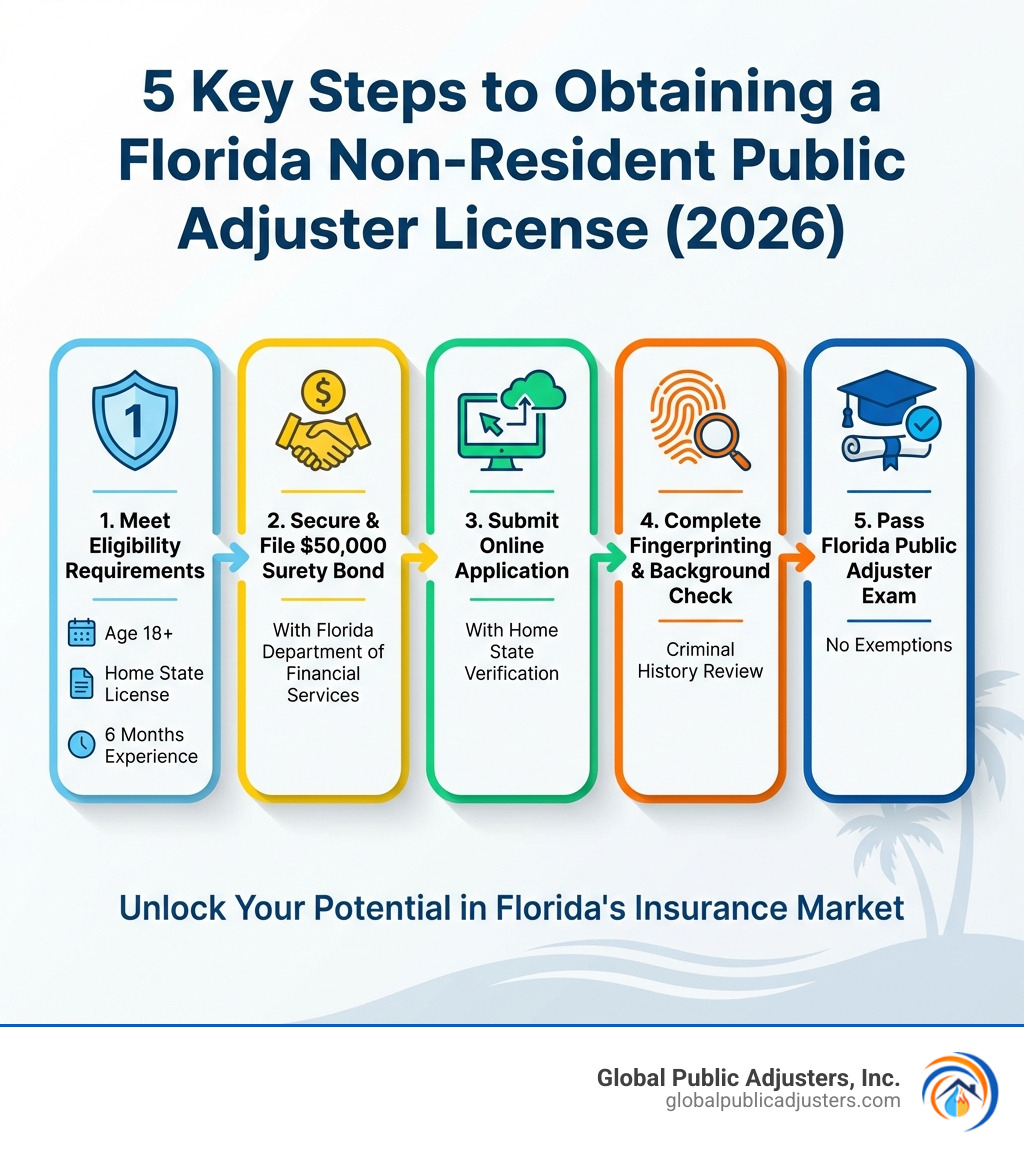
To truly understand the opportunity, it helps to see the licensing journey visually as well. The infographic below summarizes the main milestones you will move through, from confirming that you meet Florida’s eligibility standards to completing your state exam.
For insurance professionals looking to expand their practice, Florida represents a significant opportunity. The state’s frequent natural disasters create consistent demand for skilled public adjusters who can advocate for policyholders navigating complex insurance claims. But becoming licensed in Florida requires understanding specific state requirements, documentation procedures, and ongoing compliance obligations.
This guide walks you through every step of obtaining your Florida non-resident public adjuster license—from verifying your home state credentials to maintaining your license with continuing education. Whether you’re an experienced adjuster seeking new markets or looking to serve clients who relocate to Florida, this license provides the legal authority to represent policyholders in one of America’s most challenging insurance environments.
What is a Florida Public Adjuster and Why Get Licensed?
Before we dive into the nitty-gritty of obtaining yourflorida non-resident public adjuster license, let’s clarify what a public adjuster does and why this role is so critical, especially in a state like Florida.
A public adjuster is defined in Florida law as any person, except a duly licensed attorney, who, for compensation, prepares, completes, or files an insurance claim form for an insured or third-party claimant. They also act on behalf of, or aid, an insured or third-party claimant in negotiating for or effecting the settlement of a claim for loss or damage covered by an insurance contract. This also includes individuals who solicit, investigate, or adjust claims on behalf of a public adjuster for compensation. Essentially, we are the policyholder’s advocate, working to ensure they receive a fair and equitable settlement from their insurance company. For a deeper dive into our responsibilities, you can explorePublic Insurance Adjusters- What They Do.
It’s crucial to understand the distinction between a public adjuster and other types of adjusters. While we represent the interests of the insured, company adjusters are employed by insurance companies and represent the insurer’s interests. Independent adjusters, though often self-employed, are typically contracted by insurance companies to handle claims on their behalf. This fundamental difference highlights our unique position as the policyholder’s champion. You can learn more about the various roles in our article on7-Types-of-Claims-Adjusters-and-Their-Duties-in-Florida.
Why pursue aflorida non-resident public adjuster license? The answer lies in Florida’s unique geography and climate. As a state frequently impacted by hurricanes and other natural disasters, there’s a constant, significant demand for qualified public adjusters. When a major storm hits areas like Orlando or Pensacola, property owners often face extensive damage and complex claims processes. Our expertise becomes invaluable in navigating these challenges, ensuring policyholders don’t get shortchanged by their insurers. This creates a robust market for public adjusters who are ready to step in and provide essential services during times of crisis.
Step-by-Step Guide to Your Florida Non-Resident Public Adjuster License
Obtaining yourflorida non-resident public adjuster licenseinvolves a structured application process managed primarily by the Florida Department of Financial Services (DFS). While it might seem daunting at first, breaking it down into manageable steps makes the journey much clearer.

The application process is largely handled online through the Department of Financial Services’ Bureau of Licensing portal, and often facilitated by the National Insurance Producers Registry (NIPR). After submitting your application, you’ll need to set up a MyProfile account with the state of Florida to monitor your application status, view important messages, and communicate directly with the department.
Step 1: Meet Eligibility and Experience Prerequisites
Before you even think about filling out forms, you need to ensure you meet Florida’s fundamental requirements for aflorida non-resident public adjuster license.
Here’s a list of the key eligibility criteria:
- Age:You must be a natural person at least 18 years of age.
- Citizenship/Work Authorization:You must be a U.S. citizen or a legal alien with valid work authorization. If you’re a non-citizen, you’ll need to submit a copy of your work authorization documentation to agentlicensing@myfloridacfo.com.
- Non-Resident Status:While you’ll be applying as a non-resident, you must either genuinely be a non-resident of Florida or maintain a principal place of business in Florida.
- Trustworthiness:You must possess a good business reputation and be deemed trustworthy by the department.
- Home State License and Experience:This is a critical requirement for non-residents. You must have been continuously licensed and employed as a public adjuster in your state of residence for the previous 6 months. If your home state does not issue public adjuster licenses, you must have been continuously licensed and employed as a resident insurance company adjuster, public adjuster, or independent adjuster in your state or any other state for the past 6 months. This ensures you bring a foundational level of experience to Florida’s market.
Step 2: Secure and File the $50,000 Surety Bond
A significant requirement for yourflorida non-resident public adjuster licenseis securing a $50,000 surety bond. This isn’t just a formality; it serves a crucial purpose.
The surety bond acts as a financial guarantee, conditioned for your faithful performance of duties as a public adjuster. It’s there to protect the Florida Department of Financial Services, and by extension, the public, against any damages that may arise from fraud or unfair practices on your part. Think of it as a safety net, ensuring accountability and ethical conduct.
The bond must be executed by an authorized surety insurer. Once obtained, you’ll need to mail the original bond to the Florida Department of Financial Services Bureau of Licensing. This is one of the few items that requires a physical mailing, so make sure to send it to the correct address: Florida Department of Financial Services, 200 E Gaines St., Tallahassee, FL 32399-0319. You can find more contact information and details on theFlorida Department of Financial Serviceswebsite.
Step 3: Submit Your Application and Documentation
With your prerequisites met and bond secured, the next step is to formally apply for yourflorida non-resident public adjuster license.
You’ll submit your application online through the Department of Financial Services’ Bureau of Licensing online portal. Many non-resident applications are also processed through the National Insurance Producers Registry (NIPR), which streamlines multi-state licensing. You can initiate your application or check state requirements viaApply now Florida / Non-Resident Adjuster Licensing / IndividualSearch againApply now. P.O. Box addresses cannot be used for residence or business address fields, and all phone numbers must be valid 10-digit numbers.
A key part of this step involves verifying your home state license. Florida’s system typically verifies proof of your resident license through the National Association of Insurance Commissioners (NAIC) producer database. This periodic check ensures your non-Florida public adjuster license(s) is in good standing. However, if verification through the NAIC database is unsuccessful, the Bureau may request a Letter of Certification from your home state’s licensing authority. If this is requested, ensure the letter is dated no earlier than 30 days before your application date and details your licensing history and any disciplinary actions. You’ll generally email these prerequisite documents (excluding the original bond) to AgentLicensing@MyFloridaCFO.com.
Step 4: Complete Fingerprinting and Background Checks
No matter how squeaky clean your record is, a mandatory part of getting yourflorida non-resident public adjuster licenseis undergoing fingerprinting and a comprehensive background check. This is to ensure the integrity and trustworthiness of all licensed professionals in the state.

Florida applicants must be fingerprinted by IdentoGO by Idemia, formerly MorphoTrust USA. To register and pay for fingerprinting, you’ll need to go to//fl.state.identogo.com. Additional information can be found on Florida’s website at//www.myfloridacfo.com/division/agents/licensing/agents-and-adjusters/fingerprinting-information. Be aware that Florida does not accept fingerprint results from other vendors or states.
Your fingerprints are used for criminal history checks conducted by both the Florida Department of Law Enforcement (FDLE) and the Federal Bureau of Investigation (FBI). This thorough review helps ensure that only individuals with a clean record are granted a license.
Regarding disqualifying offenses, Florida takes a firm stance. Certain convictions can lead to a denial of yourflorida non-resident public adjuster license:
- Permanent Disqualification:First-degree or capital felonies, or those involving money laundering, embezzlement, or directly related to financial business services, are permanent disqualifications.
- Temporary Bars:Other misdemeanors or felonies may result in a 7-15 year bar from licensure, depending on the nature and severity of the offense.
It’s always best to be transparent about any past issues during your application, as a lack of disclosure can also lead to denial.
Maintaining Your License: CE, Records, and Renewal
Getting yourflorida non-resident public adjuster licenseis a significant achievement, but it’s just the beginning. Maintaining your license requires ongoing commitment to continuing education, meticulous record-keeping, and understanding renewal requirements.
Once licensed, you’ll need to stay appointed. An adjuster can only hold one appointment at a time, and your license will expire if it remains unappointed for 48 months. This underscores the importance of being actively engaged in the profession.
Understanding Continuing Education (CE) and Reciprocity
Continuing Education (CE) is vital for keeping your skills sharp and staying updated on industry changes. For yourflorida non-resident public adjuster license, you are generally required to complete 24 hours of continuing education biennially, which is due by the end of your birth month. Public adjuster level courses are specifically designated as CE3-20 and CE5-320.
However, there’s good news for many non-resident public adjusters: CE reciprocity. You are not required to complete Florida CE as long as you have completed a CE requirement in one of the states marked ‘YES’ in the ‘CE Reciprocity’ column on Florida’s official list. If you haven’t completed CE in a “YES” state, then youarerequired to complete Florida’s CE requirement. The Florida Department of Financial Services provides a specificNon-Resident Public Adjuster CE Reciprocity listthat you should consult.
Florida’s system periodically checks the National Insurance Producers Registry (NIPR) database to see if your non-Florida public adjuster license(s) is in good standing and if your CE requirements have been met in a reciprocal state. You’ll only be contacted if there’s an issue with your Florida CE status, so it’s a good practice to monitor your email for any communication from the state.
It’s also important to note the distinction between a non-resident all-lines adjuster license and a non-resident public adjuster license regarding CE. While all-lines adjusters may have different CE requirements or reciprocity agreements, the specific CE reciprocity for public adjusters is contingent on completing CE in those ‘YES’ states on Florida’s list.
Record Retention and Other Compliance Rules
Beyond CE, maintaining yourflorida non-resident public adjuster licensemeans adhering to strict record retention policies. You are obligated to retain all usual and customary records pertaining to transactions under your license for at least 3 years after the completion of the adjustment. This includes all documentation related to claims, communications, and settlements.
These records must be made available in Florida to the department upon request. This ensures transparency and allows the state to audit your practices if necessary. Compliance with Florida Statutes is paramount to maintaining your license in good standing. Adhering to these rules not only keeps you compliant but also reinforces our commitment to ethical practice and client advocacy. For more on the scope of our work, reviewWhat Can a Public Adjuster Do for Me.
Frequently Asked Questions about the Florida License
We understand that navigating the licensing process can bring up many questions. Here are some of the most common inquiries we hear about obtaining and maintaining aflorida non-resident public adjuster license:
What are the total fees for a Florida non-resident public adjuster license?
The fees associated with obtaining and maintaining yourflorida non-resident public adjuster licenseare non-refundable and typically include:
- Application Fee:$50
- License Fee:$5 per line of authority (for public adjusters, this is usually just one line)
- Appointment Fee:$60 (this is paid when you are appointed by a firm or in your own name)
- State Exam Fee:Approximately $44
- Fingerprinting Fee:Approximately $48.05 (paid directly to IdentoGO by Idemia)
So, while the initial application and license fees are relatively modest, remember to factor in the exam, fingerprinting, and subsequent appointment fees.
What are the main grounds for license denial in Florida?
The Florida Department of Financial Services takes the integrity of its licensees very seriously. Several factors can lead to the denial of aflorida non-resident public adjuster licenseapplication, including:
- Criminal History:As discussed, certain felonies, especially those involving financial misconduct like money laundering or embezzlement, are permanent disqualifications. Other serious offenses can result in multi-year bars.
- Lack of Trustworthiness or Good Business Reputation:If the department finds evidence that you lack a good business reputation or are not trustworthy, your application may be denied.
- Failure to Meet Experience Requirements:Not providing adequate proof of your 6 months of continuous licensure and employment as a public adjuster (or equivalent) in your home state will lead to denial.
- Providing False Information:Any misrepresentation or omission of material facts on your application can result in immediate denial and potentially future bars from applying.
- Unsatisfactory Background Check:Failing the fingerprint-based criminal history check.
- Failure to Pass the State Exam:All non-resident public adjuster applicants must pass the Florida public adjuster exam; there are no exemptions.
How do I check my application status?
After you’ve submitted your application for aflorida non-resident public adjuster license, you’ll want to keep an eye on its progress. The primary tool for this is your MyProfile account.
You can set up and access your MyProfile account at//dice.fldfs.com/public/pb_index.aspx. This online portal is invaluable because it allows you to:
- View important messages sent from the department.
- Communicate directly with the state DOI regarding your application.
- View applications applied for in the last 6 months.
- Check for any deficiency information on a pending application, allowing you to quickly address any missing documents or issues.
- Receive exam authorization once your application is processed, if applicable.
We recommend checking your MyProfile account regularly to ensure you don’t miss any critical updates or requests from the department.
Conclusion
Related:Public Adjuster vs Insurance Agent Difference in Florida: Your Complete 2026 Guide
Obtaining yourflorida non-resident public adjuster licenseis a strategic move that can open up immense professional potential, particularly in a dynamic and often challenging market like Florida. We’ve walked through the essential steps, from meeting eligibility criteria and securing your $50,000 surety bond to navigating the application, fingerprinting, and examination processes. We’ve also highlighted the critical importance of ongoing compliance, including continuing education, record retention, and understanding the nuances of reciprocity.
While the path to licensure requires diligence and adherence to specific regulations, the reward is the ability to serve policyholders in Florida, advocating for their rights and helping them rebuild after unforeseen events. Our expertise at Global Public Adjusters, Inc. spans over 50 years, specializing in maximizing settlements for homeowners and business owners across Florida, including Orlando and Pensacola. We understand the unique challenges of the Florida market and the vital role public adjusters play.
By understanding and fulfilling these requirements, you position yourself as a trusted advocate, ready to make a significant difference in the lives of those facing property damage. We encourage you to take this step andBecome a trusted advocate for policyholdersin Florida.