Public Adjuster vs Insurance Adjuster Differences in Florida: Your Complete 2026 Guide
Quick Answer
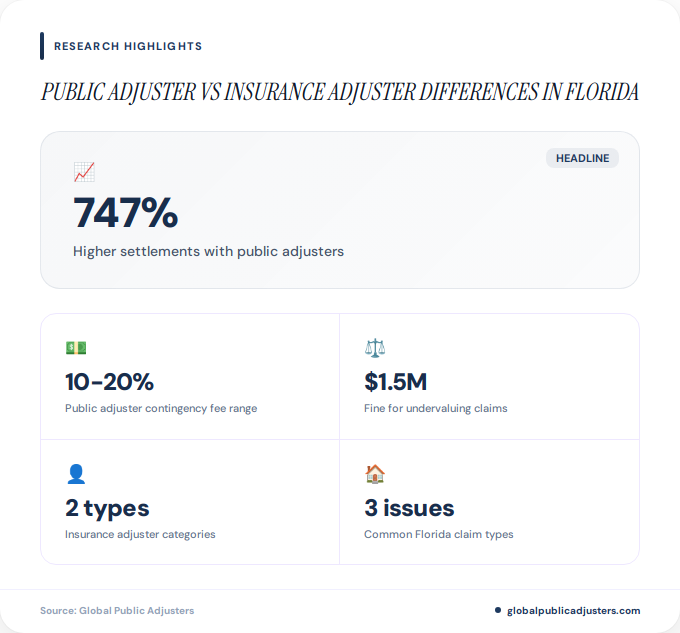
Public adjusters in Florida work exclusively for policyholders on a contingency basis (typically 10-20% of settlement), securing settlements 747% higher on average than self-filed claims. Insurance adjusters work for the insurance company to minimize payouts, creating a fundamental conflict of interest. Understanding this difference is critical for Florida homeowners facing hurricane damage, water claims, or denied insurance settlements.
If you’ve ever filed an insurance claim in Florida, you’ve likely encountered an adjuster. But did you know there’s a fundamental difference between the adjuster your insurance company sends and the one you can hire yourself? This distinction can mean the difference between receiving a fair settlement and leaving thousands of dollars on the table, especially in Florida’s weather-prone market where hurricane damage, flooding, and storm claims are common.
Recent data from a Florida Legislature OPPAGA study reveals a stunning fact:policyholders using public adjusters receive settlements 747% higher on averagethan those handling claims themselves. In cities like Tampa, Orlando, Jacksonville, and Miami, where hurricane seasons bring devastating property damage, understanding the public adjuster vs insurance adjuster differences in Florida can protect your financial interests when you need it most.
This comprehensive guide breaks down every critical distinction between these two types of adjusters, from who they represent to how they’re paid, and why Florida homeowners facing complex claims should understand these differences before signing any settlement documents.
What Is the Core Difference Between Public Adjusters and Insurance Adjusters in Florida?
The fundamental distinction between public adjusters and insurance adjusters in Florida comes down toloyalty and representation. Public adjusters are licensed professionals hired directly by you, the policyholder, to represent your interests exclusively. Insurance adjusters, whether staff or independent contractors, work for the insurance company and aim to protect the insurer’s financial interests.
This difference in allegiance creates dramatically different outcomes. Public adjusters conduct independent damage assessments, review your policy for all available coverages (including those you might not know about), prepare detailed documentation including sworn proof of loss statements, and handle all communications with your insurer. Insurance adjusters perform similar technical tasks but from the perspective of minimizing what the insurance company pays out.
In Florida’s volatile insurance market, where companies like Citizens Insurance frequently face disputes and major carriers like Universal Property and Casualty have beenfined $1.5 million for undervaluing claims, having an advocate on your side becomes particularly important. The insurance adjuster has no fiduciary duty to you and often undervalues claims, especially for complex damage from hurricanes, water intrusion, or mold.
Who Do Public Adjusters vs Insurance Adjusters Represent?
Public adjustersrepresent only you, the policyholder. When you hire a public adjuster in Florida, they become your personal advocate throughout the entire claims process. Their job is to maximize your settlement within the terms of your policy, ensuring you receive every dollar you’re entitled to recover.
Insurance adjustersrepresent the insurance company that employs them. Even if they seem friendly and helpful during the claims process, their ultimate obligation is to their employer, the insurance carrier. Their performance metrics often include minimizing claim payouts while maintaining customer satisfaction scores high enough to avoid complaints.
This representation difference matters tremendously in practice. A public adjuster will identify all possible coverage components in your policy, including additional living expenses, code upgrade coverage, or betterment clauses you might not know exist. An insurance adjuster may overlook these coverages or interpret policy language in ways that favor the insurer. For Florida homeowners dealing withhurricane damage claims in Orlandoor Tampa, this advocacy gap can mean tens of thousands of dollars in settlement differences.
How Are Public Adjusters and Insurance Adjusters Paid in Florida?
Compensation structures reveal why public adjusters and insurance adjusters have such different incentives:
| Adjuster Type | Payment Structure | Typical Rate |
|---|---|---|
| Public Adjuster | Contingency fee (percentage of settlement) | 10-20% of final payout |
| Staff Adjuster | Salary from insurance company | Fixed annual salary |
| Independent Adjuster | Per-claim fee from insurance company | Varies by claim complexity |
Public adjusters in Florida work on a“no recovery, no fee” basis, meaning you pay nothing if they don’t secure a settlement. This contingency structure aligns their incentives perfectly with yours: the more they recover, the more they earn. Under Florida’s Chapter 626 regulations, public adjuster fees typically range from 10-20% of the final settlement, depending on claim complexity and timing. For detailed information about fee structures, see our guide onpublic adjuster fees in Florida.
Insurance adjusters, conversely, receive salaries or per-claim fees from the insurance company regardless of settlement amounts. Staff adjusters earn fixed salaries, while independent adjusters contract with insurers for flat fees per claim. Their compensation doesn’t increase when they save the insurance company money, but their continued employment or contract renewals often depend on keeping claim costs down.
What Settlement Differences Can Florida Policyholders Expect?
The data on settlement outcomes speaks volumes about the public adjuster vs insurance adjuster differences in Florida:
- 747% higher settlementsfor policyholders using public adjusters versus self-filing, according to Florida Legislature OPPAGA analysis
- 3-7 times higherfinal settlements compared to initial insurance company offers when public adjusters negotiate
- 19.4% average increaseover insurance adjuster estimates when public adjusters conduct independent assessments
- Public adjusters identify overlooked coverages in approximately60-70% of reviewed policies
These dramatic differences stem from several factors. Public adjusters have deep knowledge of Florida’s building codes, current contractor pricing in local markets like Jacksonville, Tampa, and Miami, and expertise in policy interpretation. They also maintain relationships with engineers, contractors, and specialists who can document damage insurance adjusters might minimize or overlook entirely.
Consider a typical hurricane damage scenario in Orlando: an insurance adjuster might assess roof damage at $15,000 for basic repairs. A public adjuster conducting the same assessment might identify not just visible damage but also code upgrade requirements, underlying structural issues, interior water damage, and temporary living expenses, bringing the legitimate claim value to $75,000 or more. Even after their contingency fee, the policyholder nets significantly more than accepting the initial insurance offer.
What Are the Different Types of Insurance Adjusters?
Understanding the varieties of insurance adjusters helps clarify the public adjuster vs insurance adjuster differences in Florida even further. There are three main types of insurance adjusters:
Staff Adjustersare full-time employees of insurance companies. They handle claims exclusively for their employer, receive salaries and benefits, and work from company offices. Staff adjusters typically handle routine claims and have the authority to approve settlements up to certain limits without additional approval.
Independent Adjustersare contractors hired by insurance companies, often during catastrophic events when claim volume overwhelms staff capacity. After major hurricanes hit Tampa or Jacksonville, independent adjusters flood into Florida to handle the surge of claims. They’re paid per claim and may work for multiple insurance companies, but their loyalty remains with whoever hired them for that specific claim.
Public Adjustersstand apart because they work exclusively for policyholders, never for insurance companies. Licensed under Florida’s Chapter 626, they must complete specific education requirements, pass state examinations, and maintain continuing education credits. Unlike insurance adjusters who can work for any carrier, public adjusters represent only property owners filing claims.
For comparison with another frequently confused role, review our article onpublic adjuster vs insurance agent differences in Florida.
What Are the Licensing Requirements in Florida?
Florida maintains strict licensing standards for both public adjusters and insurance adjusters under Chapter 626 of the Florida Statutes, overseen by the Florida Department of Financial Services. However, the requirements differ significantly:
Public Adjuster Licensing in Floridarequires completing pre-licensing education courses, passing a comprehensive state examination, submitting to background checks, obtaining a surety bond, and maintaining continuing education credits every two years. The state tracks all licensed public adjusters, and complaints can result in license suspension or revocation. Public adjusters must also disclose their contingency fee agreements in writing before beginning work.
Insurance Adjuster Licensingalso requires education and examination, but adjusters work under the supervision of insurance companies that hold the primary licenses. Independent adjusters must maintain their own licenses, while staff adjusters work under their employer’s authority. The key difference is accountability: public adjusters answer directly to the Department of Financial Services and policyholders, while insurance adjusters answer to their insurance company employers.
For those interested in entering the field, our comprehensive guide onpublic adjuster license requirements in Floridaprovides detailed information about the process.
When Should Florida Homeowners Hire a Public Adjuster?
Understanding when to hire a public adjuster versus accepting the insurance adjuster’s assessment can save Florida homeowners thousands of dollars. Consider hiring a public adjuster when:
Your claim is complex or high-value.Hurricane damage, total losses, commercial property damage, or claims exceeding $50,000 benefit enormously from public adjuster expertise. The contingency fee becomes worthwhile when settlements increase by hundreds of thousands of dollars.
The insurance company denies or undervalues your claim.If the insurance adjuster’s estimate seems unreasonably low or your claim is denied, a public adjuster can conduct an independent assessment and invoke appraisal processes under your policy. Florida’s challenging insurance market, including frequent disputes with Citizens Insurance, makes this scenario increasingly common. Learn more in our guide onhow denied insurance claim public adjusters help win appeals.
You lack time or expertise to manage the claim.Insurance claims require extensive documentation, multiple contractor estimates, knowledge of building codes, and persistent negotiation. Business owners, working professionals, or elderly homeowners often find the process overwhelming. A public adjuster handles everything, freeing you from the administrative burden.
Damage involves multiple policy coverages.Water damage that causes mold, structural issues from hurricanes, or fires with both structural and contents damage often trigger multiple policy provisions. Public adjusters excel at identifying all applicable coverages that insurance adjusters might overlook or bundle together at lower values.
For timing guidance, read our article onwhen to hire a public adjuster in Jacksonvillewhich applies throughout Florida.
Key Takeaways
- Representation is everything:Public adjusters work exclusively for you, while insurance adjusters represent the insurance company, creating a fundamental conflict of interest in settlement negotiations.
- Payment structures align incentives:Public adjusters earn contingency fees (10-20%) only when you recover money, while insurance adjusters receive salaries or per-claim fees from insurers regardless of settlement amounts.
- Settlement differences are dramatic:Florida policyholders using public adjusters receive settlements 747% higher on average than self-filing and 3-7 times higher than initial insurance offers.
- Licensing matters:Both types must be licensed in Florida under Chapter 626, but public adjusters answer to the Department of Financial Services and policyholders, while insurance adjusters answer to insurance companies.
- Complex claims need advocacy:Hurricane damage, denied claims, high-value losses, and situations involving multiple coverages benefit enormously from public adjuster expertise.
- No recovery means no fee:Public adjusters work on contingency, meaning you risk nothing to obtain an independent professional assessment of your claim’s true value.
- Florida’s market creates challenges:With frequent hurricanes, rising premiums, and carriers like Citizens Insurance facing disputes, having a public adjuster levels the playing field against well-resourced insurance companies.
People Also Ask
Can I hire a public adjuster after the insurance adjuster has already assessed my claim?
Yes, you can hire a public adjuster at any point during the claims process, even after receiving an initial settlement offer from an insurance adjuster. Many Florida homeowners hire public adjusters specifically because they believe the insurance adjuster’s estimate is too low. Public adjusters can request re-inspection, invoke appraisal clauses, and negotiate higher settlements based on independent assessments.
Are public adjusters worth the fee in Florida?
For most complex or high-value claims, public adjusters are absolutely worth the 10-20% contingency fee. Studies show Florida policyholders using public adjusters receive settlements 747% higher than self-filing and average 19.4% more than insurance adjuster estimates. Even after paying the public adjuster fee, policyholders typically net significantly more than accepting the insurance company’s initial offer.
Do insurance companies hate public adjusters?
Insurance companies generally prefer dealing directly with policyholders rather than public adjusters because public adjusters increase claim costs through thorough documentation and aggressive negotiation. However, reputable carriers recognize that public adjusters are licensed professionals with legitimate roles in the claims process. The relationship is professional but adversarial, similar to opposing attorneys in legal proceedings.
Can a public adjuster help with a denied claim in Florida?
Yes, public adjusters frequently help overturn denied claims by conducting independent damage assessments, reviewing policy language for coverage the insurance company overlooked, and documenting causation between covered perils and damage. While public adjusters cannot litigate (only attorneys can represent you in court), they can invoke appraisal processes and prepare comprehensive evidence packages that often lead to reversed denials or settlements.
How long does the public adjuster claims process take in Florida?
The timeline varies based on claim complexity, but public adjusters typically complete initial assessments within 3-7 days and submit comprehensive claim packages within 2-4 weeks. Settlement negotiations can take anywhere from a few weeks to several months depending on the insurance company’s responsiveness and whether appraisal or other dispute resolution processes become necessary. Florida law requires insurance companies to acknowledge claims within 14 days and investigate within specific timeframes.
What’s the difference between a public adjuster and a claims attorney?
Public adjusters assess damage, document claims, and negotiate settlements but cannot file lawsuits or represent you in court. Claims attorneys can litigate denied claims and represent you in legal proceedings. Many Florida homeowners use both: public adjusters to maximize the claim documentation and negotiation, then attorneys if the insurance company still refuses fair settlement. However, using both means paying two professionals, which reduces net recovery.
Frequently Asked Questions
What does a public adjuster do that an insurance adjuster doesn’t?+
Public adjusters conduct independent damage assessments from your perspective, identify all policy coverages you’re entitled to claim, prepare comprehensive documentation including sworn proof of loss statements, negotiate exclusively on your behalf, and invoke appraisal processes when needed. Insurance adjusters perform similar technical assessments but from the insurance company’s perspective, focusing on minimizing payouts while meeting basic claim handling requirements.
How much does a public adjuster cost in Florida?+
Public adjusters in Florida typically charge contingency fees ranging from 10% to 20% of the final settlement amount, depending on claim complexity, timing, and whether the claim was previously denied. You pay nothing if they don’t recover money for you. The exact percentage varies based on when you hire them (before or after filing), claim size, and specific circumstances. For detailed fee information, visitour complete fee guide.
Can I use both a public adjuster and the insurance company’s adjuster?+
Yes, both adjusters will assess your property damage, but they’ll reach different conclusions based on their loyalties. The insurance adjuster must inspect to fulfill the company’s claim handling obligations. Your public adjuster conducts an independent assessment and handles all negotiations with the insurance company. Most policyholders who hire public adjusters let them manage all communications with the insurance adjuster to ensure consistent messaging and protect their interests.
Will hiring a public adjuster delay my insurance claim in Florida?+
Hiring a public adjuster early in the process typically doesn’t cause delays and often accelerates settlements because they submit complete, well-documented claims that require less back-and-forth. If you hire a public adjuster after receiving a low offer, there may be additional time needed for re-inspection and negotiation, but the resulting higher settlement usually justifies any modest delay. Florida law sets specific timeframes insurance companies must follow regardless of whether you use a public adjuster.
What types of claims benefit most from public adjusters in Florida?+
Hurricane damage claims, denied claims, high-value losses (typically over $50,000), commercial property damage, claims involving multiple coverages (like water damage with mold and structural issues), total losses, and situations where policyholders lack time or expertise to manage complex documentation all benefit significantly from public adjuster representation. Simple, low-value claims with clear liability may not justify the contingency fee.
How do I verify a public adjuster’s license in Florida?+
You can verify any public adjuster’s license through the Florida Department of Financial Services website using their online licensee search tool. Enter the adjuster’s name or license number to confirm their license is active, check for any disciplinary actions, and verify their credentials. All legitimate public adjusters in Florida must maintain active licenses, and checking this information takes only minutes before hiring anyone.
What should I do immediately after property damage in Florida?+
First, ensure safety and prevent further damage by making emergency repairs (document everything with photos and receipts). Then notify your insurance company immediately to start the claims clock. Document all damage extensively with photos, videos, and written notes before any cleanup. Finally, consider consulting a public adjuster for a free initial assessment before signing anything from the insurance company. For complete guidance, see our article onhow to file a public adjuster claim in Orlando.
Understanding the public adjuster vs insurance adjuster differences in Florida empowers you to make informed decisions when property damage strikes. Whether you’re facing hurricane damage in Tampa, flood claims in Jacksonville, or any other covered loss, knowing that you have the right to independent representation can mean the difference between fair compensation and financial hardship.
The statistics speak clearly: public adjusters secure dramatically higher settlements because their interests align perfectly with yours. While insurance adjusters serve a necessary function in the claims ecosystem, they work for the insurance company, not for you. In Florida’s challenging insurance market, having a licensed advocate who knows local building codes, current contractor pricing, and policy interpretation nuances levels the playing field.
If you’re dealing with a significant property damage claim, denied settlement, or low insurance offer, contactGlobal Public Adjustersfor a free claim assessment. Our licensed Florida public adjusters have recovered millions for policyholders across the state, and we work on a contingency basis, meaning you pay nothing unless we increase your settlement. Don’t leave money on the table. Get the representation you deserve.