
Orlando house fire: a $120,445 first payment, then a $508,162.89 supplemental check
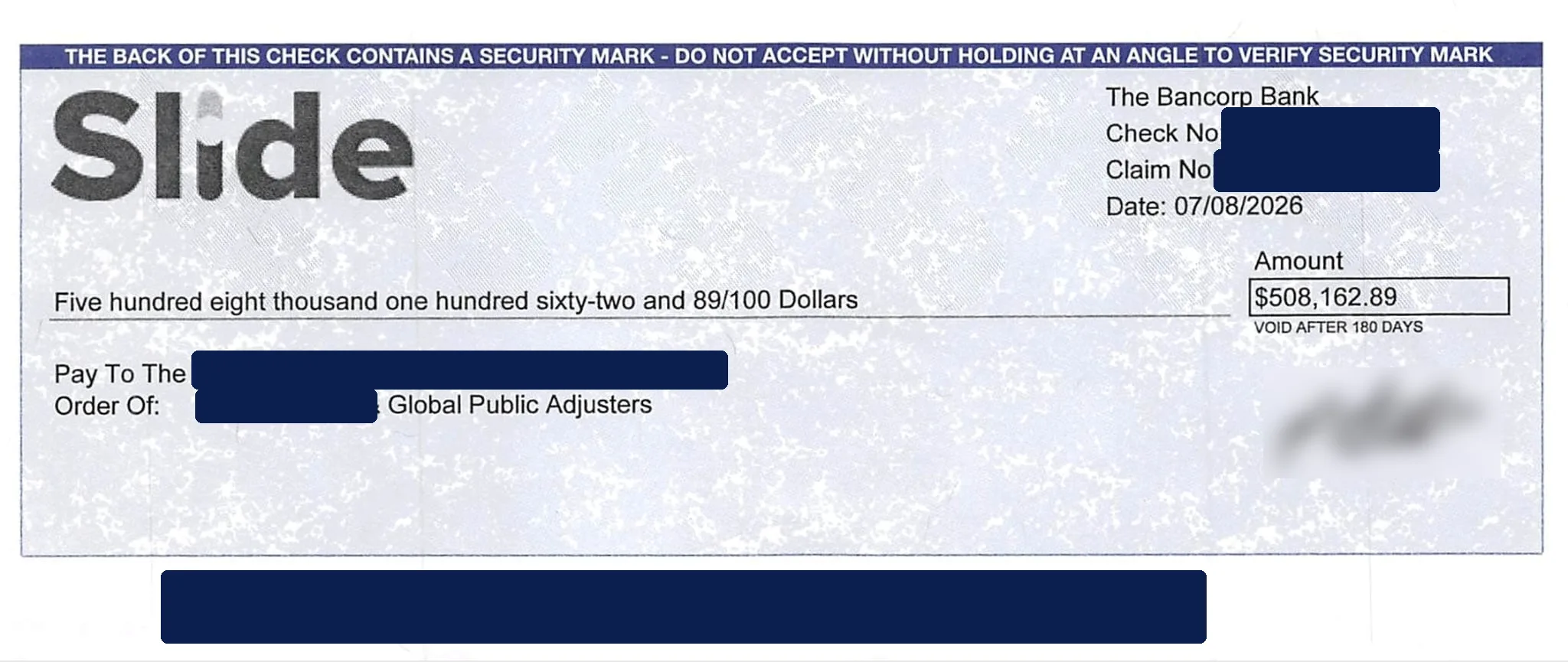
A house fire in the Orlando area, insured by Slide. The insurance company's first payment was $120,445. After we documented the full damage and negotiated, Slide issued a second, supplemental payment of $508,162.89, more than four times its first payment. Living expenses for rent and food, and the contents claim, were paid separately on top of that.
- Location
- Orlando area, Central Florida
- Type of loss
- House fire
- Insurance company
- Slide Insurance
- First payment
- $120,445
- Supplemental payment after our work
- $508,162.89 (July 2026)
- Also paid separately
- Additional living expenses (rent and food) and the contents claim
The call after the first check
Most people do not call a public adjuster the day of the fire. They call after the first check shows up and they realize it will not rebuild their home. That is what happened here. Slide's first payment on this Orlando house fire was $120,445, far below what it would really take to repair the home.
That is not unusual. A first fire estimate is often written fast, sometimes from a short walk-through, and it tends to focus on what is visibly burned. The rest of the house gets a line item for cleaning, if anything.
Send us photos. Get a licensed adjuster's opinion, free.
- 1Snap photos or video of the damage
- 2Add your policy or the insurer's letter
- 3A licensed adjuster calls you with an honest answer
Why fire claims get underpaid
Fire damage is bigger than the burn area. In our experience these are the things a first estimate most often leaves short:
- Smoke and soot in rooms the fire never reached. Smoke moves through the air conditioning system, into closets, attics and wall cavities. Cleaning does not always remove it, and the smell comes back in Florida humidity.
- Water from putting the fire out. Thousands of gallons of water go into a house during a fire. Drywall, insulation, flooring and cabinets that never burned can still be ruined.
- The electrical system and HVAC. Heat and smoke can damage wiring, outlets and ductwork that look fine from the outside.
- Code upgrades. When a large part of a home is rebuilt, the city requires current building code. That work costs money and is often covered under Ordinance or Law coverage.
- Living expenses and contents. These are separate parts of the policy, and many people do not know to claim them in full.
What we did
We treated it as the major loss it was, not a cleanup job. On a fire claim that means inspecting the whole house and not just the burn area, documenting the smoke, heat and water damage room by room with photos and moisture readings, and writing a complete line-by-line repair estimate that a contractor could actually build from. Then we negotiated with Slide using that evidence, item by item, instead of arguing about a total.
The result
Slide issued a second, supplemental payment, the check below, for $508,162.89. That is on top of the $120,445 it paid at first, and more than four times that first payment.
And that is not counting the rest of the policy. The owners also received separate payments for additional living expenses, which covered their rent and food while they could not live in the house, and for their contents claim, the furniture, clothing, electronics and everything else the fire and smoke destroyed.
If this sounds like your claim
- Do not throw anything away before it is photographed and listed. Damaged belongings are evidence for your contents claim.
- Ask about additional living expenses (also called loss of use) right away. If you cannot live in the home, your policy may pay the extra cost of rent, hotels and meals.
- Smoke damage is fire damage. If rooms that did not burn still smell like smoke, they belong in the claim.
- A first payment is not a final answer. In Florida you can generally file a supplemental claim within 18 months of the date of loss if you find more damage or the payment was too low.
Every claim is different and past results do not guarantee a similar outcome. But if your first payment looks low or your claim was denied, it is worth a second look. Send us your estimate or denial letter for a free review, or call 407-900-5025.
Questions people ask about claims like this
Does homeowners insurance pay rent after a house fire in Florida?
Most Florida homeowners policies include additional living expenses, also called loss of use. If a covered fire makes your home unlivable, it can pay the increase in your living costs, such as rent, while the home is repaired, up to your policy limits. In this Orlando case, the homeowners' rent and food were paid separately from the $508,162.89 supplemental check.
Can I dispute a low fire claim payment from Slide Insurance?
Yes. If Slide or any Florida insurer underpays a fire claim, you can ask for a reinspection, submit your own detailed estimate and file a supplemental claim. In Florida a supplemental claim generally must be filed within 18 months of the date of loss. A licensed public adjuster can handle this for you.
How long do I have to file a fire claim in Florida?
For a new or reopened claim, Florida generally gives you 1 year from the date of loss. For a supplemental claim on an existing claim, it is generally 18 months. Check your policy and act early, because evidence is easier to document before repairs start.
Related
- Fire damage claims in Orlando
- Fire and smoke damage claims in Florida
- Slide Insurance claims
- Public adjuster in Orlando
- All real claims and checks
More real claims
- Tampa Bay water damage: a two-story home, top to bottom, and a $206,910.59 check
- Destin lightning strike: fire, a full rewire and code upgrades, $163,613.15
- Pensacola tree on the roof: $38,900 first payment, an engineer's report, and a $100,000 supplemental check
- Windermere master bathroom: shower water damage, matching tile and an 8-foot custom vanity, $58,500
- Fort Lauderdale kitchen leak: swollen cabinets and mold, a full kitchen replacement, $47,000